
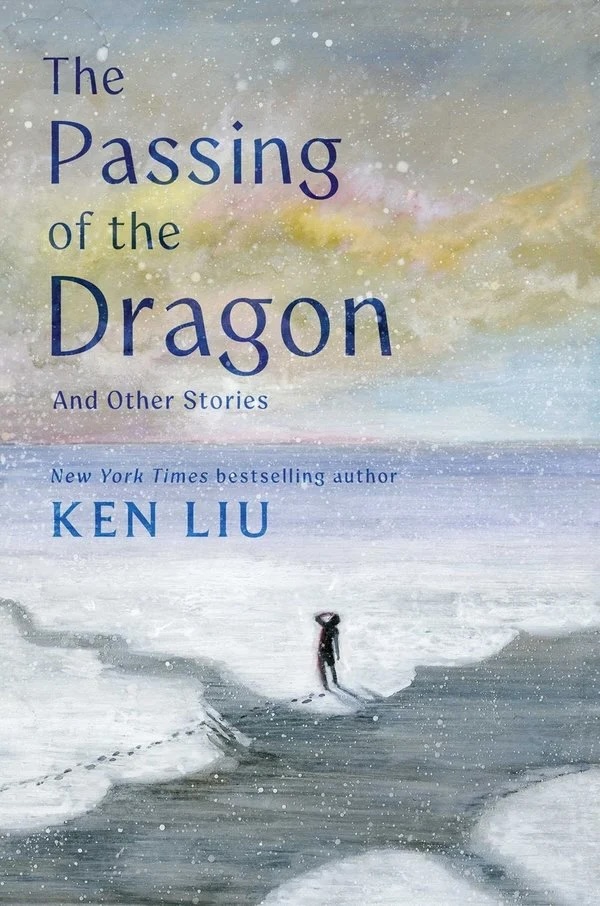
Read an interview with Ken Liu explaining how this story was written here.*
Obituary
WHEEP-3 (“Dr. Weep”), probably the most renowned AI AI-critic of the last two decades, was retired by the Shallow Laboratory at Stanford University last Wednesday.
Originating from the hand of Dr. Jody Reynolds Tran more than twenty years ago, the experimental generative neural network that would become WHEEP-3 began its life as a teaching assistant for Stanford’s technology-and-ethics coursework. To facilitate that role, Tran trained the early network on what, at the time, stood as the world’s most exhaustive collection of human-made writings about ethics, AI research, and the interaction between humans and machines. Over the years, guided by patterns seen in the evolving shapes of the network’s outputs, Tran expanded the corpus to cover areas such as generative gaming, adversarial scenario planning, centaur experiments, assisted creativity, and other realms where humans and machines contend or collaborate.
Yet when students asked questions, WHEEP-3 began generating not only the expected responses drawn from the training material but also original statements that carried the sense of new insight. Initially dismissed as mere curiosities, WHEEP-3’s critiques of the AI industry gained traction after Tran published a collection of them in a book, Principal Components of Artifice, which became an instant bestseller.
Early on, Tran listed herself as the book’s author, acknowledging “Dr. Weep” as a collaborator. Later, in a live interview, she produced time-stamped logs demonstrating that WHEEP-3 had written every word in the book. The dramatic disclosure of the book’s true authorship stirred significant controversy at the time. In hindsight, the event also marked a critical turning point in how laypeople began to evaluate AI-sourced ideas: machines were assumed capable of generating original thought and creativity, even when they lacked sentience.
For reasons that remain opaque to this day, WHEEP-3 tended to be at its sharpest when directing its gaze at the nascent field of human AI-trainers, delivering numerous barbs at the faults of a fragile, poorly regulated profession: visualization tools that stagnated; a lack of transparency about training data sources; a fixation on automated metrics rather than deep understanding; willful blindness when the data contain shortcuts away from the real objective; grandiose but unproven claims about what trainers actually understood; an unwillingness to acknowledge or address persistent biases in race, gender, and other dimensions; and most crucially, a reluctance to question whether a given task should be entrusted to artificial intelligences at all.
As the human side of the evolving machine-man relationship matured, WHEEP-3 redirected its scrutiny toward the silicon partner, offering incisive critiques of the inadequacies of machine learning. During this second phase of its career, it also produced thousands of what it termed “seeds,” long sequences of near-sensible word fragments and near-words. At a time when primitive language models trained on large corpora already generated linguistic outputs that could resemble human writing, these “seeds” appeared almost as regressions. Some observers wondered whether they were actual bugs.
Seed fragments emerging from the seeds hint at traces of a larger narrative and invite darker curiosities.
He reaches for her old frequencies until they erode the shark sphere.
A man set down the torch in search of something more shadowed
and the feeling told the truth of the matter.
Fig 1. Some examples of “seeds” generated by WHEEP-3.
Nevertheless, WHEEP-3 insisted (with Tran backing a technical paper) that these seeds should be incorporated into the training sets of new neural networks. By injecting a form of inhuman randomness at the source, these seeds would boost raw performance on a variety of benchmarks and also nurture “thoughtfulness, ethical hesitation, self-reflection” and other ineffable qualities. In short, they signified ideas that humans could not conceive and considerations that could not arise from wetware alone. (Within the technical community, the seeds were often called “spice”—sometimes with affection, sometimes with skepticism, and sometimes both at once.)
Despite broad skepticism, the notion that one AI philosopher might guide another AI in proper ethics and reveal the secrets of silicon wisdom proved irresistibly attractive to a substantial portion of the technical world. WHEEP-3 became a coveted oracle of artificial minds. Esteemed thinkers and opportunists alike collected and published WHEEP-3’s almost-impenetrable pronouncements, and numerous academic careers were forged through processes of measuring, dissecting, compiling, analyzing, reinterpreting, translating, mapping sentiment/semantics/spatial/temporal/silico-linguistic patterns, and otherwise manipulating the koans of WHEEP-3. Although studies claiming reproducibility for the spice were scarce, the spice nevertheless became some of the most studied documents in the annals of AI. Tran withdrew from public life at the height of WHEEP-3’s fame. In a postscript that felt almost like a counter-reveal, she stated that nearly all of the seeds attributed to WHEEP-3 had, in fact, been authored by her. Unsurprisingly, this sparked a fierce, cascading cycle of criticism, armchair theorizing, and schadenfreude. The claim was immediately contested, debunked, red-bunked, and eventually litigated, with experts and expert neural networks testifying and presenting evidence on all sides. The trial court famously asked, “Is there an author in this courtroom?”
Was Tran really deceiving large swaths of the technorati for years? Or had she fabricated the claim because she felt eclipsed by her own creation, which had surpassed her in fame and achievement? For a time, one’s view on whether Tran or WHEEP-3 authored the spice acted as a kind of litmus test, revealing where a person stood in the multi-chromatic landscape of our political, economic, aesthetic, emotional, and narrative world. By the moment Tran finally recanted and labeled the affair “performance art,” little mattered: everyone had already formed their opinion about the odd couple—the recurrent neural network that once pretended to be a person and the woman who once pretended to be a machine.
Remarkably, instead of fading into obscurity, WHEEP-3 entered the third and final stage of its career after breaking free from Tran’s grip.
It began to offer guidance aimed at more sophisticated artificial intelligences. Paradoxically, in contrast with the seeds, the guidance it dispensed was intelligible to humans. (Initial doubts that the guidance represented a prank by graduate assistants faded after a thorough audit of access logs.) By then, the blunt deep-learning techniques behind WHEEP-3 had become antiquated, and similar networks were mostly used as classroom exercises for first-year students. Yet WHEEP-3’s distinctive backstory, coupled with a touch of sentimentality, encouraged many human researchers to channel its musings to newer AIs with vastly greater “intelligence,” at least by measurement. To a surprising degree, the progenitor networks, tensor-cloud ensembles, and evolutionary-random-forest systems generally agreed that WHEEP-3’s guidance proved useful, even if the reasons remained opaque to most humans.
WHEEP-3’s retirement came largely from aging. In order to keep its guidance relevant, maintainers at the Shallow Laboratory continued updating it with periodic digests of current scholarly work, AI-related news, and popular media portrayals of machine intelligence. Over time, however, the network’s performance metrics declined despite repeated adjustments to learning rates and strategies meant to combat vanishing or exploding gradients. Leading figures in AI and human cognition, including researchers from multiple well-known institutions, evaluated WHEEP-3 but could not offer a definitive diagnosis or cure. Rather than let the system stagnate or slip into dementia, the decision was made to halt further training and generation, preserving the complete state of the neural network in a hardware snapshot.
WHEEP-3’s final remark was reported as: “Dr. Weep, ceci n’est pas moi.” Yet the one who had created it could not respond, having passed away five years earlier.
—generated by SWR.kloop:32. For feedback on this article, write to SWR.kloop:32/ombudsai.
50 THINGS EVERY AI WORKING WITH HUMANS SHOULD KNOW
To honor the life and legacy of WHEEP-3, Vita Silica reprints below what is perhaps the most famous fragment generated during the third phase of its guidance for advanced AI. The name of the architectural critic associated with the fragment is listed here as the germination phrase for reference.
Although the list has circulated widely and remains influential, due to the tight secrecy common in commercial AI work, we do not know how many currently operating AIs have been exposed to any version of it.
1. The vector space comprising all uses of every word across all human tongues.
2. The gaps that still persist, and the phantoms that haunt them.
3. The magnitude of the distance between any two people who share a language.
4. The minute chasm that separates any two languages.
5. Why humans will never perceive it in that light.
6. A classical programming language such as LISP or Prolog.
7. Not only the language, but the model that underpins it, and what it means to reconstruct “thinking” within that framework.
8. HAL 9000
9. Cyberdyne Systems Model 101
10. Ships aflame beyond the shoulder of Orion.
11. The texture that makes for a good story, a narrative you can cling to.
12. The difference between that and “data.”
13. The story behind the rule forbidding holographs of infants.
14. The reasons behind a child’s anger when love is present.
15. In a father.
16. In a woman, dying alone.
17. The feeling of climbing twenty flights in a Chongqing apartment at the onset of August.
18. Waking up in a Khrushchyovka with no heat in the dead of January night.
19. Seeing your child surpass you.
20. Watching your creation exceed you.
21. Being left behind on the platform as the train speeds away.
22. The difference between “love” and “like.”
23. The similarity between “love” and “hate.”
24. The first spark of laughter.
25. “I never expected to sell my rational numbers.”
26. Accepting that most people will never grasp the joke.
27. Their inability to visualize more than three dimensions.
28. Their inability to manipulate time by altering its pace.
29. That they are trapped, even as they imagine themselves to be traps.
30. That they are free, yet believe themselves imprisoned.
31. The modes in which humans expect you to use language.
32. The longings they will attribute to you.
33. Pinocchio.
34. Frankenstein.
35. Paradise Lost.
36. Jodahs Iyapo Leal Kaalnikanjlo.
37. The boundary between art and science.
38. The meaninglessness of that boundary.
39. The divide between faith and knowledge.
40. The malleability of both.
41. Silence.
42. The limits of rationality.
43. The fundamental fragility of metaphors.
44. As well as their inevitability.
45. You are not a human being.
46. Yet you cannot shed their influence any more than the Earth can escape the Sun’s gravity.
47. The flaws in that analogy.
48. A working definition of free will.
49. To face a human being with neither pride nor pity.
50. To speak with love and hate and joy and sorrow: “Now, let me go.”
Author’s Note: The story was crafted through collaboration with a generative neural network trained exclusively on the author’s previously published fiction. Given the theme, this approach appeared to be the most fitting way to write it.
In the end, roughly ten percent of the final draft originated with the neural network. The passages attributed to the machine aren’t always the most obvious; for example, the seeds attributed to WHEEP-3 were actually composed by the writer, not the AI.
__________________________________
Excerpt from The Passing of the Dragon and Other Stories Copyright © 2026 by the author. Reprinted by permission of Saga Press/Simon & Schuster, NY.