
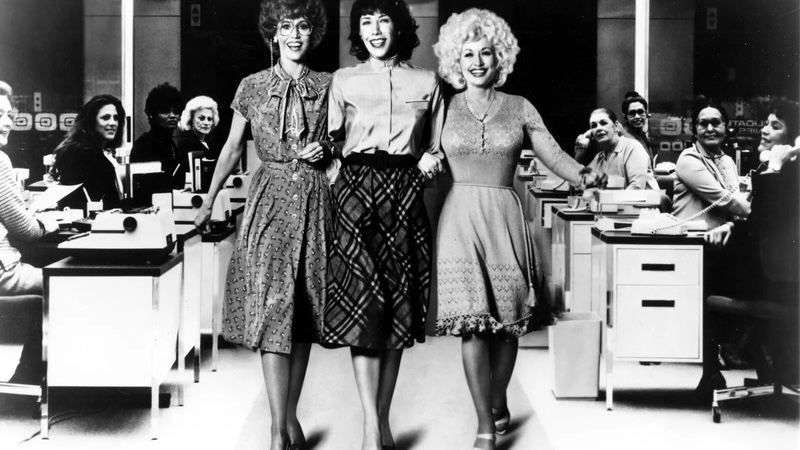
When Dolly Parton died recently, radio stations and music streamers filled our ears with her irresistible anthem, “9 to 5.” The song topped the music charts and was nominated for an Oscar. It transformed Parton, making her movie debut, into a global crossover star. The movie, a pointed comedy about three women—played by Jane Fonda, Lily Tomlin, and Parton—fighting against sexism and inequality in the workforce, was the second most popular movie of 1980, behind only “The Empire Strikes Back.” The real-life story that inspired the film is just as remarkable: How a small group of young women in Boston launched a movement to organize secretaries that transformed how women are treated in the workplace. From Parton’s powerhouse song to the #MeToo movement to the rise of women CEOs and union leaders, Parton caught the spirit of change that rings out today as loudly as it did almost five decades ago.
Karen Nussbaum sat in the back of a darkened movie theater on a winter day in 1980, watching as women in the audience whooped and cheered at the film—her film. She moved to the pulse of Dolly Parton’s tune as scenes flashed by of women in skirts, clutching coffee pots and newspapers, looking harried yet resolute, speeding through city streets to the infectious rhythm of Parton’s anthem…no, to the anthem of that era:
Workin’ nine to five, what a way to make a livin’
Barely gettin’ by, it’s all takin’ and no givin’
Across the next ninety minutes, the comedy unfolded. Fed up with being summoned to fetch coffee or pick a present for the boss’s wife, three office workers—played by Jane Fonda, Lily Tomlin, and Dolly Parton—are demeaned and harassed by a sexist supervisor (Dabney Coleman). They hatch a plan to get even, sharing a joint, abducting him, and enacting fantasies of retaliation, thereby forcing their chauvinist boss to confront the consequences. What begins as a revenge fantasy for women facing harassment at work evolves into a blueprint for reform: when the boss returns, the women reveal new arrangements—job sharing, flexible hours, and on-site child care. The company’s leadership ultimately reassigns the humiliating Coleman and elevates Tomlin to head of the office.
These secretaries wanted better pay and benefits. They wanted opportunities to advance…They wanted to be treated with dignity.
The audience in the theater cheered as though the film were telling their own story. When Fonda struggled with a copier, a spectator shouted, “Push the start button!” Many of the indignities on screen mirrored real-life experiences. For six years previously Nussbaum had led one of the country’s most effective grassroots groups—9to5—fighting for wages for secretaries, fair promotion prospects, and workplace dignity. She already knew Fonda from their days in the antiwar movement, and she was deeply impressed by 9to5’s work enough to enlist Tomlin and Parton for the film. As the credits rolled and the theater lights came back up, a hush fell over the crowd. It felt, to Nussbaum, as though men in the audience sensed that something potentially dangerous was stirring beneath the lighthearted storytelling.
The film 9to5 went on to become the year’s second-highest earner, trailing only The Empire Strikes Back. Ronald Reagan—fresh from his congressional victory and then-opponent of unions and the Equal Rights Amendment, who had branded Fonda as “Hanoi Jane” for her antiwar stance—saw a screening with his wife and called it “funny.” Nancy Reagan invited Fonda to autograph an Easter egg for the White House Easter Egg Roll.
Nussbaum hoisted her coat and stepped into the brisk Cleveland air. She was short, wiry, and had close-cropped hair. In another world, casting her in a film persona—an independent, savvy, quick-witted character akin to Sandra Bullock in Our Brand Is Crisis or Holly Hunter in Broadcast News—might have been tempting. Born to a baby-boomer, politically engaged family in a conservative Chicago suburb, Nussbaum’s mother worked in public relations for educational institutions and organizations. She would take a young Karen along while distributing materials for Democratic campaigns and serving as a poll watcher during local elections.
As opposition to the Vietnam War intensified, the family joined a weekly silent peace vigil outside the local library. “You know, it’s time that women cared as much about peace as the PTA does,” her mother told the newspaper. Nussbaum’s older brother became a draft resister. The family soon faced hostile mail from members of the John Birch Society, with crosshairs drawn on pictures directed at Karen’s mother. Meanwhile, as a teenager in the Chicago suburbs, Nussbaum longed to fit in at school, to find the perfect Villager-brand outfit—a skirt and sweater paired with a Peter Pan collar—that, in the pre-hippie era, was sweeping the suburbs. There weren’t many spaces for a bright, politically minded girl in those days to pursue social justice outside the confines of activism.
She could not wait to leave home for college. She won admission to the University of Chicago. The summer before starting, she secured a job as a “gofer” at the 1968 Democratic National Convention. Watching demonstrators outside, she left the gathering and joined the marchers, the air still thick with tear gas. Nussbaum joined the chants: “The whole world is watching.” It felt, she later recalled, as if the world itself were coming apart.
Once in college, she joined students who seized the administration building at the University of Chicago. Her politics grew increasingly left-leaning. The following autumn she left college and embarked on a “solidarity” tour of Cuba organized by the Black Panthers. She attended Yale’s May Day rally in 1980 to protest the imprisonment of Black Panthers Bobby Seale and Erica Huggins, and she joined a delegation to Hanoi to protest the Vietnam War.
Throughout it all, she resisted the narrow confines placed on women. Even as a young radical, she observed how men dominated meetings and how many women became entangled in romantic entanglements within radical movements. In high school, she had campaigned for student body president—only to lose after being told that, as a girl, she could not win.
By 1973, at twenty-three and with a growing FBI file, Nussbaum landed in Boston. She moved into a rough house with other women and organized self-defense classes for women. To support herself, she worked as a clerk-typist at Harvard University, earning two dollars an hour as a casual employee with no benefits. The daily indignities wore on her, especially since she was educated and worldly. Once a student walked into the Harvard office, looked at her, and asked, “Isn’t anybody here?” Another time, a male boss strode past and asked, “Why aren’t you smiling, dear?”
Nussbaum had encouraged her best friend, Ellen Cassedy, whom she met in college, to move to Boston and take a secretarial job at Harvard. Cassedy, who had grown up in the suburbs and studied at the University of Chicago before earning a history degree at Berkeley, later recounted experiences of harassment that echoed the broader climate: a professor exposed himself, insisting she type while he described his sexual exploits. Terrified and unsure of how to respond, she kept typing. Off hours, other secretaries shared similar stories. One recounted pausing to read a letter her boss had forced her to draft; when she explained she was thinking, he retorted that she wasn’t paid to think. For Nussbaum and Cassedy, the Harvard gigs were temporary holds—rent and activism support—while many coworkers treated the work as a permanent life. “We will be called girls until the day we retire, with no pension,” one colleague lamented.
Beyond the Harvard secretarial pool, the 1970s crystallized a period of dramatic progress for women. In 1972, Title IX of the Higher Education Act barred sex-based discrimination in programs receiving federal funds, compelling previously all-mirls or all-mirls-sport environments to open for women’s athletics. A wave of Supreme Court rulings expanded women’s rights. The Roe v. Wade decision in 1973 guaranteed abortion rights, and discrimination in help-wanted ads began to wane. The following year, women gained equal access to credit cards and mortgages. In 1975, Billie Jean King defeated Bobby Riggs in the celebrated “Battle of the Sexes,” a spectacle watched by more than fifty million people. Ms. magazine debuted in 1972, featuring Wonder Woman on its cover.
Supported by both major political parties and leaders such as Richard Nixon, Gerald Ford, and Jimmy Carter, the Equal Rights Amendment moved through state legislatures, while the share of women in higher education climbed: by the end of the decade, a quarter of medical students and about a third of law students were women, up from roughly ten percent in 1970. The Mary Tyler Moore Show—an enduring symbol of independent urban womanhood—was a top-rated comedy for three consecutive years, and Time magazine’s Man of the Year issue in 1975 celebrated Women of the Year, noting sweeping changes in every corner of American life. “Across the broad spectrum of American life, from suburban houses to state legislatures, women’s experiences are undergoing profound transformation, and with them, the age-old dynamics between the sexes,” Time proclaimed. “1975 marks not simply a Year of the Woman but a Year of Women—diverse, ambitious, and redefining themselves with new purpose and confidence.”
There would be no talk of women’s liberation or feminism. They would not be protesters in the 1960s struggle to halt a war or topple a regime. They would be organizers building a movement from the ground up.
The one group left outside this sweeping shift, Nussbaum believed, was the working class of women. For the first time, more than half of all women held jobs outside the home. In offices, where roughly one in three women worked, their earnings lagged behind men by a widening margin; gender inequality persisted in every rung of the ladder. The job ads still exuded sexism—“Secretary: a raven-haired dynamo!” or “Engineering secretary: blonde-haired, blue-eyed and charismatic!” Unlike the comfortable, middle-class women like Nussbaum, those in office work rarely identified with the era’s feminist wave. “I’m not a women’s-libber,” one secretary confided to Nussbaum. “But I believe we deserve equal treatment on the job.” They sought fair pay, better benefits, and chances for advancement, and they wanted to be treated with dignity.
One afternoon while strolling through Harvard Square, Nussbaum noticed a picket line in front of a diner where she’d eaten. Eight waitresses were striking for higher wages, and the broader women’s community joined in to show solidarity. Nussbaum volunteered for picket duty on Wednesday evenings, winding through the crowd as she contemplated how to connect the various strands of women’s work. She gathered ten friends—all employed in clerical roles across Boston—and they began meeting weekly in a “consciousness-raising” circle—an emblematic practice of early 1970s activism—sharing stories about how they arrived at their current lives, what they valued, and whether they wanted to form a group to press for change.
After a year of discussion, they announced the birth of an organization: 9to5. This was activism curated by working women themselves. It would depart from the rowdy, large-scale marches of the 1960s; meetings would be purposeful and concise, conducted with warmth and mutual respect. The movement would not dwell on the language of feminism or liberation. They would be organizers laying the groundwork for a lasting movement grounded in practical aims rather than protest for its own sake.
____________________________
From When America Roared: How the 1980s Saved, Then Broke, the Country–and Led Us to Today by Jonathan Kaufman, published by Viking, an imprint of Penguin Publishing Group, a division of Penguin Random House, LLC. Copyright © 2026 by Jonathan Kaufman.