
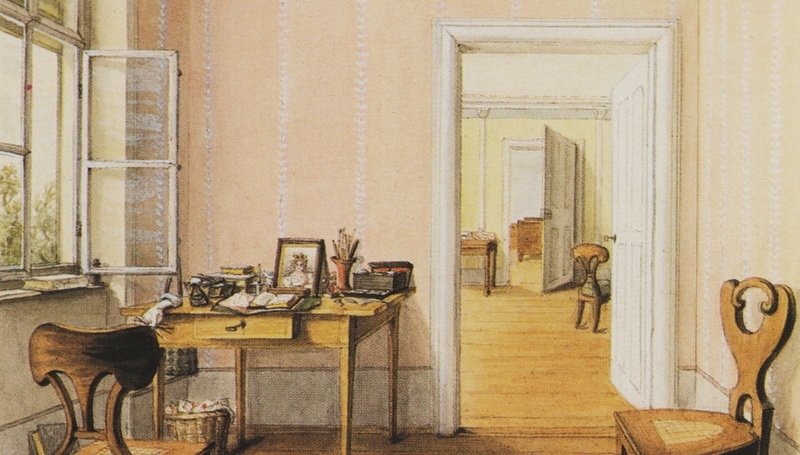
In the mid-2000s, the Guardian weekend magazine ran a regular feature called “Writers’ Rooms.” As a secretly aspiring writer (is there any other kind?) I couldn’t get enough, poring over the photographs of book-lined studies furnished with beautiful antique desks. These images seemed both to represent literary success, and contain the key to it.
The featured authors generally viewed their rooms as a retreat from the churn of daily life, where they could close the door on the household and be transported to a place of deep creative focus. There was no suggestion that what they were shutting out ever pursued them inside in the form of guilt, longing or doubt: a private, dedicated space in which to write appeared to be all they needed to work.
Virginia Woolf’s essay on this subject was published in 1929, where she famously declared, “A woman must have money and a room of her own if she is to write fiction.” But in a 1930 letter to her nephew Quentin Bell, the plot thickened: “How any woman with a family ever put pen to paper I cannot fathom. Always the bell rings and the baker calls.”
A big tension I feel about writing as a mother is the fear that dedicating time to a project might steal moments that could be spent with my children, for something that may never yield significance.
I don’t know if Woolf’s theoretical “woman with a family” was also in possession of a room of her own, but this quote struck a deep, corroborative chord when I first heard it. The closed door, however solid and heavy, stands little chance in my experience against what we now think of as the domestic load.
The particularities of the intrusions may have changed over the last century, but the woman writer’s status as chronically interruptible seems to have stubbornly endured. Even if she has a highly proactive partner committed to equity (which I do), and is disciplined enough to keep the disturbances at bay by blocking the internet on her devices (which I am only rarely), the phantom baker still persists; the existential bell doesn’t necessarily stop ringing.
For me, writing fiction requires entering a state of mind that is hard to square with daily life, rife as it is with constant action and interaction. The hours march forward in a preordained rhythm completely indifferent to my meagre word count—mealtimes, housework, school drop off and pick up, errands. To write, I need to be able tunnel downwards, away from the present moment: a painstaking, frequently frustrating process, like being a lone archaeologist in a field, armed only with an old rusty shovel and the vaguest hunch that something of value might lie somewhere beneath the vast surface.
I’ve read enough author interviews and essays to know I’m not alone in finding the multiplicity of roles and duties in my real life sometimes difficult to reconcile with the writing one, and that others have found ways—not always wholly conventional or straightforward—to have, if not the best of both worlds, at least a tenable foothold in each. In a recent podcast, Lauren Groff described the physical, signed paper contract she drew up with her husband, which guarantees her four completely uninterrupted child-free hours every morning in which to write. When Miranda July was still married, she had an agreement with her partner whereby she spent every Wednesday night at her studio, to ensure her one full day of work each week where she didn’t have to negotiate the logistics and distractions of family life.
These examples feel so potent to me because they are so unusual. There’s something almost taboo about a woman making formal, inviolable arrangements to spend time apart from her family in order to do creative work, and it’s hard to imagine a male writer or artist enshrining their rights in this way, because there would simply be no need; indeed, in this day and age, he would likely be decried as a chauvinistic egomaniac.
Yet without such firm, recognized boundaries in place, it’s all too easy for women writers (in these cases, both in heteronormative marriages) to capitulate to the many inevitable unscheduled interruptions and obligations—unexpected school closures, impromptu roof leaks, surprise rodent infestations—that plague domestic life, not to mention the powerful draw to spend as much time as possible with our wild and precious kids while they hurtle through their one wild and precious childhood.
Perhaps this issue feels so charged among writing mothers because it raises the specter of the drastic measures some of our predecessors have taken. Muriel Spark and Doris Lessing both famously left their children (Spark with her parents; Lessing with her ex-husband) in order to pursue their writing. If “full-scale child wholesale family abandonment” sits at one end of the scale and “hopelessly enmeshed to the point of creative immobilization” is at the other, an official agreement protecting a regular, prescribed period of time seems a reasonable, and almost necessary safeguard for the writing mother (albeit depressing from a gender politics point of view).
Back at my desk, when I close the door and pull up my draft, I can almost believe I’ve arrived in the writer’s room I once romanticized, where progress is swift and attention boundless.
My personal method is something I like to think of as merely temporary abandonment—three or four days, a couple of times a year, when I hole up somewhere other than my home to do nothing but write. It is far from a flawless strategy, requiring a game and available adult to take full responsibility for childcare (shout out to my husband), plus generous relatives who are also fond of traveling and also happy for their home to be occupied in their absence (big ups to my brothers-in-law) or—and this the stuff of last resort—cold, hard cash spent on accommodation, which adds a nice layer of financial jeopardy to what is already quite a shaky sense of confidence in the whole endeavor.
Part of what feels so conflicting to me about writing as a mother is the fear that I’m eschewing time that could otherwise be spent with my children to pursue something that may not ultimately amount to anything. I find this doubt and guilt harder to shake when I can hear those same children clattering cheerfully home from school, or when their dinnertime rolls around and I can picture them in the kitchen chatting animatedly over their plain pasta without me. To be so close but apart from them is my personal, internal version of Virginia Woolf’s bell—but the call is coming from inside the house and the only way to quieten it is to escape altogether for as long as I can bear, before it finds me anyway at my new address (at which point I hurry home, positively glowing at the prospect of preparing a bland, beige meal somehow requiring four different pans).
These short stints away have so far been fairly successful, with the bursts of decent progress I make propelling me along quite nicely for the next few months in the real world. Back at my desk, when I close the door and pull up my draft, I can almost believe I’ve arrived in the writer’s room I once romanticized, where progress is swift and attention boundless.
____________________________
Natural Disaster by Lisa Owens is available from Little, Brown and Company, an imprint of Hachette Book Group.