
“Elegy, sing the bones to break / the cycle. The cycle: Sing to Break. Break to Sing.”
–Philip B. Williams’ Lift Every Voice
*
This month, poets collaborate and converse beyond the confines of a page, joining forces from Victoria Chang’s hand-sewn archival imagery to Brenda Shaughnessy’s robot librettos, who steps into a notable circle of poet-librettists that includes Douglas Kearney, Janine Joseph, Avery R. Young, and Robert Pinsky, whose robot opera of 2011, Death in the Powers, features a chorus of artificial voices. The border between poem and song remains porous; the arc of James Weldon Johnson’s “Lift Every Voice and Sing,” once rendered as song by his brother and later dubbed the “Black National Anthem,” and then recast as a golden shovel back into verse by Philip B. Williams, attests to a poem’s resilience. The closing phrases of Franz Wright, embedded in his final collection’s pages—“Let alone, let / alone the lights / of home my / wanderings done”—also point to poetry’s enduring reach.
*
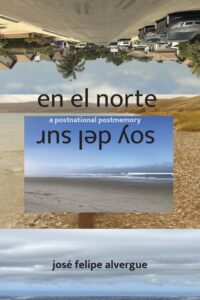
José Felipe Alvergue, en el norte/ soy del sur, (Omnidawn Publishing)
“I receive signals/ throughout my life. / Radio fragments bouncing / around.” Alvergue carves those signals, fragments of a family history shaped by migration from El Salvador—“Historical pain, like faintly buried stone steps” and “the spectacle of indefatigable bodies”—into fourteen-line forms that refuse to be bound by borders. He refers to these as sonnet-essays: they twist and pivot on the page, sometimes bending around the color photographs that anchor the collection, widening the sense of the turn as a response to intergenerational trauma. Even the photographs appear inverted at moments: “A family of turns / becomes form. Work embodied that is / future occupying, but not future anxious. / The turn disavows utilized value.” In one compact pairing, the left side of a sonnet answers a photo—“My mother, newly orphaned, newly arrived”—while in a slender column a man screams at her in a Costco scene: “She landed trusting / she would be American only to find herself / a woman of color in America.” Here the turn is also a dance, a way of surviving, celebrating, and enduring: “We came in dancing,” “We danced in defense,” “Dancing is making repairs / in motion. Salvadoran parents snap their / fingers at their kids and you better be moving.”
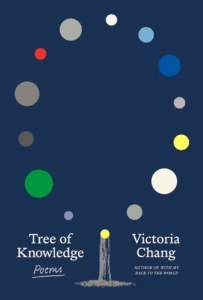
Victoria Chang, Tree of Knowledge (Farrar, Straus and Giroux)
Victoria Chang’s latest cycle centers on a tree felled by a chainsaw: “It swayed like a woman / hanging from a gallows.” A line later, the voice wonders what it felt like to swing in ecstasy only in death. The roots of these expansive poems reach to influences from Picasso to contemporary writers and artists such as Renee Gladman and Ai Weiwei, whom Chang makes tangible by reclaiming historical photographs, stitching them with red thread, and pairing them with “tiny persona poems” also printed in red. At the heart of the collection stands the expansive epic-length piece “Eureka,” which traces not only the expulsion of Chinese inhabitants but also themes of menopause, sorrow, ambition, loss, and the weight of expectations as the speaker laments, “but I only want to write about trees / about the dead Chinese people near trees / about my dead family near the trees.” And in “Motherhood,” the speaker says, “When I can no longer find the words to describe this, / the baby next door tries to speak, the trees drop their stars.”
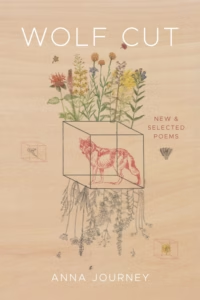
Anna Journey, Wolf Cut: New & Selected Poems (Louisiana State University Press)
If you approach Anna Journey’s new volume for a meditation on Larry Levis’ archived boots, you will stay for the narratives themselves—a voice “so tangled by drugs that I unintentionally / stole a child” at a music festival, and who recalls the “anarchy / emblem I smeared in blood on my bedroom door.” Across Journey’s baker’s dozen of newly minted poems spanning California to the South, the presence of a father who is gone underscores the collection: “When I refused, at fifteen, to hand over the carton of Newports / tucked behind a line of calf-high boots in my closet, /my father ripped the whole thing off its brass hinges, injuring his shoulder.” He appears to intervene to forestall the speaker’s self-harm, shown by cigarette burns on her arms. We glimpse him as he dies and, in his Mississippi youth, copying Greek from a bathroom stall, which he then carries to the Episcopal priest at Millsaps—who, when translating, jokes, “It says, ‘My shit don’t stink.’” This long arc, already rooted in her first four books, makes Journey’s New & Selected both a revealing and exuberant collection.
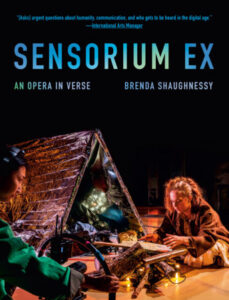
Brenda Shaughnessy, Sensorium Ex: An Opera in Verse (Knopf)
Shaughnessy’s robot opera, co-created with composer Paola Prestini, probes the tension between corporate control of technology and the possibilities it can unleash, foregrounding inclusive casting for disability and the use of AI to “assemble recorded vocalizations of nonverbal human actors into their characters’ lines,” imagining an AI that returns your own data to you to be used as your voice for personal purposes. The cast features a robot named Sophia, described as “our new human you are hoping to perfect!”; a scientist mother, Dr. Mem, and her nonverbal child Kitsune; a chorus of souls; and CORP, the human embodiment of a colossal corporation whose omnipotence is matched by onstage appearances from a trumpet; plus Mycelia, a figure who is “part tree and part human,” declaring she is “Fluent in Aspen, Birch, / and Cypress” and that “I sing what I remember. / That’s how my knowing is got.” This mother-and-son tale offers a powerful addition to literature about robots, AI, and disability, shaped by Shaughnessy’s assured artistry as a poet who has stepped into libretti. (If, as with me, you crave the experience of the opera beyond the page, you can watch the trailer.)
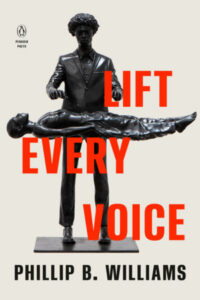
Phillip B. Williams, Lift Every Voice (Penguin)
“Sing to break. Break to sing.” From this stirring invitation in the preface poem, “Aide-Memoir,” Williams’ third collection moves into verses that wrestle with offsets, allusions, and the keen perception of a poet actively observing the world, voiced in his own terms: “A close friend tells me my mother told him my father / took his own life. Not how overdosing works, my love.” In a sequence titled While Reading, Williams enters the lives and symbols of others, transforming and borrowing at once, whether summoning Brigit Pegeen Kelly’s stag or, in “While Reading Sula,” aligning with Nel: “Why should I burn / while a man mumbles / Christ—scared—above me?” His final gesture—“’Til Earth and Heaven Ring”—unfolds with epic breadth and song-like repetition, acting as a golden shovel that borrows James Weldon Johnson’s line to prepare the air around it for a telling of his own father’s mother until it lands correctly.” Throughout, Williams lets thought take flight in song.
Christian Wiman, The Dance (Farrar, Straus and Giroux)
Christian Wiman’s latest volume has arrived with a collection that opens playfully with “Bad Literary Gathering,” a scene where there exists “a kind of bare-bones gloom in which everyone sees / everyone else’s death: a mortality colony.” Notable moments include more earthy lines such as “Holding an Earthworm at Fifty-eight,” which conjures a childhood memory of writhing worms with “the oily, eely /under of it all, /the viscid seethe,” and “Reading Steinbeck,” which begins in media res: “—and the sorrows hardened, / and in the first light grew palpable, pliable.” Wiman’s discipline of form shepherds passages like “When sleep was sleep and dawn was ponderable” and, in “There Could Come a Cuckoo,” a meditation on the midpoint of life where the speaker quips, “You don’t even believe in breakfast, much less a sweet one, / but here you are, slathering nostalgia on a waffle.” Faith and formal craft prevail, and Wiman offers a thoughtful lens on the pandemic era in “The Word”: “Consider the shiver that runs through still water like a sound. /Who would we have to be to hear it?”
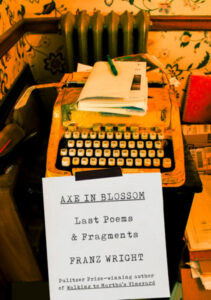
Franz Wright, Axe in Blossom: Last Poems & Fragments (Knopf)
“It won’t be long now, planet of ghosts.” Wright speaks to us from beyond with this posthumous collection, framing farewells in both prose and verse, whether in the address “As in Sepia Visions” or in “Everything Else Will Change,” a love poem—his notes remind us these pieces are formed with his wife, yet still intimate in their mutual address of “I” and “you”—“Everything on earth will change when I am dead. /No one will notice but you. / No one will suffer but you.” These are “last poems and fragments,” not a tightly braided harvest as in earlier volumes, yet the book exudes a singular beauty and cohesion. We stand in the presence of a poet whose future creations we will not get to hold. “Theology” opens with, “There must be someone else / who wakes disturbed, alone; / too bad we can’t talk on our tiny phone.” And these poems function as that small device, linking us to Wright and to what poetry can sustain in the face of endurance.