
1952
Clay Lockhart’s cries stretched for half a mile along the rain-soaked shoreline, carried by the late January gale that tore across the Outer Hebrides—an isolated, wind-sculpted chain of islets off Scotland’s western edge. The downpour arrived with cold speed, driven by a sharp, frigid wind that battered old panes and sank into bone. In Saltwell—a tiny coastal settlement along St. Magnus Bay—the villagers pulled shutters tight, summoned the children indoors, and herded their livestock as they always did when a western squall hammered at their sturdy homes.
But Clay Lockhart flung open his oak front door and stepped out into the storm, a body slung and weighted in his arms: hair of gold spilling from a pallid skull, arms drooping like damp rags.
Neighbors farther along the coast caught sight of his figure in the bursts of moonlight between storm clouds, and they noticed the white dressing gown that clothed the body he bore—now stained with blood from the waist downward.
He carried her to the cliff’s edge of his property, overlooking the ruthless sea, and began to dig. It took an hour to finish the task, until he sank to his knees—hair slick with sea-wet, shoulders bruised by grief—and laid her down with care, just as he’d done with his parents a decade earlier. He returned to the house to fetch the two smaller bodies. They were not bodies at all, but stones—tiny as gourds, not yet ripe. He placed them beside his wife, cradled against her ribs, then set to shoving muddy earth back into the shallow grave—three in a row, one for each life.
This tale—of the night Clay Lockhart buried his wife and their newborn twins in the soil beside the sea—might have been the only story told come morning. It might have traveled among the Northern Isles for weeks, if it had been the sole calamity to befall that storm-lashed night.
But it was not.
Clay Lockhart stumbled back toward his house, grief bowing his shoulders, the digging draining his strength. The sea-wind screamed through the open doorway, and as he vanished inside, the storm began to hurl itself against the world—as if it no longer belonged to the ocean, but to an underworld it had dragged ashore.
Auld wives and pike staves, his neighbor Neil Hagdorn—an ornery sheep farmer—would later recall, speaking of the storm’s ferocity that night, of the sky turning a sulfurous green. Rain pelted the walls of every home as if stones from LockMull Beach were raining down from the heavens.
Neil Hagdorn heard the land crack and the water surge, as though a landslide were careening down from the treeless moor to the east. The breaking of rock seemed to vibrate through the islands, and many believed it an earthquake, or the fabled long-sleeping giant Benandonner waking to push the ground apart with a foot and an elbow raised above the soaked earth. But it was neither an earthquake nor a giant that rocked the Hebrides.
By morning, when Neil Hagdorn unlatched his door and scanned the coast, he found the white-washed house perched atop the sea cliff—where Clay Lockhart had lived with his pregnant wife—had vanished.
But it wasn’t only the house that had vanished. The entire tract of land was gone. Neil, despite his creaky hip, climbed the steep shore and peered down at the spot where the dwelling once stood, expecting to see it reduced to broken beams, shattered glass, and heaps of foundation stones far below the cliff. Instead, only waves battered the rocks, and there was no sign of the house—or the land.
Or the land.
Neil lifted his gaze again to the sea, the sky now calm, the air sharp and strange. And he wondered …
In the years that followed, stories drifted from neighbor to neighbor, from one island town to the next, about Clay Lockhart, whose wife perished in childbirth, and whose grief spread so wide it seemed to split the ground open the night of the storm, lifting the house and its four hectares of land away from the mainland and letting them drift into the Atlantic.
Sea-worn sailors, fishermen, and grizzled captains swore they spotted the newly formed island, its white house perched on a rocky outcrop, drifting toward the far reaches of the gray Atlantic. Men would go to their graves insisting they’d seen someone on that island, Clay Lockhart, still consumed by grief, wandering the rocky shores with no intention of calling out to ships or seeking to leave the place where he’d buried his wife and two infant children.
It came to be known as Saltwell Island, a ghostly ship, a legendary drifting bit of land that people claimed to avoid. A cursed heap of earth. Yet, with the passage of years, these warnings faded. The old tales were dismissed as superstition and lore. Clay Lockhart, in his despair, likely hurled himself over the cliff that night. And as for the house, perhaps it fell to pieces in the storm— lashed to splinters, dragged into the sea along with the lush shoreline— and the locals chose to tell stories of forsaken islands lost to the Atlantic rather than face the truth: a man driven into the sea by his own sorrow.
Many decades would pass before, somewhere far away along a foreign coastline, another person would glimpse the elusive island and dare to tread its rocky shore.
A girl named Eleanor Mills, whose life would veer off course on a rain-soaked, tempest-tossed night. Who would be both remembered and forgotten because of that island. Because of what would happen. And what had already begun.
__________________________________
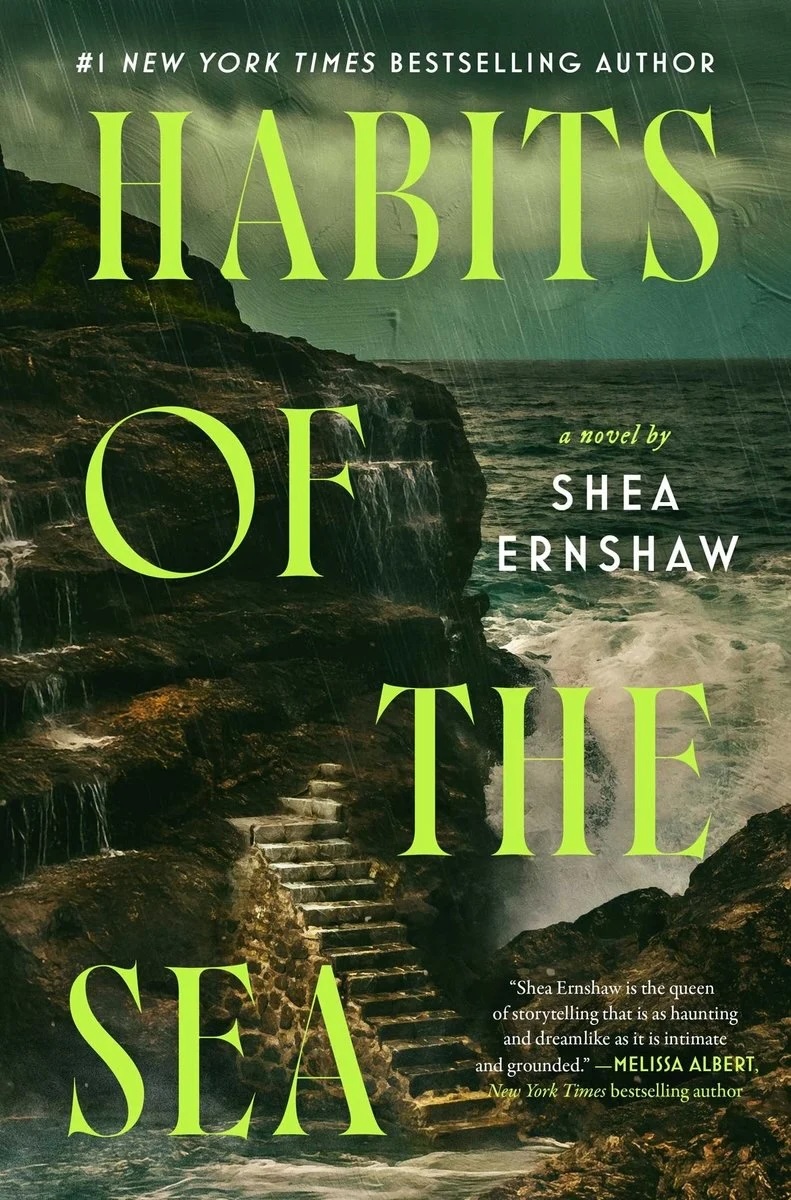
From Habits of the Sea by Shea Ernshaw. Used with permission of the publisher, Atria Books. Copyright © 2026 by Shea Ernshaw.