
“WHAT a pretty girl!” cried Antonio, as a contingent of riders moved through the village square of N***, just arrived to participate in the town’s celebrations planned for the next day, a moment that marked the start of a memorable visit.
Antonio González had long been a schoolmate and my dearest friend from our younger days. After we both earned our medical doctorates, he offered to drop by my hometown to join in the parish festivities, and indeed he reached N*** the day before the events began. We were nearby the barrier-making area around the square, preparing for the bullfight scheduled for the following day, when, as I noted earlier, a group on horseback swept by, and among them stood out—the most enchanting figure in the district—my cousin Dolores.
“What I admire most,” added Antonio, “is her complexion, so pale and delicate, a rarity under our sweltering sun.”
Dolores’ obsidian eyes and hair formed a stark contrast with her rosy skin and the deep red of her lips.
“You are right,” my father commented, standing beside me, “her complexion seems almost foreign to our climate… My God!” he added with a hint of emotion, “I had never noticed that before.”
Neither Antonio nor I grasped the old man’s exclamation in the moment. Years later, we would recall the vague fear it stirred in us, a feeling that felt strangely unsettling at the time.
My father served as the physician of N*** and would have been celebrated for his practical know-how and his charitable acts in any more advanced town. Unlike many parents, he had always encouraged me to pursue medicine, expressing his hope that I might someday surpass him in the profession.
As an only son, content with my own fortune, cherished by my father and surrounded by a large family who loved me, I had always felt content with my situation. At that moment I was in N*** temporarily, handling a few business matters so I could soon marry the woman I had come to love in Bogotá.
Among all my relatives, my Aunt Juana—an eminent and wealthy woman—had always been the strongest anchor in my life. She had looked after me since my mother’s death, and Dolores—her niece, who had lost both parents—had also lived with her for many years. Thus Aunt Juana divided her affections between her favorite niece and her nephew.
As we grew older, it became clear to Dolores and to me that a union between us would please Aunt Juana; yet human nature often chooses the harder path, and we tacitly agreed that our attachment should remain strictly fraternal. I suspect a certain reluctance to go against expectations motivated me to accept a betrothal in Bogotá—while still a student with no prospects—so that Dolores would be treated as a sister from the moment I left for college, and I would keep her abreast of my studies and hopes as an engaged young man.
That short explanation is necessary to understand the uncomplicated dynamic that existed between us.
After lingering in the square for a while, we returned to our homes. My father’s residence lay not far from the village, but since the fireworks were to begin after sundown, Antonio and I decided to head back to see the evening spectacle.
The moon lit up the countryside, and a warm, fragrant breeze rustled the trees, carrying with it the scent of countless blossoms. The smaller birds slept or murmured softly as the philosophic owl—always quiet and brooding—voiced a deep, hoarse complaint.
Antonio and I faced a short stretch of meadow and then the main road before reaching the square. Our conversation turned to the future—an almost universal symbol of happiness and possibility for youth. Antonio had chosen the demanding yet brilliant field of law, a choice he pursued with evident talent and eloquence that predicted a promising career. I, meanwhile, imagined a future of study under a reputable physician, followed by a settled life in my homeland. It must be admitted that N***, despite its pretensions to city status, remained little more than a large village, carrying all the inconveniences of a rural town masquerading as an urban center: a mayor, magistrates, judges, and a host of administrative annoyances. It was, in effect, a rural town dressed up in the trappings of a metropolis, a bit like a barefoot countrywoman fitted with boots, a corset, and a crinoline.
As we drew nearer to the village, the quiet gave way to a lively uproar: songs rose in treble voices, bandolas filled the air with music, and cries and laughter echoed, punctuated by occasional rockets announcing the fireworks. The square looked festive, with straw towers and oil lamps that needed constant relighting. The night’s star of the spectacle—the organizer of the show—captivated the crowd, who followed his every instruction with rapt attention as he directed his assistants in the precise choreography of lights and rockets.
Antonio and I reached Aunt Juana’s house, the finest in town, perched on the square. At the entrance, seated on wicker chairs lined along the front wall, many local young women chatted and laughed while their mothers and other respectable ladies discussed more serious matters inside the house—concerns about illness, provisioning, and household help. Cachacos from the region and beyond, who had come for the festivities, moved up and down the doorstep, too hesitant to approach the young ladies who reigned over their circle with grace and coy reserve, foreseeing the attentions of the young men without openly inviting them.
I approached the group with confidence, buoyed by my recent Bogotá visit and the familiarity of being among kin. I introduced my companion to both the inside and outside company, and we seated ourselves to partake in the outside conversation with the rest of the women and girls gathered there.
The fireworks soon fired up: the vacaloca, the buscaniguas, and other popular diversions stirred everyone into motion. The smoke from the pyrotechnics dimmed the moonlight that had so poetically bathed the scene in its glow, and the towers of straw burned away one after another as the crowd cheered. After a moment, a piercing bang signaled the finale, and a final volley of red flashes and dense smoke marked the end of the display. The throng dispersed gradually, all declaring the show excellent, even though the true exhaustion of tired feet, torn garments, and minor burns might tell a less flattering tale if one chose to recall it realistically.
I proposed that we take a stroll around the square with the rest of Aunt Juana’s guests.
The ladies formed a column, with the male figures flanking and weaving around them. A certain magnetism always operates in such moments: soon enough Antonio and Dolores found themselves in conversation, and a lively exchange ensued.[4] The square buzzed with tables hosting various games of chance—bisbis, pasadiez, cachimona, and others—for a modest stake. At other spots, people drank all sorts of beverages: chicha de coco, guarapo, anisette, mistela, and even stronger options like brandy and wine—though not always of high quality. Elsewhere, the tables offered a feast of culinary delights: ajacos, roasted turkeys, and lechonas stuffed with garlic and cumin seeds; there were horchatas, naranjilla, blackberry, and pineapple juices, as well as corn and rice guarruz bottled and garnished with little clusters of flowers. Sweets—candied fruits, cocadas, panderos, and small arepas shaped in various forms—lined the trays beneath rough but clean tablecloths, a veritable collage of delicacies that people simply called a “collation.”
Here and there, groups sang popular tunes accompanied by treble guitars, alfandoques, and carrascas, moving from one spot to another in search of guarapo or brandy, always singing in a lingering, melancholy mode that never quite abandoned a certain sorrowful cadence, even as they danced and drank into the night. In this, the height of civilization’s apotheosis appeared to lie in the capacity to feel nothing at all amidst the revelry, as though indifference were the ultimate sign of sophistication. Lord Chesterfield’s old counsel—that one should never laugh in public—was invoked by some, echoing a belief that gravity and masking constancy are traits of a “savager” elegance.[5]
Without warning, the distinct sharpness of the chirimía cut through all other sounds, announcing that the festivities had begun in earnest.
*
[1] The author uses the initial N to refer to towns she wishes not to name. The 2021 edition of the novel, published by Ediciones Uniandes and translated by Carolina Alzate, speculates that this might reference a town near Natagaima in Tolima. It also notes that at the time universities were located in Bogotá, and ambitious young men often left home for extended periods to pursue education.
[2] A cachaco was a young man from 19th-century Bogotá—elegant and courteous, but not necessarily a flashy dandy; the term here is used to denote a distinctly Bogotá-born gentleman. The note remains in Spanish to preserve the historical nuance of its usage.
[3] The vacaloca—literally a “crazy cow”—was a favorite late-19th-century firework display in Colombia, while buscaniguas were small, erratic chasing crackers that darted along the ground.
[4] The subsequent paragraphs assemble a gallery of popular Colombian 19th-century table games, foods, drinks, and musical instruments, drawing on Alzate and the sources she cites, including the Nuevo diccionario de americanismos, the Diccionario de bogotanismos, and the DLE, plus common knowledge.
[5] Lord Chesterfield was an English statesman and author (1694–1773) renowned for his witty and polished Letters to His Son and Letters to His Godson, whose gravity and distinction were often cited as exemplary (Alzate).
__________________________________
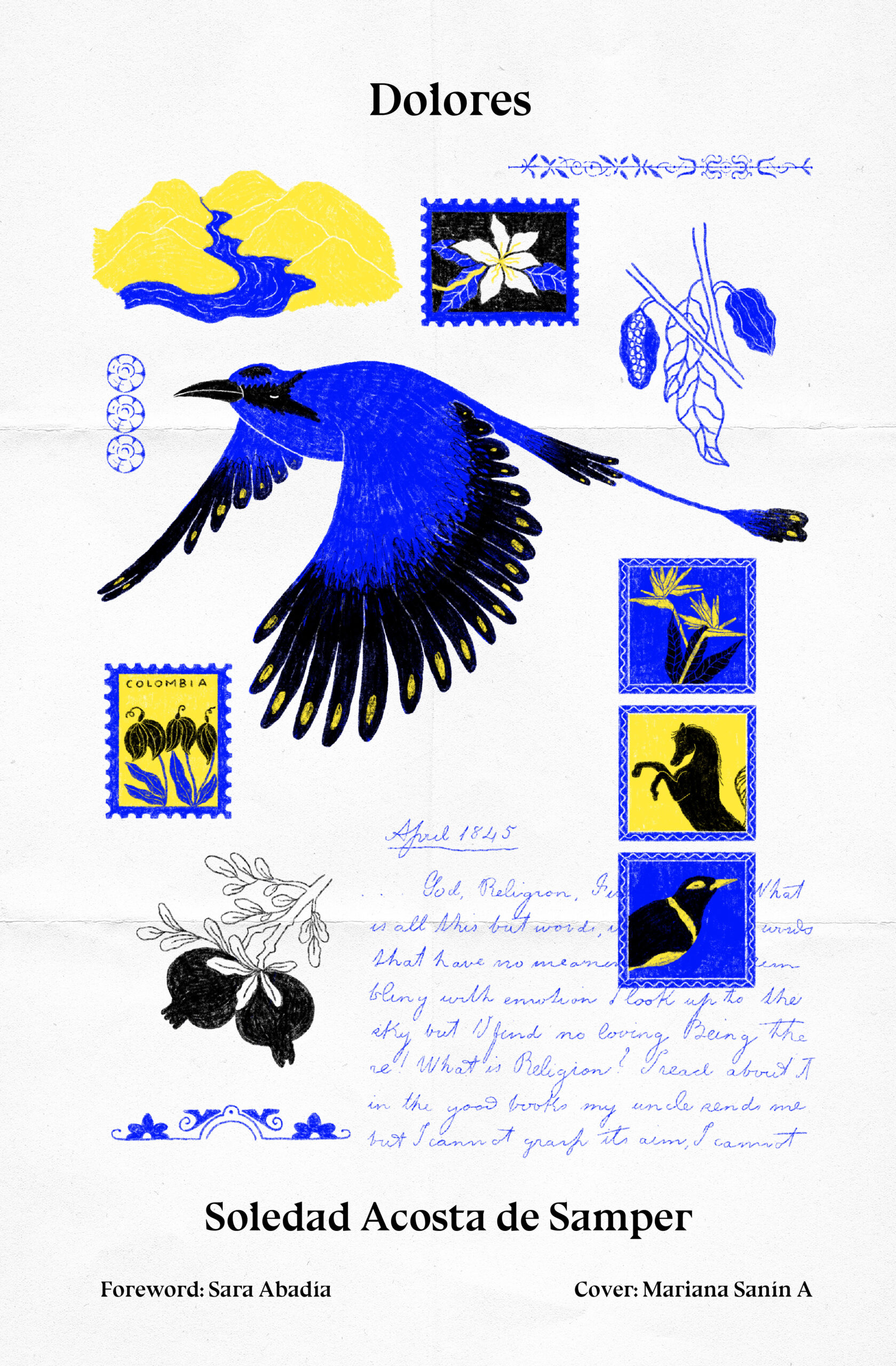
From Dolores by Soledad Acosta de Samper. Used with permission of the publisher, Cita Press. Translation by Sara Abadía Alvarado and cover image by Mariana Sanín A. (CC BY-SA 4.0).