For most of my life I didn’t read books of letters. I wanted what I read to be deliberately shaped. I wanted art. And in middle age, I lost some vision. I read more slowly, so every word had to be right. Letter writers, I assumed, would not work at their writing. Then I had a surprising experience: a scholar, Chad Wriglesworth, asked to compile a book of letters that a friend and I had written thirty to forty years earlier. She was the poet Jane Kenyon, who died of leukemia in 1995 at the age of forty-seven. My letters, which I didn’t remember, were in an archive. I feared they were boring and foolish, but I put that thought aside. I had Jane’s letters. They’re observant, honest, loving, quarrelsome, funny.
For most of my life I avoided volumes of correspondence. I preferred reading works crafted with intention and artistry. As middle age came, my eyesight began to fail, and reading slowed; every word had to be precise. I assumed letter-writing wouldn’t stand up to artistic scrutiny. Then a surprising moment arrived: a scholar named Chad Wriglesworth proposed assembling a book from letters written with a friend of mine three to four decades earlier. The friend was Jane Kenyon, a poet who passed away from leukemia in 1995 at age forty-seven. The letters I’d written with Jane, long forgotten by me, surfaced in an archive. I feared they might be dull or foolish, yet I set that fear aside. I possessed Jane’s letters — they were perceptive, sincere, affectionate, at times argumentative, and humorous.
Jane was unusually transparent, even with strangers. Yet she strongly did not want her husband, Donald Hall, to learn certain confidences she shared with me. And even beyond those secrets, her letters remained private. As her literary executor, Don granted permission for publication, but I wasn’t sure Jane would have agreed. Legally, I could block publication only of my own writing. But if I refused, there would be no book. I said yes, though I wasn’t certain I was doing the right thing ethically. I taped over some passages, copied Jane’s letters, and forwarded the copies to Chad. When Don died three years later, I sent Chad what I had omitted. In the meantime, he went to the archive and copied my letters. After he arranged the entire correspondence chronologically and had it typed, I read it. My letters weren’t as dreadful as I’d feared. Through years of careful selection and pruning, Chad transformed our pile of mail into a book.
When letter-writers finally meet, they’re happy, but the reader is excluded. Letters stop. I felt deprived each time, but sometimes there was a photo.
Its impending publication—What Clever Friends: The Selected Letters of Jane Kenyon and Alice Mattison, edited by Chad Wriglesworth, will be published by the University of Michigan Press in July—reminded me that I’d still never read a correspondence between friends. Would I read this one if I hadn’t written half of it? My vision was worse. I needed brisk, purposeful writing more than ever. But now I wanted to read books of letters. Maybe they would answer some questions. What was this form? Did letters tell us anything we wouldn’t already know about friendship? Was such publication ethical? Searching online, listening to friends’ suggestions, I got hold of five books of letters.
The cover of Sister Love: The Letters of Audre Lorde and Pat Parker 1974-1989 (edited by Julie R. Enszer with an introduction by Mecca Jamilah Sullivan), photographed by Susan Fleischmann, shows two middle-aged women leaning into a hug, their faces bright with delight and mischief. When letter-writers finally meet, they’re happy, but the reader is excluded. Letters stop. I felt deprived each time, but sometimes there was a photo.
Audre Lorde and Pat Parker—two middle-aged poets who also spoke publicly and were active fighters for justice—often vent about their frustration as Black lesbian feminists: both with people who share their political commitments but don’t take poetry seriously, and with others who prize poetry but not among Black feminist lesbians. Typewriters malfunction; when Pat Parker obtains a computer, it tortures her, giving her “a lifetime of blank pages.” Writing a letter is interrupted by demanding individuals and unreliable machines, by illness and trouble. Their correspondence reaches a heartbreaking high point when Parker writes about breast cancer, a condition Lorde herself endured. Compounding Parker’s earlier frustrations, it becomes hard to be taken seriously as a cancer patient. Friends oppose her choice to undergo chemotherapy, or try to be helpful but end up in her way. It’s evident that among all the people she knows, Audre Lorde, whom she calls “Sister Love,” is the one who truly sees her for who she is.
As Always, Julia: The Letters of Julia Child and Avis DeVoto, was edited by Joan Reardon, who also wrote an introduction. Avis DeVoto, living in Cambridge, MA, handled the mail for her husband, the historian and novelist Bernard DeVoto. In 1952, Julia Child mailed him a kitchen knife from France, to thank him for an essay he’d written about the flaws of American knives. Avis DeVoto penned a long reply. Nine months after her first “Dear Mrs. Child” letter, she begins another, “Julia, my pet.” They both sign off with “Love.”
Together with two French friends, Child is composing the manuscript that would become Mastering the Art of French Cooking. DeVoto persuades an editor at Houghton Mifflin to offer a contract; when Houghton Mifflin ultimately rejects the manuscript, DeVoto finds a home at Knopf. They present themselves as fifty-something homemakers, “Mrs. Paul Child” and “Mrs. Bernard DeVoto,” yet they are also serious, capable professionals. Even with imperfect vision, I long to read all four hundred pages of As Always, Julia.
These men don’t sign letters “love” but their closeness is apparent.
Words in Air:The Complete Correspondence Between Elizabeth Bishop and Robert Lowell is eight hundred pages, edited by Thomas Travisano and Saskia Hamilton. Bishop and Lowell had both published well-regarded early poetry collections when they met in 1947. Their first letters didn’t enchant me much: Bishop is unhappy and appears powerless; Lowell, whose first marriage has just ended, is entangled in a relationship not fully explained by the footnotes. But the letters become irresistible when Bishop moves to Brazil to live with her longtime partner, Lota de Macedo Soares, in a bustling home that also includes children connected to Lota. Bishop and Lowell, who would never again reside in the same country, wrote about writing—how difficult it remains despite success, which seems to make writing even harder for Bishop. Their letters rarely focus on their turbulent love lives, Lowell’s manic episodes, or Bishop’s battles with alcoholism. Lowell believes Bishop’s poems surpass anyone else’s, including his own, and he recommends her for any honor that comes up.
Lowell and Bishop frequently mention their friends Mary McCarthy (whom Bishop had known in college) and Hannah Arendt. Between Friends: The Correspondence of Hannah Arendt and Mary McCarthy 1949-1975, edited with an introduction by Carol Brightman. Mary McCarthy is frank about people Robert Lowell cites. She writes about her own four husbands and several lovers. Arendt is candid when she thinks McCarthy is making a foolish choice or unfairly blaming an ex. Both navigate difficult writing projects. Arendt travels to Israel, then writes Eichmann in Jerusalem: A Report on the Banality of Evil. The book is misunderstood and attacked just as McCarthy’s novel The Group is dismissed by reviewers. McCarthy defends Arendt’s book in a lengthy response. Serious reflection comes so naturally to Arendt that her letters take on a philosophical tone; McCarthy responds. Arendt explains the implications of current events; McCarthy obtains assignments and travels from Paris to write about them.
Trading Twelves: The Selected Letters of Ralph Ellison and Albert Murray, edited by Albert Murray and John F. Callahan, with a preface by Murray and an introduction by Callahan. Like Bishop and Lowell, Ellison and Murray begin corresponding in 1947, exchanging companionable notes about unfinished novels. Invisible Man gains acclaim, but the ensuing travel and teaching eventually pull Ellison away from other Black writers; Murray becomes indispensable to him. These two don’t sign letters “love” but their closeness shines through. They bring a rigorous sensibility to literature and jazz, more so than most people they know; with each other they can say exactly what they think. Ellison, though his letters are infrequent, are long, and he writes, “Maybe if there weren’t so many things I’d rather talk to you about than anybody else I know, I could do a better job of just keeping in touch.”
Friendship itself binds these books, offering a glimpse into a phenomenon rarely chronicled: how it forms. Lorde’s and Parker’s letters are direct and humorous from the outset, while the others begin with restraint and politeness. Later they become more open and opinionated. They grow more relaxed and more invested: they need this other person. Avis DeVoto’s reaction to a new omelet pan Julia Child sent reads, “First omelet practically perfect. Second omelet jerked right out of the pan onto the stove. What a mess.” Elizabeth Bishop writes from Brazil to Robert Lowell in Boston, about their publisher: “I sent them all my stories to date, and they dropped them like a hot potato, so if you ever go by 2 Park Street you can throw stones at their windows for me, if you want to.”
The relationship and the privacy permit frank discussions of weighty matters. Albert Murray to Ralph Ellison, about “Letter to the North,” in which William Faulkner protested the legality of integration: “Saw that Faulkner piece in Life. Sad, pitiful, and stupid thing for a writer like that to do.” The book’s title—Trading Twelves——feels fitting not only because both writers adore jazz, but because Murray’s voice wiggles with cadence, shifting from scholarly to colloquial, brisk and driving. Lowell suggests that Bishop’s letters are fit for publication because they possess the piercing eye and the steady momentum of printed work, yet Bishop’s voice often sounds approachable, even ordinary, as when she asks Lowell, “Do you think The Observer is a good place to send a poem or two?” The letters I read included polished, professional passages, but my favorites were the informal, expressive ones—Pat Parker’s, Julia Child’s, Albert Murray’s—made intimate by greetings and closings, moving from current events to what the writer has been thinking, sometimes barely contained by charm or feeling.
Letters are both formless and formed. Their conventions ground the prose as surely as meter and rhyme anchor a sonnet. Letters begin with “Dear” (or “Dearest,” or simply a name). Then comes either an apology for tardiness or an explanation for writing at that moment. DeVoto and Child often promise to keep messages brief, yet they rarely do. We discover the time and place, what just went wrong. The familiar format lulls us into expecting what follows to feel familiar, and then, frequently, something unexpected emerges. A burst of feeling makes it immediate, as if it were just being written for us, in that moment.
Letters, now, have nostalgic glamour.
The form endures; letters conclude and settle into quiet. They close with a wish for the household or partner, then a signature, usually ending in “Love.” As the writers grow freer, the lack of shape becomes more apparent. Sometimes excitement, anger, or anxiety is so intense that it breaks the pattern. A subject may disappear, only to reappear later, or writers may pause, return, and explain what has happened since the prior sentence.
Letters tell stories—within each missive and across the whole exchange. There isn’t much of a traditional plot, but, much like a novel, readers require less plot than we might expect; curiosity is all that’s needed. The letters I read were all from professional writers except Avis DeVoto’s, yet she functions almost like an unpaid agent. Writers live with uncertainty: perhaps they will write, perhaps not. A book may be completed, published, receive favorable reviews, or fail to bring in money. The publication of Mastering the Art of French Cooking——a project that seemed unlikely at first, then became possible, then definite, then uncertain, and finally realized—renders As Always, Julia an experience of suspense. Relationships, too, are uncertain. The reader toggles between identifying with each friend and racing to see if the other comprehended, disagreed, helped, or explained. Sometimes there is no letter, or a crucial issue is never revisited. Perhaps the writers spoke on the phone, or a letter was lost. Yet often—thanks to a patient and skilled editor who has mapped a chronology—an answer arrives. The question is settled. But a fresh issue then emerges.
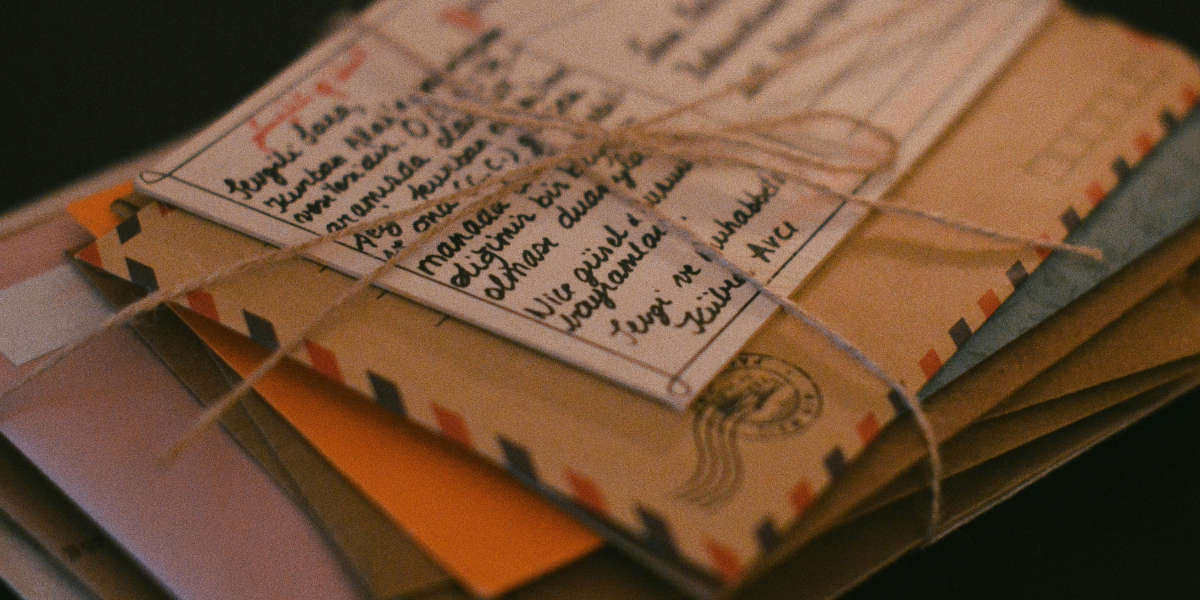
Letters, now, have nostalgic glamour. Like hats and horses, they have become something apart from the everyday; most of the writers I engaged with were born roughly between 1904 and 1917. Letters are paper objects: fragile yet tangible, their presence felt in thickness or thinness, neatness or lumpiness, as if folded paper had been stuffed into an overpacked envelope. They took time to arrive, so curiosity—or worry—could bloom. Days or weeks might pass, but then the dog would bark, the mail carrier would trudge onto the porch, and the mailbox would rattle. Letters from a close friend looked distinct from letters from others, from greeting cards, or from business correspondence. They carried a signature handwriting unique to that friend. Jane Kenyon always sealed envelopes with cat stickers or other playful marks, a knowing touch that made me feel I was in on her joke. I would drop everything to read them. They then lay around my kitchen, gathering dust and smudges. Or the telephone would ring, and I’d scrawl a thought on the nearest scrap of paper, perhaps even on one of Jane’s envelopes. They might almost be discarded, but I would rescue them: bring them to a desk, sort them into piles, answer them, and tuck them away in a shoebox.
Mecca Jamilah Sullivan, in introducing Lorde and Parker’s letters, argues that “reading writers’ letters is the best form of eavesdropping. It delivers the rush and sweetness of hidden listening….” In her view, the cloak of privacy somehow makes listening even richer. “Eavesdropping” is a handy word for something that’s morally gray but not catastrophic; I was relieved when Joan Reardon used the same term to describe Child and DeVoto’s correspondence. Yet she adds, “A letter truly belongs to the sender and the recipient, and to intrude upon their privacy—by listening over their shoulders—feels like trespassing on a private exchange.”
As someone who decided that my late friend’s letters and mine would be read by strangers, I was unsettled by that claim, and unconvinced by the next idea: “But when a collection of letters reveals a fantastic story—showing professional growth, insatiable curiosity, and culinary awakening—it’s important, yes, even essential, to peel back those envelopes again and examine what the correspondence discloses.” Reading published letters is gratifying, but is it truly “essential”? Certainly, if a life-saving secret exists only in a private note exchanged between scientists, publishing it would be indispensable. But in the story of two people managing everyday life, relationships, and work? Perhaps it isn’t necessarily right.
On occasions, Ralph Ellison mentions that he’ll fill Murray in on a personal matter when they’re together, as if he had just noticed me peering in. Indeed, publishing letters can cause harm. Carol Brightman, in an Editor’s Foreword, recalls McCarthy’s warning that “we can’t go into print saying that so-and-so is a drunk!” Yet, within their collaboration, McCarthy revealed only one discussion. After her death, Brightman followed her lead, and the letters address drinking and many other topics with uncensored candor.
To claim the problem lies solely in the potential harm of publication would be an oversimplification. It’s difficult to explain my unease when I come across a letter from Jane that was meant for me but is now accessible to anyone. All of her letters feel intimate, not just those containing delicate disclosures; there are moments when what I agreed to seems unquestionably questionable. And then I reconsider. I want people to read Jane’s letters.
Several times, Elizabeth Bishop mentions reading anthologies of letters. She even suggests the possibility of a college course focused on poets’ epistles. But when Lowell tells her he plans to sell his papers to Harvard, adding, “Your letters are the most valuable and large single group. I would like to have them pay you $5000,” Bishop writes back, “Oh! No, no, a thousand times no—or five thousand times no… I feel guilty enough about living with the possible intention of selling personal letters.” She has been reading reviews by W. H. Auden, who often rants about the moral wrong of printing private letters. (Yet she concedes that he seems to enjoy the gossip.) Henry James is even harsher on this issue. Yet when Harvard offered money to Bishop, she reluctantly accepted it to help finance a harbor-side apartment in Boston, from which she wrote to Lowell about ships passing by.
Would they have stopped if they’d known the letters would be printed? But I’m grateful to learn what I couldn’t know from my own experience.
After Bishop reads a draft of Lowell’s The Dolphin, she pens a famous letter to him about his use of letters in poems. Lowell had left his wife, Elizabeth Hardwick, for a liaison with Caroline Blackwood. In addressing the breakup, he incorporated and altered Hardwick’s letters. When Bishop notes that she was troubled by this blend of truth and fiction, I was surprised that among possible objections she chose that one. Perhaps changing the letters bothered her most because publication inevitably undermines the letter’s integrity—the message from writer to recipient. Lowell’s poems, in order to express his own truth, required that Hardwick’s words be altered.
Bishop writes, “IF you were given permission—IF you hadn’t changed them… etc. But art just isn’t worth that much.” Perhaps that is what Joan Reardon is driving at—or opposing—when she affirms the importance of the writers’ privacy while also insisting that a compelling narrative can justify some intrusion. Collections of letters between friends don’t rewrite the letters themselves, but they do select, abridge, and rearrange them according to the book’s needs, the reader’s expectations, or the publisher’s aims—not the needs of the friendship.
Letters are intimate. After Invisible Man won the National Book Award, Ellison’s travels took him to New Orleans, where he told Murray about missing a parade because he wouldn’t ride in the airport’s limousine or the white taxis, and “spent hours steaming.” DeVoto shares details with Child that you’d only reveal to a close friend, writing about a troubled son. After a visit from Arendt, McCarthy writes, “It was sad to watch you go through the gate at the airport without turning back. Something is happening or has happened to our friendship….”
Arendt, writing from New York to McCarthy in Paris, begins her reply as soon as she reads the letter, so unsettled that her usually precise English falters: “I just come home and find your letter, and it is too late to call.” She is perplexed. At the airport, she explains, she was simply sad and lonely. These letters are between people who love one another. What effect does our presence have on their friendships? Publication invites public scrutiny. Readers can judge Jane and me, deciding that one of us was unsympathetic or unaware. I often felt Bishop exploited Lowell; I frequently disagreed with Lowell. This is none of my business! I felt uneasy about eavesdropping when Pat Parker and Audre Lorde discussed being Black lesbians, since I’m neither Black nor a lesbian. Would they have stopped if they’d known the letters would be printed? But I’m grateful to learn what I couldn’t know from my own experience.
Readers benefit from published letters, not always for selfish reasons: what we learn can illuminate. Yet privacy is compromised, and letters may wound for reasons we cannot foresee. How much is art worth? Perhaps all art causes some harm: perhaps a painting we adore upsets the person who posed for it. Great novels delight everyone except the author’s somewhat unobtrusive relatives.
Yet that isn’t the sole dilemma. While chatting on the phone with a close friend I met after Jane’s death, I realized why I felt uneasy about our letters being published. I told my living friend that it felt as though a third person were listening in on our conversation. We weren’t sharing our own secrets or those of others. But inviting someone to listen would undermine the intimacy of the friendship itself. The publication of letters between friends intrudes on what those letters illuminate. As far as misdeeds go, there are worse things than this.
__________________________________
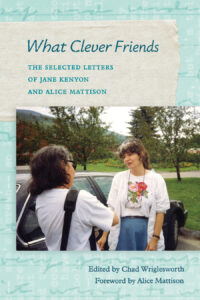
What Clever Friends: The Selected Letters of Jane Kenyon and Alice Mattison is available from the University of Michigan Press.