
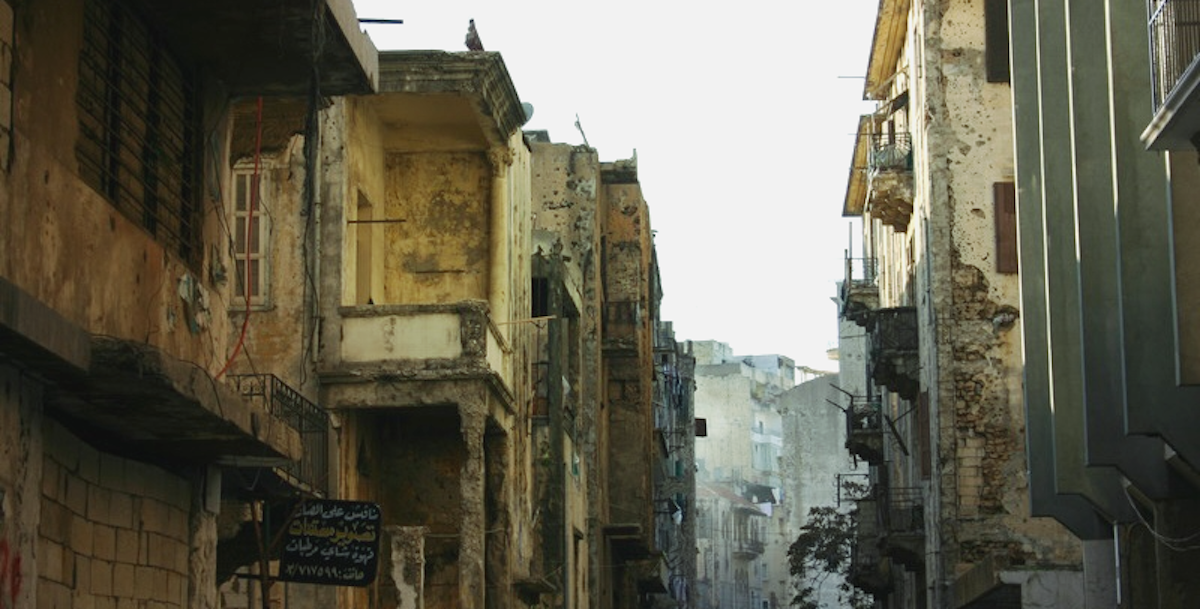
At the outset of Beirut Fragments: A War Memoir, the scene unfolds with a Beirut dinner party set against the early tremors of Lebanon’s protracted civil conflict. The distant rattle of shells punctures the gathering, puncturing the naive hope that the newly brokered truce would hold. The room falls silent as the night takes on a percussion of its own. “Someone ought to capture this madness,” one guest murmurs after a pause. “Someone ought to commit all of this to memory.” The noise of fighting grows louder; the party breaks up. Makdisi and her husband make their way home with their children, careful to wait out the danger together.
Who possesses the authority to tell the tale of a war—of wars that exist within other wars? Which voice is best situated to “record all of this”? Makdisi’s Beirut Fragments, first published in 1990 and reissued in 1999, answers these questions with both humility and audacity. The narrator is an Arab woman—stodgily ordinary in some ways, deeply involved in the rhythms of daily life, a mother, a teacher, and a person deemed a civilian who is nevertheless inseparable from the city’s fate. Through a blend of poetry, essay, and diary-like passages, the book crafts a sense of life amid fifteen years of violence that feels intimate yet sweeping. The central tension—choosing to stay in a city shadowed by danger rather than depart for safer shores—underpins the entire work. The result is a dual achievement: a record of civilian endurance during a period of siege and a portrait of a city perched on the brink of obliteration, a witness document that doubles as a quiet, nonviolent act of dissent.
Beirut Fragments is less a memoir of survival than a meditation on endurance, a distinction that suggests resilience does not simply imply a clean escape from catastrophe but rather a steady presence that survives even when the self seems fractured from the outside world.
Beirut Fragments begins with a stark, documentary chronology, tracing the war’s hot spark in a Beirut suburb in April 1975, through the major clashes, the first interventions by Syria, the various diplomatic conferences aimed at peace, the Israeli invasion of 1982 and the persistent resistance that followed, the pivotal assassinations, and the fragile ceasefire that would surface and fade anew. This timeline invites readers to feel the long, arduous road endured by those who chose to stay. Placing the chronology at the book’s entrance signals Makdisi’s intent to counter Western simplifications of the region and era: this is not an event that can be reduced to a single, neat narrative arc.
The narrative then slides from the early days of the war to a glossary of wartime Beirut phrases, pivots to Makdisi’s formative years, and returns again to her recollections of war and the people lost to it. The book’s structure undermines the sense of fragmentation suggested by its title; rather than feeling disjointed, the sections interlace to form a coherent portrait not only of the author but also of Beirut itself—its streets, its architecture, its evolving idioms through the war years—treating the city as a vivid secondary character that moves and shifts alongside its inhabitants.
In a 2023 talk at the American University of Beirut on the legacy of her brother, the eminent thinker Edward Said, Makdisi praised Said’s rare capacity to “talk back to empire.” She described him as someone who never appeared subservient to colonial power’s expectations. In her own way, Makdisi practices a similar form of resistance in Beirut Fragments. One of the most effective strategies of defiance is to tell the truth with unflinching specificity: to let personal experience rise above the noise that would flatten you into a stereotype. Makdisi’s attention to Beirut’s varied architecture, her fascination with the city’s evolving linguistic texture as the war drags on, and her focus on individual lives touched by the conflict—these choices give concreteness to what others prefer to keep abstract. Her decision to stay in the city—despite the ease with which she and many others could have left—emerges as a decisive act of self-determination as well as a rebuttal to imperial presumptions. “Choosing life over death, solidarity over division, and perseverance over despair,” she writes, “transforms the future into a possibility where war’s hostilities have no final say.”
*
In the opening of “Mirrors, or Contradictions: A Self-Portrait,” the most autobiographical chapter, Makdisi writes, “I was born in Jerusalem, raised in Cairo, matured in America, and found my way home to Beirut.” This line invites scrutiny for its apparent paradoxes—“I am the product of Christian and Muslim upbringing”—and for the ways it positions her as both a plausible and unlikely person to recount Lebanon’s wars.
Born into a Palestinian-Lebanese Protestant family in Jerusalem, Makdisi and her siblings attended local schools until their father’s business took the family to Cairo. The youngest of the first trio, she recounts a British-influenced education and memories of relatives fleeing Palestine after the 1948 war and the Nakba, when Arabs were uprooted from their homes and land. Among the family’s many tales of displacement, their particular stories leave a lasting imprint on her, not merely as a statistic but as singular lives affected by catastrophe:
Later, 1948 took on in my mind the stature of history itself—the archive of injustice, the politics of justice, fate on a global scale. In a corner of my memory, however, history remains the personal tragedy of people whose lives were shattered and scattered, their paths diverging in silence.
The Egyptian Revolution followed four years later, and the Suez Crisis arrived when she was finishing high school. Her memories mingle air-raid sirens and searchlights with lighter moments from adolescence—marching to morning assembly, playing school sports, and enjoying the theater’s lively entertainment, which she absorbed as part of a broader sense of cultural life in the region.
In the United States, where she enrolled in college, Makdisi found herself repelled by pervasive anti-Arab prejudice. “A biased image of the Arab world had taken hold in American imagination,” she notes, and she felt compelled to defend a culture often misrepresented. The second-wave feminist critique, which she encountered, also frustrated her by assuming a universal script for female emancipation. After finishing her studies, she spent a formative decade in Washington, DC, in the 1960s, a period abuzz with movements for equality and antiwar protests. She drew inspiration from those currents of progress, even as the 1967 Arab-Israeli War reminded her that Western allies and allies of justice were not always aligned with Arab calls for justice, either.
That posture of refusal—refusal to embrace a life in the United States while rejecting its prejudices and the prospect of a future there—helps readers understand the stakes of her long stay in Beirut. In 1972, Makdisi and her family moved to Beirut, her husband’s homeland, hoping to build a home, to settle in, and to feel rooted. Yet war erupted only three years later, sending thousands abroad while many remained. The strength of Makdisi’s approach in Beirut Fragments lies in her honesty about fear: she does not pretend to feel fearless at every juncture but acknowledges the moments when fear overtook her and wondered what might lie beyond exposure to so much violence. “As these events unfolded and as I wrote, a new aspect of my own self emerged,” she notes, “my skin shed its old layers.”
Beirut Fragments is thus less a tale of mere survival than a meditation on endurance, a form of survival that does not pretend to guarantee wholeness once catastrophe passes. It documents bearing the unbearable, thriving on quiet days when truce holds, schools reopen, and ordinary routines reappear. In the 1999 afterword accompanying the reissue, Makdisi explains that she sent the manuscript into the world before any lasting resolution had arrived; the narrative did not emerge from a calm distance but from a present still ablaze with memory.
A sustained defense of the ordinary Beirutis runs through the book, along with a scathing indictment of a world that distances itself from their suffering. “All my life has unfolded under the shadow of violence,” Makdisi remarks, “and my only defense remains outright rejection, a refusal to stand by while desolation is normalized.”
*
By the time Beirut Fragments appeared in 1990, Western discourse had grown accustomed to portraying Beirut as an anomaly, a place where fighting never ends, a single obstacle on the long road toward a broader dream of regional peace. This genre of commentary often failed to acknowledge the complicity of foreign powers in the region’s pain. Makdisi’s most biting critique comes in her portrayal of the 1982 Israeli invasion, when American and allied support enabled the technological edge of American-made weaponry. She uses precise description to deflate the distance often placed between Western observers and the violence on the ground:
There existed a strange, almost romantic bond between Beirutis and Israeli aircraft: a mix of revulsion and allure, alienation and belonging. There was admiration for the astonishing technology, the gleaming forms cutting through blue skies, the soldiers’ elegant command of force, even as the sound of destruction grew louder.
Several episodes from the chapter “Summer 1982: The Israeli Invasion” feel hauntingly contemporary: leaflets urging evacuation dropped just before strikes began, calls for temporary truces ignored by humanitarian actors, and a staggering toll of civilian casualties—the images of dying children, the wrecked shops and vehicles, neighborhoods reduced to rubble. Beirut Fragments remains a record of lived testimony, a chronicle of what it feels like to be inside a cafe when gunfire erupts outside and to resume ordinary life once the smoke clears.
Beirut Fragments is a record of lived testimony. It is concerned with the sensation of being trapped inside a cafe during a sudden firefight and of returning to normal life in its aftermath.
As this introduction was written in the autumn of 2025, after nearly two years of Israel’s renewed bombardment of Gaza, the world has witnessed, through millions of screens, the intimate human cost of high-tech warfare. The connection between shattered bodies and cities—along with the complicity of governments in the devastation—has become impossible to ignore. Yet in 1982, public opinion was more opaque, obscured by physical distance, denial, and a comforting myth of neutrality.
When Beirut Fragments first appeared, some critics argued that its politics were conspicuously absent. But Makdisi’s aim was not to dodge political argument; it was to affirm the city itself as a political actor. While the memoir traverses the political logic of a sequence of wars that displaced thousands, the emphasis remains on the visceral experience of living through those times, and on bearing witness to the lives of ordinary people caught in the crossfire.
Beirut Fragments is a document of lived experience. It contemplates what it feels like to be constrained inside a cafe as gunfire rages just outside and to re-enter ordinary life afterward. It recalls the moment when an electrician, whose family later becomes a casualty in a massacre, is consulted repeatedly over the years; such details articulate the texture of a city under siege. Makdisi observes that war comprises a dense cluster of contradictory experiences, and the title hints at the way violence fragments both memory and community.
Like much Western media coverage at the time of its publication—and even more so today after decades of upheaval—the book points to a broader political wind while insisting that there is more to the human story than political slogans. The refrain that “bad things happen in war” is met with a deeper insistence that good things persist too—the acts of ordinary kindness that sustain people in the face of despair. The Beirutis Makdisi describes extend a hand across sectarian lines, share food in a shelter, and offer a small space for hope to take root. A man ferries people across a no-man’s-land; a diligent office administrator stubbornly tries to brighten a cramped workspace; people in a shelter from religious and national backgrounds comfort one another with blankets and candles. In such moments, humanity remains palpable, even in the midst of fear and loss. The message is not naïve optimism but a stubborn, stubborn belief in the possibility of renewal.
“It is not easy to mend the wounds of a people,” Makdisi observes, “and some still sleep in their clothes, refusing to leave or to retreat indoors. Others tremble at every sound, while still others move forward, imperfectly but with resolve.” The narrative’s cadence asks readers to witness the slow, imperfect process of healing, one incremental step after another, as life compels people to endure and continue.
____________________________
From Beirut Fragments: A War Memoir by Jean Said Makdisi. Introduction copyright © 2025 by Angela Flournoy. Available from Outsider Editions, an imprint of Knopf Doubleday Publishing Group, a division of Penguin Random House, LLC.