If you’ve wandered through a bookstore with a writer beside you, you might notice something odd: authors don’t judge new releases the same way most readers do. The typical reader, when they pick up a book, will first study the cover, then skim the synopsis, and finally steal a glance at the author photo, sizing up the hair, skin, and posture of a species that mostly prefers to stay in the background. In short, they rarely crack the spine before buying. A writer, however, who has long since learned to spot the Draperian tricks hidden in jacket copy, tends to open the book to the very first page, sample a paragraph or two of prose, and only if the voice passes the taste test will they bother discovering what the whole thing is actually about.
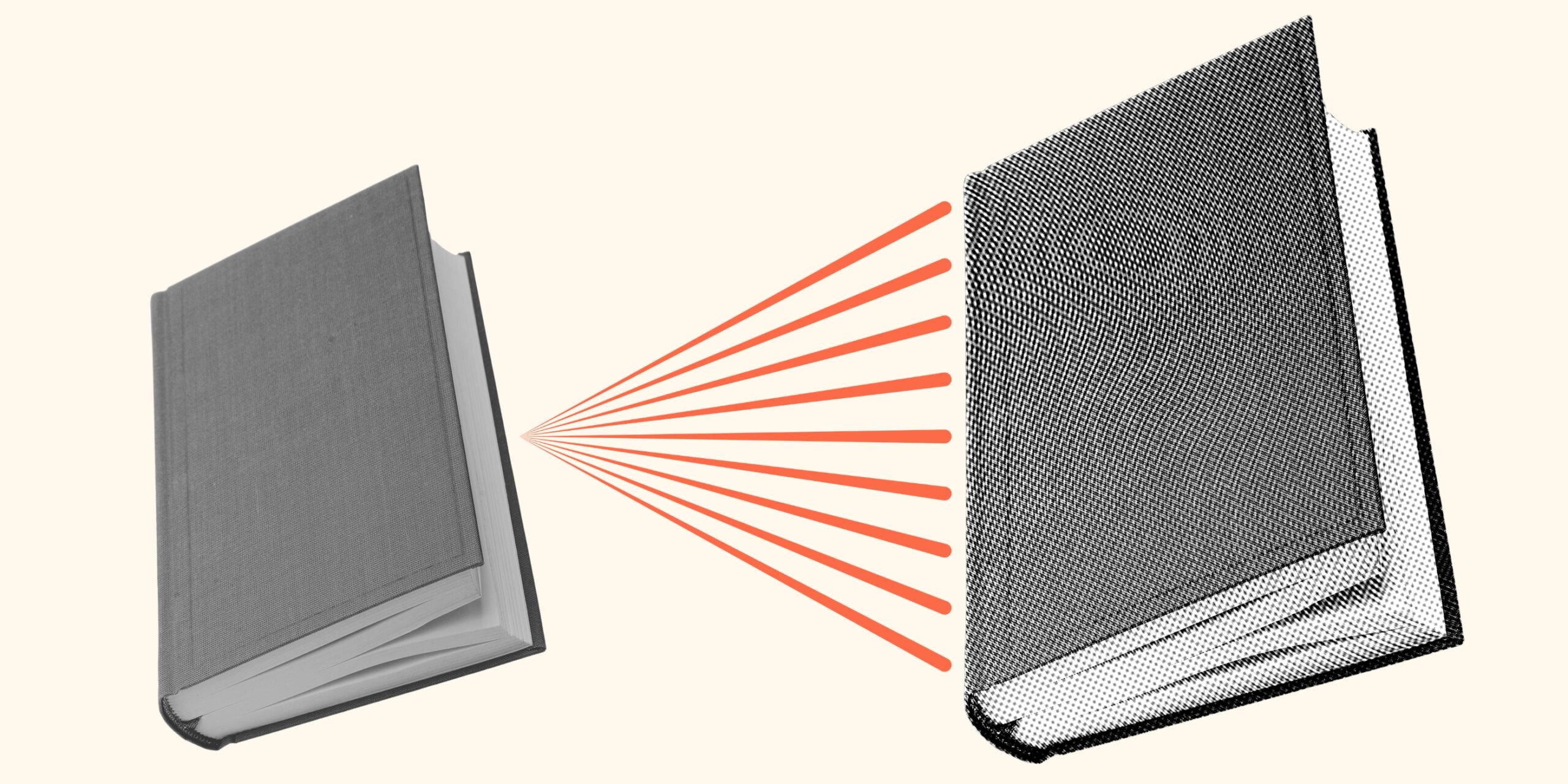
Authors recognize that every book is, in truth, two objects in one. There is the manuscript itself—the exact words pressed onto the page—and then there is what I call its hologram—the bright, shimmering version of the work that the author must pitch to the publisher, and which the publisher then pitches to the world. The act of converting a layered, nuanced piece of art into a concise, marketable caricature is, for writers, tormenting. Yet we are compelled to do it, because no one can read a complete book before buying it.
Put differently, people don’t purchase books. They purchase holograms, and they hope the book behind the hologram will live up to it.
Throughout history, some of the most celebrated books struggled to find broad readership at first precisely because their holograms misrepresented them: the real work shone, but the title, synopsis, or cover failed to spark interest. Robin Wall Kimmerer’s Braiding Sweetgrass, for instance, spent six years climbing onto the Times bestseller list, where it has held a steady if unconventional perch. Some of my own favorites—Marilynne Robinson’s Housekeeping, Norman Rush’s Mating, Toni Morrison’s Beloved—are novels I postponed reading for years because the label sounded stodgy, even though the actual writing was anything but. Eventually, truly remarkable books tend to outgrow their dull holograms and win over a broad audience, but the process requires time, effort, and a bit of luck.
Sometimes the relationship runs in the opposite direction: the work itself may be mediocre, yet the hologram shines brilliantly. I recently encountered Infinite Jeffs, a reductio ad absurdum example: a novel that replaces every word in Infinite Jest with the word “Jeff.” The result, at 776 pages, is not a book anyone would read straight through, but as a holographic stunt, it’s fiendishly clever.
Readers are increasingly blurring the boundary between hologram and book, between map and territory.
Publishers are not shy about admitting that the industry is in trouble. One strand of modern fiction—what many call “serious nonfiction” or, less flatteringly, “dad books”—appears to be faring especially poorly as readers retreat from historical snarls toward more comforting, cozy fantasies. “The trend is unmistakable,” one publisher told the Wall Street Journal. “This is a sea change, and people should wake up to the fact that we’re living in a new world.”
The easy explanation is that people are simply overwhelmed by time, money, and attention. Add to that the broader media environment’s current “discoverability crisis.” Book-review sections are disappearing; NPR’s influence seems diminished; and social media followings do not reliably convert into sales.
Yet I suspect the root cause is both stranger and deeper. I fear readers are rapidly losing any clear sense of where the book ends and the hologram begins. The problem isn’t merely that the industry fails to assemble compelling holograms; it’s that the holograms have grown so effective that they train readers not to demand the actual reading experience. Rather than relying on traditional reviews—brief, crafted to balance description with revealing too much—the industry now feeds the public with long-form holograms in the form of podcast conversations that spend one or two hours chewing over a book’s contents, extracting every crumb. Some authors even go further, offering exhaustive lists of “key insights” designed for busy professionals who want the story in a checklist. I myself recently participated in a form of ritual self-consumption, a Book Bite that boiled a nine-year project down to a quick list, which I then shared as a nibble on Instagram.
The situation grows more insidious when holograms take the shape of AI. Amazon has rolled out a feature called “Ask This Book,” which allows readers to interrogate software about a text and then decide not to read it at all. Not long ago, the writer and podcaster Tyler Cowen released his new book, The Marginal Revolution, with a full online edition plus an “integrated AI assistant” that pre-digests the prose for you, in a fashion reminiscent of a mother bird feeding her chicks. As of this writing, the opening lines of that book still contain a typo, suggesting that those closest to the author may not have treated the text with care.
During a month-long book tour from Vancouver to Los Angeles, I reconnected with friends and colleagues I hadn’t seen in years. The conversations I had confirmed a common thread: a holographic crisis reaching far beyond the world of publishing. A friend, pressed for time, has started running PDFs through an AI program that converts them into podcasts, two conversational voices accompanying the text. A literary agent told me that her clients fear their proposals will be read first by AI before they ever meet human eyes, prompting them to tailor pitches to algorithms rather than readers. A Hollywood producer recounted an instance in which a studio executive pretended to have read a script, while in fact an AI tool had summarized it for him. The illustration was stark: the system had misinterpreted a subplot in the script as the film’s plot.
In the work Simulation and Simulacra, Jean Baudrillard warned about the hazards of living among simulacra. The book opens with a line borrowed from Ecclesiastes—an epigraph that presents the simulacrum as something that reveals rather than conceals truth: the very idea that a copy can stand in for reality, and that truth itself may be concealed by the appearance of truth. This is not a ministerial quotation from scripture; Baudrillard is playing with the texture of textual truth, inserting a simulacrum into a book about simulacra. Yet the point is sharp and unsettling: truth, in Baudrillard’s view, is something we must wrestle away from the glimmering surface.
Holograms aren’t the sole product of the digital era, nor are they simply a byproduct of industry: they have existed since antiquity whenever people tried to articulate the ineffable about the divine or the ultimate in concrete terms. There is a persistent temptation to stop worrying about falsity and authenticity, to accept the surface as sufficient. Baudrillard leaned into that temptation with a wry audacity, turning it into a form of art. I refuse to surrender to that temptation, and I hope you won’t either. If we allow the line between surface and substance to blur further, we risk stepping into darkness.
Most authors and editors I know see our current holographic upheaval as only a prologue to something even larger: an onrushing flood of texts generated entirely by AI, books that lack authors, endless layers of holograms stacked upon one another with no stable ground truth beneath them. The warning of Ecclesiastes—about the folly of multiplying words—rings anew: at first, such words may seem innocent, but in the end they spiral into things that are not merely meaningless but dangerously unfounded.