
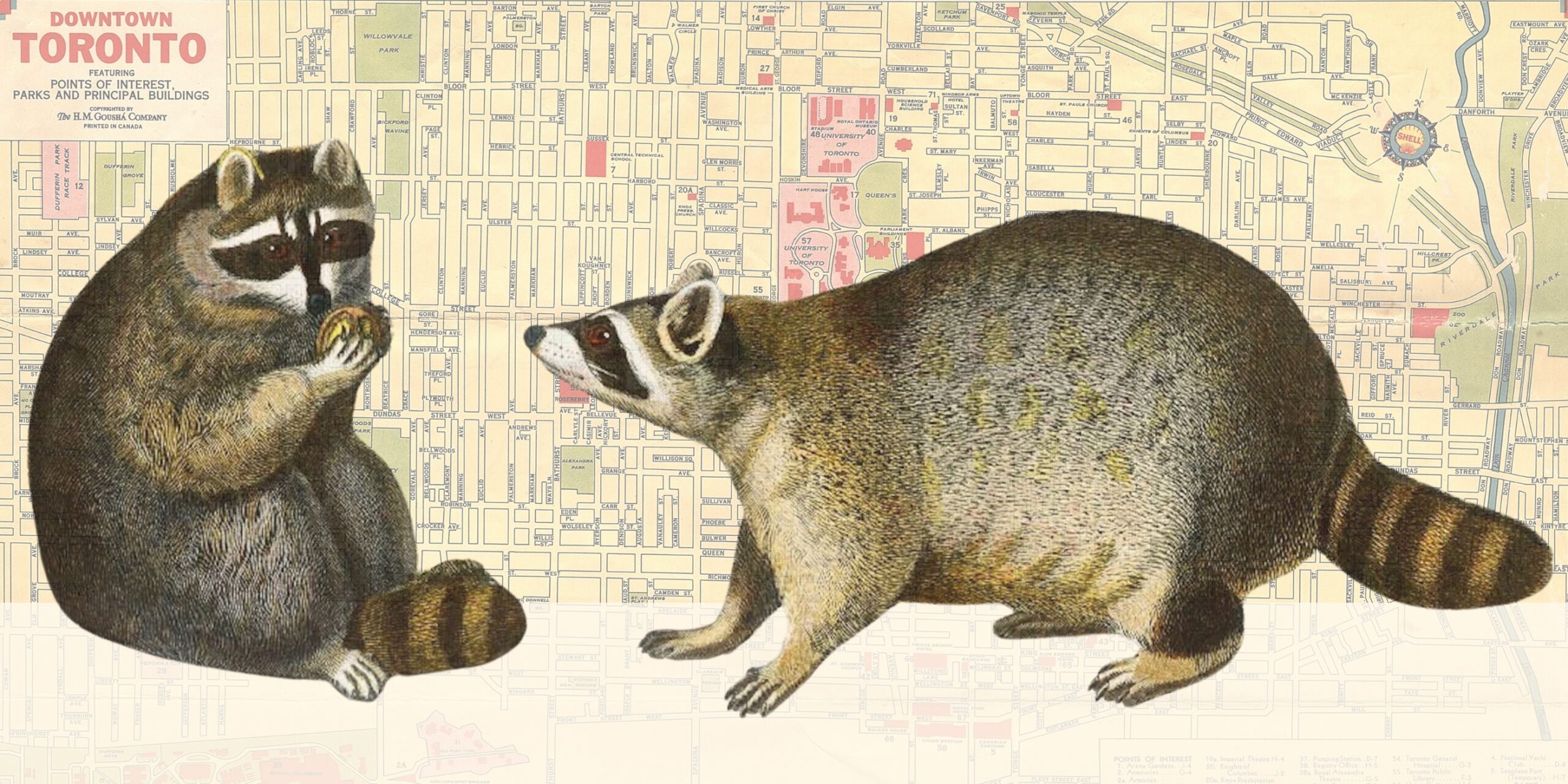
If you ask anyone in Toronto, they’ll tell you that raccoons, AKA the Procyon lotor (Latin for “before-dog washer,” given their apparent penchant for washing their food), are everywhere. The creatures have turned even the most gray urban spaces into wild landscapes, which have come to suit them far better than their original woodland home. There is no part of the city that they can’t master—or at least that’s what people here believe.
I want to test that theory by venturing to the most urban, concrete, and unforgiving spot I can think of to try to glimpse them. My choice falls on Union Station, the hub of the city’s rail and transit network and the gateway to its sprawling, gridlike downtown. If raccoon traces show up there, I figure it would serve as solid proof that these animals have learned to operate in even the least forgiving micro-habitats of this vast metropolis. So I ride the subway during the rush, just as a raccoon did a few days earlier (a feat praised for its composure), and surface into a sea of rushing bodies.
Union Station sits among slick, gum-polished sidewalks, encircled by streets where traffic snarls and exhaust clouds swirl around. All around, towering glass and steel cliffs loom, a canopy of skyscrapers reflecting sunlight into a maze that partitions the light itself.
If New York City has 8 million stories, Toronto has just as many—but they’re all about some crazy raccoon.
In the heart of this hyper-urban space, I wander Union Station’s broad corridors, taking measure of the human currents flowing through. At one moment, the light shifts into a warm, buttery glow, and I lift my gaze to the frosted skylights etched with an intricate web of semicircles and droplets that spread across the panes in a crude, organic motif. The pattern pulls me away from the stream of travelers and I press my back against a wall. At first glance the blobs and droplets appear randomly arranged, yet they seem to reveal a hidden order the longer you study them. It’s a surprisingly organic touch in a space otherwise dominated by straight lines and sterile materials. I’m drawn to it. I trace the rough etched lines across the opaque glass to the corner of one skylight pane, where five semicircular blobs and droplets stand apart from the rest. It’s then that a realization hits me.
This isn’t mere decoration. It’s a worn layer of grime built up over years, bearing paw prints from raccoons pressing with their metacarpal pads. The semicircular shapes come from their paws; five digits extend outward, compact like a dog’s yet spread wide like human fingers. I’m astonished. While thousands of people pass through this space daily, hundreds of raccoons are moving across and beneath this urban shell. Here, in a patch of concrete that seems designed to exclude wildlife, there is tangible proof that the animals are thriving—just out of reach yet clearly present.
I circle the station again and again, then slip through nearby buildings to glimpse the rooftop communities, but luck remains elusive. Later, I visit a friend’s third-floor apartment and learn I’ve just missed a dramatic standoff between their cat (Kenneth) and the resident raccoon that roams the fire escape—an encounter that apparently turned into a drawn-out stand-off. It feels as if raccoons only exist in the corner of my eye. When I try to focus, they vanish.
In the following weeks, these frustrating almost-catches mount across the city. Eventually, I realize I could use some expert help.
*
When I meet Rob Gordon at Cafe Paradise, a bright café a few blocks from where he lives, he looks a bit worn down by a long night. He spent the early hours—between midnight and two—at the back door of a neighbor’s flat, next to his landlord’s cat (Jason), watching a mother raccoon and her four kits attempt to breach a cat flap and reach the kitchen for scraps. Jason hissed, while Gordon, who maintains an unusual calm, tried to reason with the mother and push her back each time the flap swung open. “I spent one hundred and fifty dollars on Amazon last night,” he says, “trying to buy coyote urine as a deterrent.”
Gordon is cherubic, with a restrained demeanor, and speaks with a dry, analytical cadence, wearing black and dark blues as a signature, his long brown hair gathered into a ponytail that falls to the small of his back. He is a pest-control expert who has spent a decade in the trade. He’s also a quieter, influential force in Toronto’s music scene, touring for years as a drummer with the world-renowned violinist and composer Owen Pallett (who first rose to fame with Arcade Fire), and helping launch some of the city’s most storied venues that have often doubled as living spaces. “At one point,” Gordon recalls, “I lived on planes, never seeing sunlight, and worked until five a.m.” He has held about ten different jobs—barback, line cook, construction worker, server, and assorted shift roles—that he could switch between depending on his tour schedule. Then, when an ex-girlfriend’s roommate, who managed an arts space called Studio Gallery, offered a short, lucrative pest-control gig, he discovered a talent for the field. The idea grew into a full-fledged business, and he soon became a trusted lieutenant as the company expanded. Yet he wasn’t ready to treat pest control as a lifelong vocation. That changed after a botched injection left him with permanent paralysis in one arm—a career-ending blow for a drummer. With performance behind him, he reassessed what he loved—his wife and daughter—and chose to build something sustainable for them. “I’m allergic to money,” he quips. “So do I want to run a pest-control company? Not really. I don’t even care about pests,” he adds, “but I care about people.” He named his firm Out of Body Pest Control.
Asked about raccoons, Gordon sighs. “I’ll encounter ten dead raccoons on the way to a job,” he says, “almost every day.” It’s painful to witness. He respects the animals’ knack for solving problems, yet it’s their temperament that resonates with him most. “When I trap a squirrel,” he explains, “the energy is ferocious. They’ll slam their heads against the bars for hours, leaving their fur torn and their heads bloody. I drive around with them howling in the back of the van.” Raccoons, in contrast, strike him as different. “When I catch a raccoon,” he notes, “ninety-five percent of the time it looks like a teenager busted for smoking pot: suddenly aware of what they’ve done and prepared to face the consequences.” He chuckles softly. “They won’t high-five you on the way out, but they’re shy and strangely serene.”
*
In one of the planet’s most diverse cities, welcoming tens of thousands of newcomers each year, an encounter with a raccoon (or a group of them, since they rarely travel alone) signals that you have truly arrived. The raccoon belongs to the Procyonidae family and draws its name from Sirius, the “Dog Star,” the brightest in Canis Minor. They resemble a compact, armadillo-like creature with a mask of dark fur around their eyes, framed by a white halo, above thick whiskers and rounded, bear-like ears. Their long, ringed tail and strong forelimbs ending in highly capable paws give them a playful, almost Burglar-like air, and they’re equally hungry and cunning, capable of tipping the scales at up to thirty-five pounds.
Raccoons are genuinely ubiquitous in Toronto, a byproduct of urban expansion that has absorbed their ancestral ranges into human habitats at an astonishing pace. Estimates place the city’s raccoon population at no less than 100,000 and possibly as high as 640,000—roughly one raccoon for every four residents. This abundance explains why almost every Toronto resident has a raccoon tale. From monthly power outages caused by raccoons drawn to the warmth of electrical substations, which affect tens of thousands of homes, to the time someone swerved to avoid a raccoon strolling through a downtown crosswalk (with no injuries on either side), to the raccoon that calmly followed a customer into a McDonald’s and refused to leave until it was served a Chicken McNugget, the city buzzes with stories. If New York City has 8 million stories, Toronto has just as many—but they’re all about some crazy raccoon.
Raccoons aren’t just numerous in Toronto. This member of Carnivora, a group that includes bears, wolves, cats, seals, and other meat-eaters, has learned to reorganize itself to exploit every facet of urban life. In forests, their population density hovers around thirty-six individuals per square kilometer. In Toronto, estimates suggest around a hundred raccoons per square kilometer—ten times higher than in their natural territories. The result is a staggering crowd, a city designed in part as a sanctuary for this adaptable mesopredator. So how does a creature that evolved over hundreds of millions of years to flourish in swampy woodlands manage such outsized success amidst humanity’s most sprawling and relentless habitats?
Cities have revealed that raccoons have the power to reset their internal logic and learn the game all over again each time they enter a new urban microhabitat.
Their triumph stems from adopting human-made environments to their advantage. Like humans, raccoons approach unfamiliar spaces with a blend of caution and curiosity, a reflection of their innate ability to weigh multiple threats and opportunities at once. This kind of flexible thinking, coupled with shifts in their typical home ranges, gives city-dwelling raccoons a distinctive edge over the rest of the urban fauna, hinting that urban life may be reshaping how these animals think.
Cognitive flexibility is essentially how adaptable an animal’s problem-solving is when faced with new or unexpected conditions. Researchers evaluate this trait using what’s known as a reversal learning task. In a recent study by the National Wildlife Research Center of the United States, scientists trained raccoons, skunks, and coyotes in Colorado and Utah to seek a reward by tapping one of two illuminated buttons near a mock food dispenser. The setup began simply: press the left button, and a pellet falls from a hole. Of the species tested, raccoons swiftly discovered that the left button granted the prize, solving the task within one or two attempts. Skunks did somewhat better, needing around four tries, while coyotes—nervous and reluctant to experiment—lagged far behind. A single coyote, Orion, needed forty-four tries before selecting the left button.
The experiment didn’t end there. After weeks of training, researchers tweaked the scenario: tapping the left button no longer produced food and instead triggered a ten-second time-out. To again obtain a reward, the animals had to unlearn the previous rule and choose the right-hand button. This is where raccoons shone—their cognitive flexibility and problem-solving shone through.
Raccoons quickly recognized that their newly learned tactic no longer worked and pivoted, far faster than skunks or coyotes, to testing new strategies, including pressing the right-hand button. This phenomenon is called a “paradigm reversal”—an apt description for the confusion and recovery that raccoons (and sometimes humans) experience daily in urban landscapes. And while stumbling upon a literal food-dispenser button on their nightly wanderings may be as rare as a person stumbling upon free money, the capacity to seize such opportunities—even when they defy the safest bet—helps explain their near-total dominance in cities like Toronto.
The swampy forests that raccoons and their forebears evolved in for 28 million years could not be more unlike urban landscapes. From a single raccoon’s viewpoint, any given forest patch presents a familiar mix of trees, plants, fungi, ponds, and creatures arranged in countless permutations, with so many variations that mapping them all would be impossible. Yet viewed from a broader scale, the forest becomes a monolith. In a healthy woodland, each section resembles the others, and differences between patches—rocky outcrops, ponds, or grassy clearings—emerge gradually. Mud and tall grasses signal nearby water; a steep, pebbly slope hints at a nearby cliff. Features rarely appear without a reason.
Cities, by contrast, upend this logic. A singular urban area can be navigated by any individual, be they raccoon or person, by moving from one microzone to another: a parking lot, a street corner, a basement, a rooftop, or a high-rise. However, when you scale up, cities—unlike a uniform green forest canopy—disassemble into a chaotic mosaic of microenvironments that bear little relation to one another. There is no inherent link between the exterior face of a Walmart and the enclosed electronics counter, the McCafé, the fruit displays, or the passport photo booth inside, all lit by harsh fluorescent glare three stories above.
That towering cliff has nothing to do with the surroundings: a concrete clearing with yellow lines, where metal vehicles circle in disarray and people navigate their way through, in and out of cars and buildings. If you push the map farther, you encounter another expanse of even more rectangular structures, where hard-edged porches, windows, and slanted roofs sprout as if by chance. Each fragment—the Walmart, the parking lot, the road, the residential block—exists side by side. From an ecological perspective, the relationship makes little sense.
Learning to forage and shelter in a Walmart doesn’t translate to thriving in the parking lot outside. Mastering one space does not prepare you for the raw speed and indifferent violence of the road beyond, where cars race like rolling boulders and rules of spatial reasoning strain to keep pace. The same goes for the homes that lie farther on, and the park beyond, and the skyscrapers, shops, bars, alleys, clinics, schools, and building sites that lie beyond, beyond, beyond. Mastery of one environment can temporarily postpone danger, but the ongoing cycle of learning and unlearning as one moves from space to space—this, more than anything, is a radical adaptation. It is a rare synanthrope that can manage such a feat. Cities have revealed that raccoons can reset their internal logic and relearn the game anew whenever they enter a fresh urban microhabitat, turning a rather ordinary swamp-dweller into a formidable urban thinker. And the oddest part of all? We don’t yet know how far their minds might go.
____________________________
Excerpted from Our Wild Familiars: How Animals Are Adapting to Cities and Reshaping the Natural World by Dan Werb. Copyright © 2026 by Dan Werb. Published in the United States by Crown, an imprint of the Crown Publishing Group, a division of Penguin Random House LLC.