
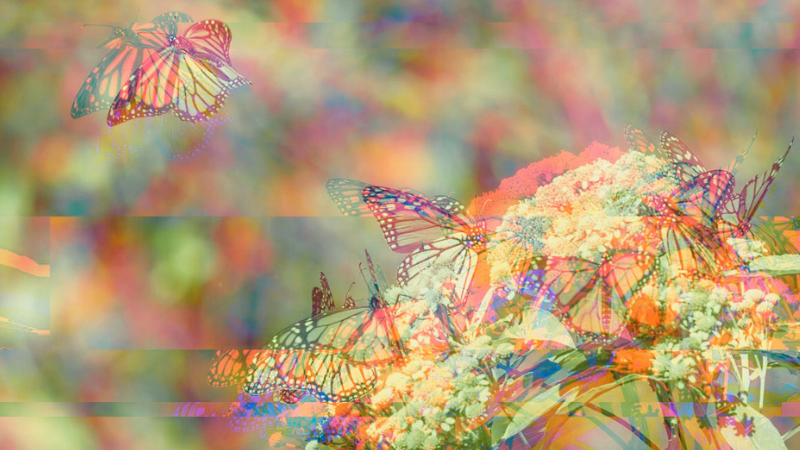
Growing up, Mia Monroe remembers monarch butterflies as a natural cadence of everyday life. This was the 1960s, and her family lived in San Carlos, California, a quiet suburb of redwood bungalows and postwar cottages south of San Francisco. She was a true “nature kid,” and from an early age the monarchs helped shape the fabric of her feelings and experiences.
She would gather milkweed that clustered along the tracks near the town’s rail yard, haul the plants home, and rear caterpillars in batches. Autumn signs were the migrating monarchs heading toward their rainy-season havens on the coast. Winter arrived with trips to the renowned butterfly-clustering site at the Monarch Grove Sanctuary in Pacific Grove.
Pacific Grove—a charming seaside village skirting the southern edge of Monterey Bay—had long attracted visitors who came to see the monarchs. A 1914 study, The Butterfly Trees, celebrated how the monarchs each winter “hung in masses from the branches, thousands upon thousands… absolutely countless.” There, among pines and eucalyptus, Mia and her grandmother would scan the canopy for patterns of folded wings. Whole limbs wore orange-and-black beads, like festive decorations, and the clusters dangled downward in a shower of life.
Sometimes, as the air warmed, a flock would lift into the sky together in a blazing orange burst. “It was extraordinary,” Mia recalled. “So I grew up with monarchs. I grew up with tying them to the signals of the changing seasons, and to the wonders of the world, and to moments spent with special people.”
She carried that childhood zeal into adulthood. As a teenager she began volunteering with groups like the Sierra Club and eventually spent most of her working life as a park ranger at Muir Woods National Monument, the ancient grove of redwoods just north of the Golden Gate Bridge. In the 1990s, the National Park Service heard from the World Wildlife Fund and the Xerces Society—dedicated to invertebrate conservation—about conducting a census of monarchs. Mia immediately offered to help. “I raised my hand because I already knew monarchs well and was paying close attention.”
Shifting baseline syndrome names something many of us have felt—the way the fog of forgetting shrouds our memory. We live in a present that is invisible because we are blinded by the glare of now.
Among other butterfly enthusiasts and professionals who were paying attention, unease began to spread. Monarch numbers in both the East and West seemed to be on the decline. But there was no agreement on how much, and scientists sought hard numbers.
Mia and a circle of friends and colleagues formed what would become the Western Monarch Count, a volunteer-driven, community science effort to tally the number of monarchs that overwinter along California’s coast. The project began in 1997 and confirmed the growing suspicion: butterfly numbers were shrinking. That year volunteers tallied more than 1.2 million monarchs at the overwintering sites—a peak that has not been matched since.
Over the past twenty‑five years, Mia has watched the monarchs’ numbers steadily slide, mirroring a broader disappearance of butterflies across the United States, where counts have fallen by roughly 20 percent. In 2000, volunteers logged about 400,000 monarchs. The following year, the total halved. For a stretch the counts hovered between 100,000 and 200,000. But in 2018 and again in 2019, fewer than 30,000 overwintered in California—less than one percent of their historical total. At the celebrated Pacific Grove sanctuary, the count dropped to 815 in 2018. The next year, the tally declined further. “People like me, who had grown up in this community science effort, noticed the steady drop,” Mia said. “Each year I remained worried because I wasn’t seeing them at the larger sites.”
Then winter arrived of 2020-21, a season dominated by the pandemic, and the monarchs did not appear. Across coastal California, counts fell to near-zero. No monarchs were sighted at the Pacific Grove sanctuary. None appeared at Monarch Lane in Los Osos, where several years earlier more than 4,000 had shown up. The youth hostel in the Marin Headlands hosted none at all. Across the state, only 1,914 monarchs were recorded that winter.
Mia faced a flood of volunteers seeking reassurance. Her decades of devotion and the contagious enthusiasm that had earned her “monarch czar” status in butterfly circles prompted many to seek her counsel about the collapse. She has a fondness for monarch-themed jewelry—brooches and earrings—and a voice that rises in pitch with excitement when she discusses the butterflies. Some people call her the monarch’s guardian.
That winter of fear, she did her best to lift others’ spirits. “I felt like I was a messenger sharing what people could do,” she recalled. “So-and-so planted milkweed. So-and-so is working on a neighborhood garden.” Even the smallest sightings became moments of triumph: “You start to value one or two. Each one becomes precious. If there are four of them, you celebrate those four. You want them to stand for hope for the future.”
Privately, though, she felt crushed. To cope and stay buoyant, she tended a native-plant garden and did Zoom presentations for local schoolchildren on naturalist topics. She revisited foundational environmental writings by Rachel Carson, John Muir, and Gary Snyder. Yet after years of sounding alarms, she found herself confronting a crisis of belief. “Is this the onset of the deep, dark days for this remarkable insect? Who could have imagined it would unfold like this?”
Monarchs had always been central to her life. What would the world be like without them?
Then, almost miraculously, a turn for the better occurred. In the winter of 2021-22, the western monarch community breathed a sigh of relief as butterflies returned to the pine and eucalyptus groves in significant numbers. The volunteer monitors tallied around a quarter of a million monarchs at the peak of overwintering. The following winter, 2022-23, proved even more encouraging: the Thanksgiving Count registered about 335,000 monarchs in California, the strongest showing in more than ten years.
Journalists who had recently reported doom began to write upbeat stories. “California’s Western Monarch Butterflies Are Making a Comeback,” announced the New York Times. “The Monarch Butterfly Beats Extinction in Triumphant California Comeback,” proclaimed Los Angeles Magazine. The San Francisco Chronicle declared, “Environmentalists Cheer as Monarch Butterfly Numbers Continue to Rebound in California.”
Even as Mia and other advocates found encouragement in the rising numbers, the public’s reaction unsettled them. The monarch population in the West remained far below its late-1990s peak, yet the media celebrated as if a full recovery had occurred. A decades-long history of decline had dulled people’s sense of what counts as abundant, and many seemed to have forgotten what constitutes a healthy ecosystem. The public hadn’t kept pace with the reality of change.
In conversations with volunteers and ordinary observers, Mia could sense people’s thin, ahistorical sense of what a healthy monarch population looked like.
“There are a few monarchs in your yard,” people would tell her. “But I’m afraid I must break some bad news,” she would respond. “It’s not like it used to be.”
And the replies would come back: “There are monarchs everywhere.” “Like, tens of thousands?” she would press.
“Oh, just a handful.”
“Okay. Do you remember when you used to see ten thousand?”
*
There is a term for this sort of collective amnesia that Mia witnessed—the way the present erases the past, how destruction becomes background noise, and how daily life gradually adjusts to a world that looks less vibrant. Scientists call it shifting baseline syndrome.
Here’s the essence. Each person carries a baseline expectation—usually formed during youth—about how the world should function and what it should look like. When circumstances shift, that baseline drifts. Yet we either forget how the world first appeared, or a new generation establishes a fresh baseline based on its own youthful experiences. Shifting baseline syndrome gives a name to a familiar phenomenon—the way memory fog obscures understanding. We live in a present that blinds us to what has been lost.
Shifting baseline syndrome sounds clinical, as if it belonged in a psychiatric manual. Yet it is a common affliction. You have felt environmental amnesia whenever you recall summers before heat waves became an annual catastrophe, or when you try to describe a place to a younger person and are met with confusion: “There used to be red-winged blackbirds at this pond.”
As soon as you recognize shifting baseline syndrome, you notice it everywhere—from the pace of technological change to social life before social media, to the evolution of fashion, cars, and music. You see it in the steady coarseing of American civic life, where outrage and aggression have become settled into the everyday.
The invisible present confounds every generation across eras. The passenger pigeon, the chestnut tree, and the million-strong bison once defined the American landscape, yet all are gone—and now that absence can feel normal. It’s hard to remember what farms looked like before suburbia swallowed the countryside. Baby boomers recall “paved paradise,” while their Gen Z descendants have only ever known a parking lot.
“It was always that way,” wrote John Steinbeck in East of Eden, about the cycle of dry and wet years eroding memory. “The dry years were forgotten during the wet years, and the wet years were forgotten during the dry.” The world changes, and we adapt with it. The old wisdom remains true: you can never step in the same river twice.
Yet the problem of shifting baseline syndrome is most acute when it comes to our twenty-first-century relationship with nature. We inhabit a planet undergoing transformations so vast that the current Earth is unlike anything humans have previously known. Alongside that truth lies another reality: even amid such changes, it is all too easy to forget what once existed and to grow comfortable with what is now. Change is constant, and that constancy makes it hard to detect.
Our capacity for adjustment is celebrated as a human strength. We adapt to new conditions, we acclimate to different climates, and we train our minds to predict what comes next, normalizing and muddling through as a instinctual survival tactic.
But adaptation can backfire. When conditions shift, a trait that once helped can become a hindrance. Our ability to adjust increasingly looks like what evolutionary biologists call a maladaptation. What if our habit of normalizing reality makes us accept superstorms and sparse winters as ordinary? “Man is a creature who can grow used to almost anything,” wrote the Russian novelist Fyodor Dostoyevsky, in The House of the Dead, a meditation on life in a Siberian prison camp—hardly a compliment to human nature, but a reminder of how easily we become conditioned to hardship.
Shifting baseline syndrome distorts our understanding of the world. It can leave individuals and societies unable to distinguish impoverishment from abundance, hiding the magnitude of loss behind the veneer of the present. The invisible present prevents a clear view of what has already vanished and what we still stand to lose.
Shifting baseline syndrome was originally seen as a vivid parable about the estrangement between people and wild nature—a warning cast as a hypothesis.
The salmon vanishings, the vanished sea stars’ constellations, the once- abundant fireflies now scarce and hidden by hot July skies and smoke-filled nights. Or perhaps it has always been this way. It is often difficult to recall.
*
The idea of shifting baseline syndrome originated in a compact, mid-1990s essay by fisheries scientist Daniel Pauly, who sought to describe a shared forgetfulness he perceived among fishermen. Pauly observed that each generation looks to the catch at the start of its career to define normal, failing to realize that the standard has already dropped from what earlier generations would have considered ordinary. He described this as “a gradual accommodation to the creeping disappearance of species.”
Though Pauly’s piece was a short one—written in a single afternoon to help a colleague fill a gap in an academic journal—it has had a surprisingly enduring influence. The concept has been cited in more than two thousand research articles, spanning topics from African bushmeat markets to Australian cultural preservation and the global erosion of ethnobotanical knowledge. Shifting baselines have been cited as a complicating factor in ecosystem management: should restoration aim to bring a landscape back to its form a century ago, or five centuries ago?
Researchers have explored how shifting baseline syndrome affects children’s commitment to environmental protection. If a child only knows a degraded environment, how can they comprehend that the pollution they currently endure was once considered abnormal? “Across generations, baselines slide downward for what counts as healthy nature,” writes Peter Kahn, an environmental psychologist who coined the term environmental generational amnesia roughly at the same time Pauly introduced shifting baseline syndrome.
Here is where the concern grows. Studies show that collective landscape amnesia can occur not only across generations but within a single lifetime. A study in England assessed how people perceive the decline of ordinary birds like the common cuckoo and the house sparrow and found that some individuals fail to recognize environmental loss because they never perceived environmental abundance in the first place. Even as bird numbers fell, younger participants failed to notice the losses. Researchers have a troubling label for this phenomenon: “knowledge extinction.”
Shifting baseline syndrome began as a vivid warning about human estrangement from wild nature, but it has moved from parable to a well-established question about our ability to safeguard the planet. This is not a mere hypothetical concern: the syndrome is real and consequential.
“Shifting baseline syndrome is no longer only a cautionary tale,” according to a group of researchers, “but a genuine obstacle for those using human perceptions of change to guide conservation policy.” As Kevin Gaston and Masashi Soga—two scholars who have studied the idea extensively—have argued, environmental amnesia is a universal phenomenon affecting people in wealthy and impoverished nations, across ages and cultures. They warn that shifting baselines pose “one of the fundamental obstacles to addressing today’s global environmental issues.”
Kahn cautions: “It’s not simply a matter of adjusting to diminished nature without noticing it, and then getting by. Rather, we adapt, we fail to notice, and unconsciously we do not thrive as individuals or as a species.” He has described this blindness as “one of the central psychological problems of our era,” and also one of the central ecological challenges of our time.
One of the most striking illustrations of shifting baseline syndrome comes from Loren McClenachan, who studied dockside photographs of recreational anglers in Key West, Florida, where fishermen long paused to pose with their catches. Examining photos from 1956 through 2007, she found that the average length of what people called a trophy fish shrank by more than half, the average weight fell by nearly 90 percent, and the fish kinds themselves changed—from mighty groupers, six-foot behemoths, to small, one-foot snapper by the early 2000s. Creatures that had once been tossed back as nuisances were now celebrated as trophies. The sea’s abundance had diminished dramatically, yet the anglers’ smiles did not reflect that decline—they appeared unchanged, as if they hadn’t noticed what was missing.
____________________________
Adapted from The Earth Said Remember Me: How to Revive Our Memories and Restore the Planet by Jason Dove Mark. Copyright © 2026 by Jason Dove Mark. Used with permission of the publisher, W. W. Norton & Company, Inc. All rights reserved.