
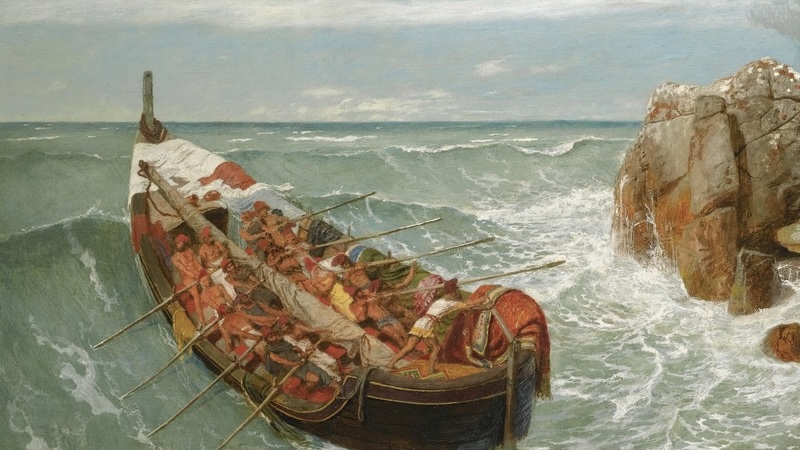
The first time I read the Odyssey, I was sixteen years old. The fantastical creatures, the alien cultures, and the wily hero’s desperate search for home were all thrilling to me. I felt an uncanny familiarity: with the characters, yes, but also with the way the story was told, and what it seemed to be about. Although I didn’t know it at the time, many of my favorite books were modeled on Homer’s tale. I’ve read the Odyssey many times since then, and I learn something new—about the world, about myself—every time. Now that I am nearly the age Odysseus was when he returned to Ithaca, I realize the gravitational pull of this story has been the idea of nostos, the ancient Greek concept of homecoming.
I’m not really from a place, like Odysseus is. He’s the son of a king who is the son of a king who is the son of a king and so on of a small and stubborn island in the Ionian Sea. He can claim one home, and yearn for it exclusively. I had lived in a dozen places by the time I was an adult. One thing I know is that you can find allegorical Lotus Eaters and Sirens and Phaeacians and Cyclops in all kinds of places.
As I traveled from place to place, I too was searching for clues about how to live, how to be a fully realized person, everywhere I went. I was searching for my own idea of home.
The first book I ever loved was the D’Aulaires Book of Greek Myths. These stories anchored themselves into my understanding of what a story is—beauty and danger pressing in on all sides, bad behavior and heroics, the drive to make meaning out of the unmitigated chaos of human existence. This all made sense to my young brain. I’d had a chaotic childhood up until then; we had lived in a commune, a van, a tent, an abandoned barracks, on a friend’s living room floor and in my grandparent’s basement. It seemed that there was outrageous beauty and a looming threat around every corner. I’d received this book as a gift when I was about four years old. My mother and I were living in a commune of artists—my father was a poet who was always coming and going from our lives—when their friend Michael presented me with the book. There, on the first page, a picture of Cronus shoving a baby into his mouth. In the drawing, there are five little-kid faces crowded together in his stomach. The facing page depicts a mother, fearful, sneaking away to protect her new child.
Not long after he gave me the book, Michael entered the bedroom where my mother and my father and I all slept. He slipped in with a machete in his hand. When he brought it down in one swinging arc, my father rolled out of the way, pulling us off the bed with him. Michael hacked the bed to pieces while we cowered in the corner. Then he ran out of the building. Everyone said he was having a bad trip. Once I learned to read, those illustrations took on more meaning, the stories started to take form, to become about something beyond my own experience, but the terror and the fascination of the pictures remained.
I’ve continued to read Greek Myths, in various forms, since then, but I first read Homer’s Odyssey in high school, using the Fitzgerald translation. I have a theory that most people will remain loyal to the first Odyssey translation they read. I will always compare other renderings to the Fitzgerald. My friend Sylvie is partial to the Lattimore—like me she first read it as a teenager and so even as new and wonderful translations make their way into the world (Emily Wilson’s, Daniel Mendelsohn’s), we remain most comfortable with our first love. At sixteen, much of the poem went over my head, but I was truly moved by the adolescent anger and confusion of Odysseus’ son, Telemachus. By then I hadn’t seen my biological father in more than a decade. Anytime we ran into someone who knew him, this is what they said: “I’m friends with your father, you know. He is a brilliant, misunderstood genius. He’s a mystic. He’s special. He should be famous. I met him on the astral plane last week.” When Telemachus runs into anyone who knew his father, this is what they say: “As to stratagems, no man would claim Odysseus’ gift for those. He had no rivals, your father, at the tricks of war…The son is rare who measures with his father, and one in a thousand is a better man.”
I re-read the Odyssey again in my twenties, the Fagles translation. This time around, I was fascinated by Odysseus’ adventures. I spent much of that time traveling abroad—Central and South America, Spain, Morocco, London. As Odysseus wanders from place to place, discovering the foreign customs and attitudes of each one, the story explores the concept of home, asking what kind of civilization is appropriate for an authentic human being. If the Iliad is a story about war, about seeking glory in death, about making death meaningful, the Odyssey, then, is a story about life, about survival, about making life meaningful. I wanted a meaningful life, too. As I traveled from place to place, I too was searching for clues about how to live, how to be a fully realized person, everywhere I went. I was searching for my own idea of home.
This for me, has become the true meaning of nostos, homecoming—it is a restoration of humanity, community and relationship after enduring hardship.
Once I became a wife and a mother, it was Penelope’s struggle that gripped me. That’s when I read Emily Wilson’s translation. Her extraordinary introduction alone is worth the price of the book: “The poem meditates on what women might be capable of, and the degree to which their potential can or should be suppressed.” Penelope’s story is asking the same questions I was at that time: What makes a good marriage? In ancient Greek the word is homophrosyne—a kind of like-mindedness. Penelope is Odysseus’ equal, in cunning, in stubbornness, in wiles. How do you navigate your partner’s pathos, deception, wrong-headedness? How do you navigate your own? And how do you parent a growing son (especially once he is taller than you)? Here is Wilson’s stark translation of Telemachus’ famous insolence: “It is for men to talk, especially me. I am the master. That startled her.” I saw Penelope’s doubt, and her conviction, and the trouble that tension caused for her.
Reading Daniel Mendelsohn’s elegant new translation this past year, firmly in my middle years, I am fascinated by what it takes to reintegrate with your people, to show up, to finally drop the lies and masks and tricks, and to be seen, truly, for who you are. Odysseus has to do that for his son, for his father, for his people, and in the end, for Penelope, or she will not accept him into her home. In Mendelsohn’s translation, Penelope’s reservations, and discernment are palpable: “But if indeed it is true that he’s Odysseus and has come home, then the two of us will be able to recognize each other with more confidence, for we have signs that we two know, kept secret from other people.” When he throws off the beggar’s disguise and enacts his revenge, it is barbaric. It is horrifying. I want to look away, every time. In the end, Penelope is the one with the power to recognize him, or not. This for me, has become the true meaning of nostos, homecoming—it is a restoration of humanity, community and relationship after enduring hardship.
My novel, The Shared Life of Egan and Lucian, is set on an island off the coast of Maine. It’s the story of identical twin brothers. One of them leaves, and one of them stays, as so often happens. In the end, there is a homecoming; in this case, one that feels too late. Writing about a family living their life on an island, I couldn’t help but think of the Odyssey: returning home after a long absence, fathers and sons, mothers and sons, long marriages, craftsmanship in art and sport, the way the natural world shapes a person’s experience. In my novel, I gave that obsession to the character of Ian, Egan and Lucian’s father. Every day Ian checks the tide gauge at the eastern end of his island home, measuring and charting the rising sea levels. He also spends time each day working at their kitchen table, slowly and painstakingly writing his own book about the Odyssey. He’s trying to make out how the two are related in his mind. Warming seas and suitors feasting in the hall. Furious storms then and furious storms now. The Odyssey is as relevant as ever it was. And I, for one, cannot wait for the next rendition of this story.
____________________________
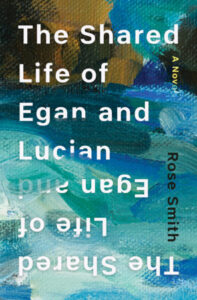
The Shared Life of Egan and Lucian by Rose Smith is available from Hawthorne Books.