
Dawn brushes the horizon with pink-tinted fingers, and I suddenly remember I forgot to roll the bin to the curb. I switch on the radio, and the news unfolds with reports of powerful individuals whose fragile egos drag the world toward disorder, alongside portraits of people who endure under conditions that seem almost unthinkable. These patterns feel threaded through two poems I encountered at eight years old, said to be the work of a blind man named Homer. I have carried those lines with me every day since. Homer sits already in my thoughts as I haul the bin out, and he will remain there when night returns, the reconciler of gods and mortals.
I teach literature at a university, so Homer cannot be escaped in my professional life: echoes of the Iliad and the Odyssey surface throughout the literature of the English-speaking world, and beyond. Yet I notice their trace beyond the pages we analyze in class. In a faculty meeting, two sensitive colleagues square off; I do not expect actual violence, but I conjure Achilles reaching for his sword after being provoked by Agamemnon. Protesters have pitched tents on the hill by my office window; I picture Hector and his troops camped on the plain, ready for the next day’s confrontation. My son calls to ask when I’ll be home and if there’s anything he can eat; I think of Telemachus, patiently waiting two decades for his father’s return.
It’s extraordinary to think that a single poet could provoke such different responses—but we’re not talking about a single poet.
It doesn’t end when I walk through my door. As I scrape burnt fish fingers from a grill pan, I picture the shipwrecked Odysseus clinging to ragged rocks, the skin on his arms and shoulders scraped raw. I uncork a bottle of wine and recall Helen handing out bitter nepenthe to her Sparta guests, “whoever drinks from this cup will shed no tears today.” And when the house falls quiet and sleep beckons, I imagine the many places Odysseus slept on his voyage: beneath leaves on a Phæacian shore, on the ground before he attacks the suitors, and, more softly and exhilaratingly, the beds of the witch Circe and the goddess Calypso. At last comes his own bed, hewn from a living olive tree, shared with his wife Penelope.
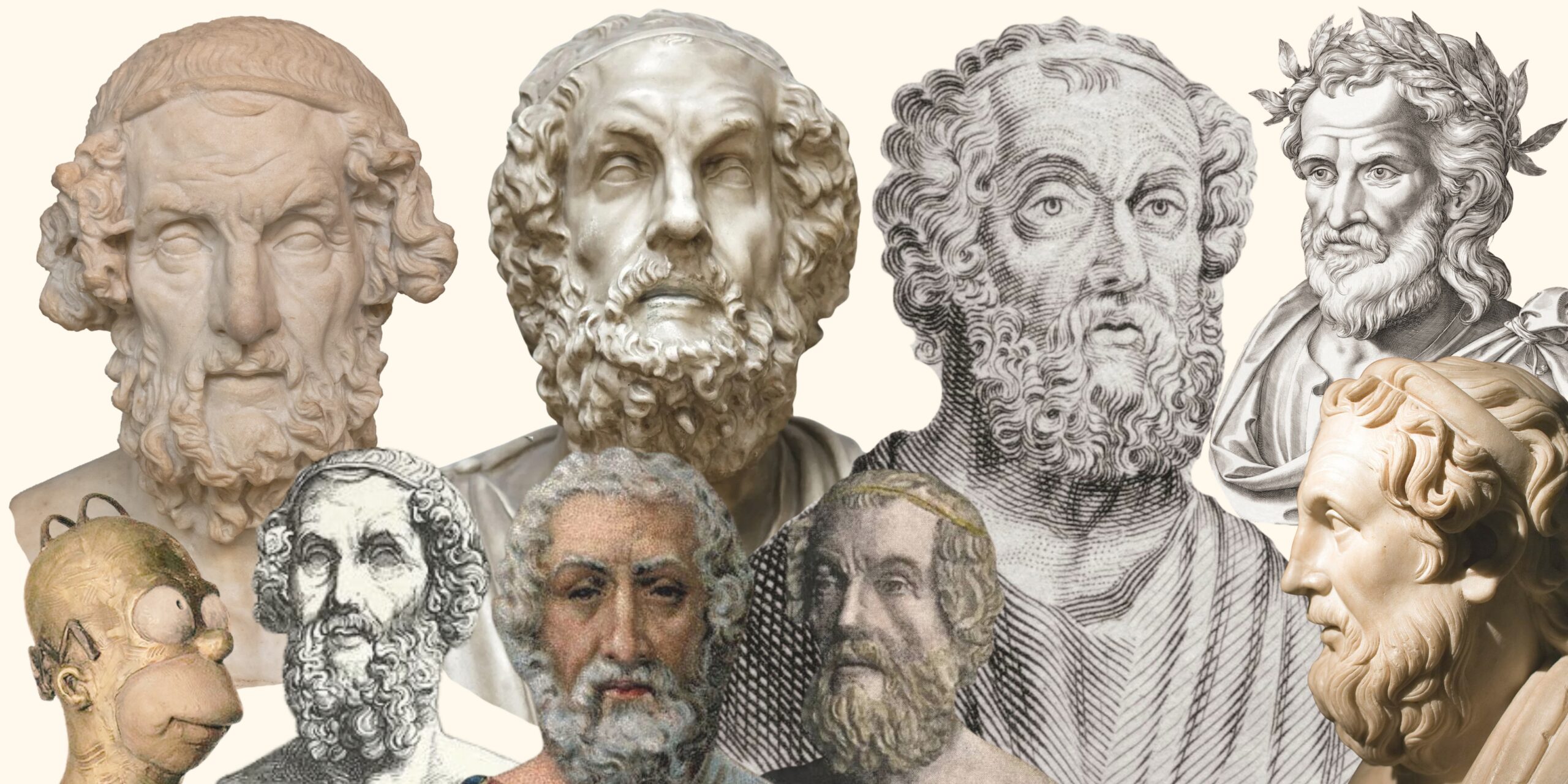
I don’t merely think about the goddesses, enchantresses, warriors and monsters who populate these poems. I also think about the person who originated the stories that have shaped our culture and haunt my imagination. And that is where things become complicated. Homer didn’t write them. He could neither read nor write in Greek, English, or any other language. On top of that, he did not exist. But perhaps that framing is too stark. Better to say that Homer is the name given to the traditional force that produced these poems. Or, if we prefer, instead of declaring “There was no such person as Homer,” we might say, “There were thousands of Homers.” These poems were not the work of a single man; they are folk songs that evolved over time—improvised, revised, and altered by generations of singers. Those singers drew on stories whispered to children at bedtime, or recited by soldiers on the march, by farm workers and fishermen, in kitchens and at looms.
It’s no exaggeration to claim that the Homeric poems contain thousands of voices—men and women whose names have vanished into history. At some moment in the seventh century BCE, those many voices were fixed in two written texts. That explains the poems’ staggering range and variety: strange and familiar, brutal and tender, harrowing and witty; attentive to grand geopolitical upheavals and to intimate domestic details; populated by characters we feel we know and by otherworldly gods and creatures.
This book concerns the Iliad and the Odyssey, and the voices that were miraculously preserved in their Homeric amber. More than that, it examines the poets who have heard these voices and brought them back to life. Because there is so much within the poems, Homer has been reimagined in countless ways. Homer functions as a poet of war, of enchantment, and of family life. He is a learned thinker, yet also a folk musician—an emblem of establishment, but also a figure who belongs at the cultural margins. It’s astonishing to think that a single poet could elicit such a wide range of responses—but we’re not dealing with a single author. The voices, lives, and experiences of an entire culture are concentrated within those two works, and thousands of additional voices have emerged from them.
*
European literature contains nothing older than the Iliad and the Odyssey. It’s remarkable that the oldest poems in our literary heritage are so expansive and intricate, and over the last 2,700-odd years many people—scholars, enthusiasts, poets, and even the occasional eccentric—have engaged with what is sometimes called the Homeric Question. How did a society just learning the alphabet craft works of such elegance? It’s hardly less strange than supposing the oldest European painting is Guernica, or the earliest European music is OK Computer. As one scholar has described reading Homer, it feels like opening the caves at Lascaux and discovering a Sistine Chapel ceiling inside.
The problem was brilliantly posed by the German classicist Friedrich August Wolf in 1795. Wolf likened Homer’s text to a colossal ship built far inland by someone with no sailing knowledge and no access to the sea. It seemed clear to Wolf that the Homer we hold in our hands is not the same as the one known to the Greeks in his day. His theory—that the poems were patched together much later from various ballads—was not universally accepted. Nevertheless, since Wolf, the question of Homer’s origins has persisted. Was he one man or many? Did he write or sing?
A major shift in our understanding of the poems came from the work of a young Californian scholar, Milman Parry. Parry was reading the Iliad on a Los Angeles beach in the summer of 1923 when a thought struck him. Could these poems have been improvised by singers drawing on a stock of formulae? At twenty-one, Parry sketched out his theory in a master’s thesis. He later completed a doctoral dissertation at the Sorbonne and soon secured a position at Harvard. Yet his ideas remained theoretical until a serendipitous meeting with a Serbian scholar in Paris led him to test the hypothesis in a living oral culture. Parry’s fieldwork in the early 1930s confirmed his hunch: the guslari he encountered in the Balkans—many of whom were illiterate—improvised freely as they sang, while drawing on inherited motifs, formulas, and themes.
The search for gifted singers led Parry to Bijelo Polje, in Montenegro, where he met Avdo Međedović, an illiterate farmer in his sixties who sang him the song of “Osmanbey Delibegović and Pavičević Luka”; at 13,331 lines, it was nearly as long as the Odyssey. Međedović did not sing from memory nor compose anew, and Parry argued that the Homeric songs likely arose from a similar oral tradition. The Iliad and the Odyssey were not the work of a single poet, nor of two different poets. They were the product of countless singers over generations, brought together by a particular performer on a single day.
Today most scholars agree that the Homeric poems were produced orally, that they preserve strains of earlier songs, and that we cannot analyze them with the same expectations we apply to later, literate poetics. But even with that consensus, there remains broad disagreement about how the poems came to be. For some, Parry’s brilliance has led to underestimating the artistry embedded in the works: the value, they argue, lies in continuing to imagine a single inspired poet arriving and transforming the material supplied by a folk tradition. Others contend that such a view seduces us with an anachronistic notion of sole authorship and the Romantic ideal of genius. Isn’t it equally plausible—and exciting—to picture the works as the product of a vibrant culture and its living tradition? As Giambattista Vico argued in the early eighteenth century, “The Greek people were themselves Homer.”
There is no need to choose a side. It would be perverse to dismiss the overall significance of the tradition, or to downplay the impact of a singular, brilliant singer. Balancing the two is a matter of taste, and perhaps a reflection of personality. When Wolf argued for a fragmentary Homer in 1795, the romantic poet Johann Wolfgang von Goethe was struck, yet could not shake his sense of a guiding, creative intelligence at work: “The Iliad and the Odyssey, even were they to have passed through the hands of a thousand poets and editors, reveal the tendency of poetic and critical minds toward unity.”
Homer is the first poet and the poet of poets. To write poetry is to be haunted by Homer.
The debate about where the Iliad and the Odyssey come from is nearly as old as the poems themselves. The uncertainty surrounding Homer’s nature and existence has proved incredibly generative for poets, who have been free to imagine him (or her, or them) in a multitude of ways. Time and again writers have been haunted by this great unknown predecessor. I do not mean this in a vague sense; I mean they have literally spoken with Homer’s phantom. The first major Roman poet, Ennius, recounts a dream in which Homer’s ghost appears and explains that souls migrate after death; this spectral presence would henceforth inhabit Ennius. Ennius’s poem was revisited in the fourteenth century by the Italian humanist Francesco Petrarch in his epic Africa. Petrarch pictures the specters of Homer and Ennius together, and Homer’s ghost points out a solitary figure, Francescus, laboring on a grand epic, Africa. There is a poignancy in the encounter, since Petrarch could not read Homer: he struggled with Greek, and there was no complete Latin text available. In 1360 he wrote a letter to Homer “in the realm of the dead,” lamenting the long wait for a translation: “Penelope did not await her Ulysses any longer or more anxiously than I have waited for you.”
Homer’s specter frequently appears at moments of national or cultural transition. Dionysios Solomos was among the Greek poets who turned to Homer in the early nineteenth century during the struggle for independence from the Ottoman empire, invoking the ancient poet to define the culture of the nascent modern nation. Solomos is now best known for penning the lines to Greece’s national anthem (which, at 632 lines, is the world’s longest). In a shorter poem, The Shade of Homer, he encounters the poet “resting on the shore;/over his old torn garments… slowly he rose,/ and as if still seen, drew near me.”
Sometimes Homer’s spirit is invoked by writers seeking answers about the origin of the Iliad and the Odyssey. Lucian of Samosata, writing in the second century AD, claims to have visited Homer in the underworld and asks why he began the Iliad with the wrath of Achilles. The ghost shrugs: “it was the first thing that popped into my head.” This is often how Homer’s specters behave: they do not pretend to grandeur. When Lemuel Gulliver travels, a necromancer offers him the chance to summon any dead spirit. Naturally, he calls up Homer, who appears pursued by a long caravan of commentators and scholars—whom he’s eager to shake off. Gulliver notes that Homer’s “eyes were the most quick and piercing I ever beheld.” Swift’s reversal of the tradition of Homer’s blindness in Gulliver’s Travels underscores not only the poet’s eye for detail, but also the possibility of a direct link between Homer and his audience.
Forget all the theories and commentaries, Homer seems to say. Forget the language barrier. Just meet me eye to eye, human being to human being. Homer frequently returns to defend the poets who have followed him, to assure them that they have understood him correctly. “Homer himself seems inclined to correspond with me, and to reveal a good portion of his designs,” wrote Alexander Pope as he undertook his Iliad translation. And if a poet feels uncertain about the path ahead, Homer can offer reassurance. Patrick Kavanagh’s tightly worded poem Epic (1960) tells of a boundary dispute between two Irish farmers in 1938; the poet begins to lose faith in his subject—why write about something so trivial as Europe sinks into war?
Till Homer’s ghost came whispering to my mind.
He said: I made the Iliad from such
A local row.
Other poets have appeared in ghostly form from time to time. Most famously, Virgil’s shade guides Dante through the circles of Hell. Yet it’s striking how often Homer’s ghost returns to his successors. That is partly because Homer stands as the first poet and the poet of poets. To write poetry is to be haunted by Homer.
____________________________
From Homer-Haunted: The Many Afterlives of an Ancient Poet by Henry Power. Copyright © 2026. Available from Bloomsbury Continuum, an imprint of Bloomsbury Publishing.