
Mark Haber’s Ada begins largely how it ends (no spoilers): Gerard Desacroux IV, the sly, newly minted ruler of a tiny domain somewhere in Central Europe (whether Saxony or Bavaria remains unnamed), paces the Great Room in perpetual agitation as he awaits an arrival that promises upheaval. Is the anticipated guest the peasants’ revolt he has provoked by spilling blood in pointless clashes against a neighboring lord? Could it be the Habsburg Inspector General, a spectral food inspector looming at the door? Or is Ada, the object of Desacroux’s desire and fixation after a feverish night five years earlier, the visitor who will redefine everything?
Although the narrative spans only a few hours, Desacroux’s restless circuit through the room—between laudatory asides to Ada and his father and blistering tirades at those in his service—sketches out the entire arc of his life. It is a Modernist impulse, certainly, yet Ada aligns more with the spirit of Tristram Shandy, Monty Python, and even Roberto Benigni in Jim Jarmusch’s Night on Earth. Servants receive shoves in the shins and hear about their ugliness; a patriarch’s foolhardy military choices are celebrated for their bravado; the mere sight of blood on a carpet becomes a matter of inconvenience rather than catastrophe. In short, Ada unfolds as a farcical, exuberant romp.
Desacroux first meets Ada on the streets of Paris, a city he inhabits under the guise of scholarly study but under which he instead indulges in drink, opium, and unrestrained visits to brothels. “I was lecherous, despicable, a libertine with a single-minded appetite,” he confesses, “until the moment Ada appeared—a radiant spark, a celestial light—and I glimpsed something boundless.” Yet Ada, in the years that followed, though she remains only a servant, seizes the Paisley fortune and weds the heir—an outcome Desacroux laments as “filthy paisley money.” A duel with the husband then becomes his chosen path, or else a lingering moment spent in the adjacent sword closet, consumed by his impulses.
Haber achieves what many of us chase: the near-impossible rendered almost effortless. In Ada, he devotes his pages to a character who is plainly odious and who harms those most vulnerable. The book has no conventional paragraph breaks—its energy is a stream of consciousness. The page layout is compact, yet sentences frequently spill to the next page, and semicolons are abundant. In less adept hands, this could collapse, but Ada remains a gleefully sharp and meticulously crafted delight. And while I won’t linger too long for fear of dispelling its spell, the novel’s charm lies in presenting a spoiled heir with excessive power as a laughable caricature—proof that the thing he is is, indeed, a joke. If you crave something concise, incisive, historically flavored, and riotously funny, this is your choice—and it could easily slip into a back pocket.
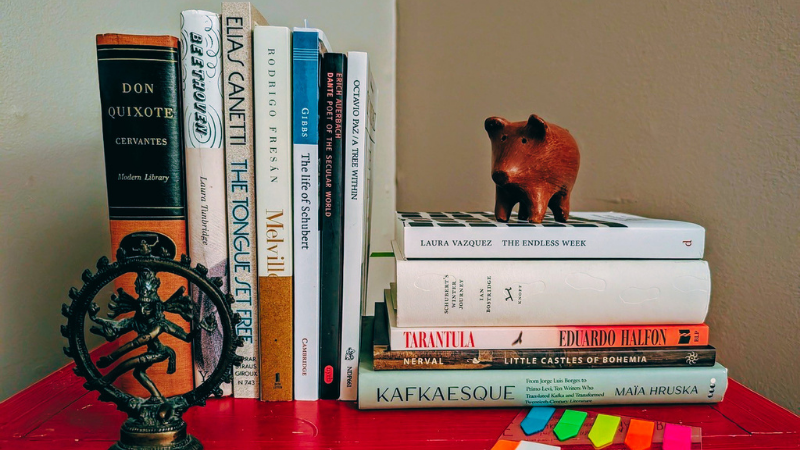
Haber also offers readers his marginalia about what he plans to read next, along with a few mementos. He writes: “I love reading in bed. For many of us, the nightstand serves as a kind of way station, a place where a book travels from the bookstore (or another room) toward my most cherished space. I naturally lean toward fiction, so the nightstand is stacked with novels and collections, though poetry and literary biographies also excite me. I enjoy hybrid genre works. Sometimes I simply want to read the introduction to a classic, such as Middlemarch or Dom Casmurro; I admit I’m a sucker for a strong introduction.”
Items on my nightstand:
During my days in bookselling, we were fortunate to host the remarkable Isabel Zapata. She brought a little Mexican piglet as a gift, and I’ve kept it nearby ever since, usually perched on my nightstand.
Back in my twenties I lived in Los Angeles, and this was a Vishnu statue I picked up at a small shop in West Los Angeles. I can’t recall the exact storefront.
*
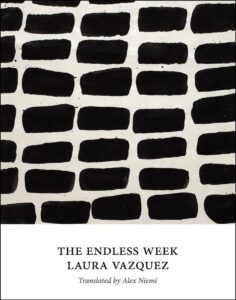
The Endless Week, Laura Vazquez (tr. Alex Niemi)
INCREDIBLE. I want to send a copy to everyone who loves fiction because their minds would be blown. It shouldn’t work, and yet it does. Why does it work?
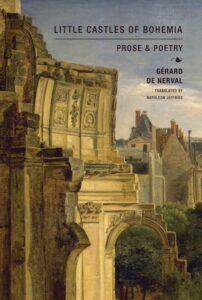
Little Castles of Bohemia, Gerard de Nerval (tr. Napoleon Jeffries)
Every independent bookstore worth its salt stocks Wakefield Press titles. Their publications are wonderfully offbeat and singular, often spotlighting obscure and experimental writers from the 18th and 19th centuries.
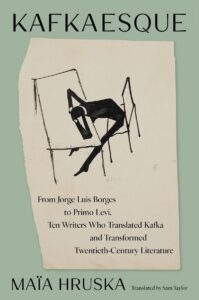
Kafkaesque, Maïa Hruska (tr. Sam Taylor)
An outstanding volume about Kafka’s earliest translators and how his works found their way to American readers during the Cold War. It is beautifully written and highly engaging. Kafka reminds us that literature isn’t a place for literal knowledge but a sanctuary filled with mystery and awe.

Tarantula, Eduardo Halfon (tr. Daniel Hahn)
I have read every one of Halfon’s books that have appeared in English. His novels frequently address questions of identity, memory, and the Jewish diaspora from Europe toward Latin America, especially Guatemala. Subtle, singular, and quietly powerful, his work traverses memoir, fiction, and historical narrative with ease.

Schubert’s Winter Journey: Anatomy of an Obsession, Ian Bostridge
This is a charming study of opera, music, Vienna in the nineteenth century, and the mindset behind genius. I’m reading it for pleasure as well as research. I’ve grown fascinated with harmony, melody, and imagination (in my mind, three ways of naming the same phenomenon). I’m crafting a novel about creative acts—the rapture and delight they generate, how they sometimes emerge from nowhere, and how they coexist with the everyday grind.