
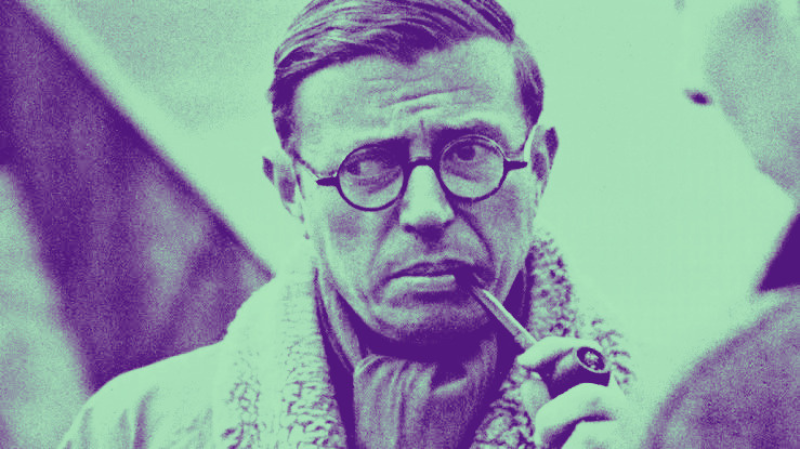
It’s hard to overstate the enthusiasm of French intellectuals for Marxist theory in the 1950s and ’60s. If Sartre was the most important living philosopher, Marx was the most important dead one. And the École Normale, an institution filled with young men “overeducated in the art of interpretation,” as Derrida put it, was a central incubator of Marxist zeal. Newspapers, literary journals, and bookstore shelves teemed with work by normaliens staking out their positions on Marx, Stalin, the working class, and the revolution—and attacking anyone who opposed them.
A lot of this work is almost unreadable now, the pained efforts of young eggheads twisting themselves into rhetorical knots over the moral conundrums posed by real-world applications of Marxist principles. It was impossible to deny that the Soviets’ attempt to turn their country into a workers’ paradise had fallen short. The French knew about some of Stalin’s excesses—the show trials, the labor camps, the bloody purges of those who strayed from the party line. But for hardcore believers, this didn’t mean that the philosophy undergirding the Soviet experiment was wrong. Certainly Soviet communism was preferable to the imperialistic capitalism of the United States. (The term antiaméricanisme first appeared in France in 1948 and quickly caught on, reaching a crescendo during the Vietnam War.) “Whatever the nature of today’s Soviet society, the Soviet Union is, by and large, and given the balance of power, on the side of those who are struggling against the forms of exploitation we are so familiar with,” declared Les Temps Modernes in an editorial in 1950. “The fact that Russian communism is decadent does not mean that the class struggle is a myth, that ‘free enterprise’ is either possible or desirable, or, more generally, that the Marxist critique is dated.”
The Marxism they embraced was one largely of their own making and, as pure theory uncontaminated by practice, it endured longer in France than elsewhere in the West.
Yet by the time Derrida arrived at the École Normale in the fall of 1952, several of Sartre’s closest friends had either renounced their commitment to communism or spoken out forcefully against it, and Sartre was publicly feuding with both Camus and Merleau-Ponty over the issue. These rifts were mirrored at the École, where students argued about politics and split into groups according to their leftist persuasions. Even so, a generally militant atmosphere prevailed, and few dared admit to harboring more conservative views. “Every morning, straight after breakfast, the members of the École’s ‘cell’ would gather in the ‘aquarium’ to read L’Humanité”—the Party newspaper—“and wave the best pages around,” Derrida’s biographer Benoît Peeters writes, adding that on the day in March 1953 that Stalin died, “the Communists—many of whom could not dry their tears—forced the École to observe a minute’s silence, while trying to find out to whom in the USSR they could address a telegram of condolence.” Put off by the militants, Derrida opted to join a noncommunist leftist group.
The historian Tony Judt refers to the “holistic strain in French styles of thought,” noting the attraction of French intellectuals to theories that emphasized “‘totality’ or the absolute” over partial or small-bore explanations, a tendency he traced to Descartes and his legacy of “distaste for intellectual doubt.” Marxism was a prime example. “Because Marxism offered a way of recovering ‘the illusion of total knowledge,’” Judt wrote, “modern French intellectuals were always likely to be susceptible to its appeal, appropriately packaged.”
The same could be said about the appeal of French theory decades later to intellectually insecure American students (like me). With its grand explanatory ambitions, theory swept away doubt, offering in its place the certitudes of an all-encompassing system. In the case of Judt’s Parisian thinkers, the Marxism they embraced was one largely of their own making and, as pure theory uncontaminated by practice, it endured longer in France than elsewhere in the West. “In France, the owl of Minerva does not spread its wings at dusk but at mid-morning the next day,” observed one historian, paraphrasing Hegel. “For all of France’s stylishness, intellectual and political news arrives late.”
The philosopher Raymond Aron, who had been Sartre’s classmate at the École Normale (placing first in the agrégation the year Sartre failed it) was so alarmed by the French left’s cultlike embrace of Marx and the Soviet Union—the latter as proof of the former’s prophetic vision—that he devoted a book to the subject. As a young professor at the University of Cologne in the 1930s, he had witnessed Germany’s transition to totalitarianism, and he was as appalled by the French intellectuals’ reverence for Stalin as he was by the Germans for Hitler. For the title of his 1955 bestseller, The Opium of the Intellectuals, he took inspiration from a damning critique by Simone Weil: “Marxism is undoubtedly a religion, in the lowest sense of the word. Like every inferior form of the religious life it has been continually used, to borrow the apt phrase of Marx himself, as the opiate for the people.”
Refusing to be cowed, Sartre responded to Aron with his own book on Marx, the nine-hundred-page Critique of Dialectical Reason, in 1960. By then, even Sartre had lost his enthusiasm for the USSR and had broken with the doctrinaire French communists. (In his view, the Soviets, in their violent suppression of the 1956 Hungarian Uprising, had finally crossed the line to indefensible.) His aim was to salvage Marxist theory from its corrupt application behind the Iron Curtain, and he opened the book with crusading words: “I consider Marxism to be the unsurpassable philosophy of our time.” Even so, he was unwilling to abandon existentialism, and so the book became an uneasy attempt at reconciliation: a hugely ambitious but often contorted endeavor to join the anxiously free human actor of existentialist thought with Marx’s determinist view of class-based conflict and of history itself. As Sartre poses the problem: “How are we to understand that Man makes history if at the same time it is history which makes Him?”
Even as Sartre’s intellectual star began to dim, and existentialism fell into disrepute, this focus on lived experience endured, though recast in ways Sartre might not have recognized or approved.
For Sartre, the great limitation of orthodox Marxism was that it had nothing to say about individuals. He cited Engels’s description of people as wholly formed by their class and its relations to production at a particular moment—people as products, not agents, of history. “Lacking Napoleon,” Engels insisted, “another man would have filled his place.” Not true! Sartre protested. By way of proof, he offered the case of Flaubert. (The book is peppered with allusions to Flaubert, a writer with whom Sartre was so obsessed that he went on to devote a four-thousand-page psychobiography to the novelist—at his death in 1980, he still had one volume to write.) The traditional Marxist framework may explain why Flaubert, the conflicted son of a successful provincial surgeon, wrote naturalistic novels mocking the grandiose aspirations of the rural bourgeoisie, Sartre conceded. But it failed to explain “why Flaubert preferred literature to everything else, nor why he lived like an anchorite, nor why he wrote these books rather than those of Duranty or the Goncourt brothers.” To answer such questions, Sartre argued, we needed to consider Flaubert’s childhood and the psychodynamics of his family life. Only then were we likely to learn why Flaubert negotiated the tensions of his social class in the precise way that he did and chose literature as his vocation—his “project,” to use Sartre’s term.
In this way, Critique of Dialectical Reason attempts an impossible balancing act, straining to acknowledge Marx’s mechanistic model—dialectical materialism—on making us who we are while insisting on the fine-grained particulars of lived experience, all commingling to motivate and constrain us in our pursuit of freedom, our chosen “projects.” The book meant a great deal to Sartre—he said it was the philosophical work for which he wanted to be remembered. He wrote it in haste, at the height of the Algerian War, propelled by irritation with Aron, animus toward the French Communist Party, and up to twenty pills of Corydrane, an amphetamine, per day. Unfortunately, the effects of this high-pressure, drugged performance show. At one point, Sartre left his voluminous manuscript— hundreds of handwritten pages—on a windowsill, where it was caught by the wind and scattered about the room. As Fredric Jameson, who wrote his dissertation on Sartre and became a leading Marxist cultural critic at Duke, tells the story, it took Sartre’s friends nearly a week to reassemble the pages in the proper order. The book is that challenging—turgid, repetitious, and laced with technical jargon.
This is a shame, and not only because the book’s style obscures its significance as the most high-profile effort by that date to marry what were then the two most important currents of French philosophy. It’s a shame because Sartre’s lasting contribution to the field, beyond existentialism itself, was stylistic. Moving fluidly among genres—from novels and plays to essays, and even a handful of screenplays—he showed that philosophy could be literary and literature philosophical. What his works shared was an attention to the everyday life of ordinary people, which he insisted should be at the center of philosophical endeavor. Even as Sartre’s intellectual star began to dim, and existentialism fell into disrepute, this focus on lived experience endured, though recast in ways Sartre might not have recognized or approved.
____________________________

From The Frenchmen: Or, My Life in Theory by Emily Eakin. Copyright © 2026. Available from Penguin Press, an imprint of Penguin Publishing Group, a division of Penguin Random House, LLC.