
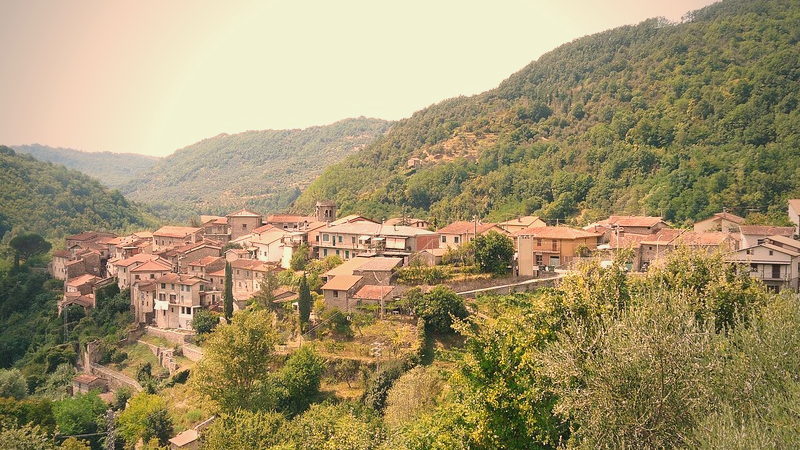
In certain borghi (small medieval villages) in Lunigiana several centuries ago, some impoverished mountain people, pushed by necessity, began climbing the arduous paths of the Apennines and then descending and dispersing across the northern plain to sell sacred images, almanacs, sharpening stones, trinkets, remnants of fabric, and household utensils. And they sold books as well, which they often didn’t know how to read.
When good weather arrived, after the folk songs of May, people met up on the Cisa Pass to agree on their selling zones. Then they went down the other side of the mountains to buy in bulk the merchandise they would carry for sale to every corner of the plain. This huge itinerant market could make deliveries to almost every door. Even today, certain towns in Lunigiana are remembered for their particular merchandise. Information about what to sell, and to whom, was passed down within a restricted group of fellow residents and a few others. By tradition, the barsan departed from Vespeno, Groppo, Darbia, and Pieve. They were called by that name because they spread as far as Brescia (or Barsa, as that city was called in the local dialect). The booksellers departed from Parana, Mulazzo, and Montereggio. They had in common poverty, the will to work, and a courage that came from having no alternatives.
The itinerants were all a bit peculiar, capable of making imprudent choices. For them, there were no borders that couldn’t be crossed.
The first itinerant sellers, either barsan or booksellers, would load their merchandise into wicker baskets they carried on their backs. Then they began using hand carts, then carts pulled by horses, then motorized carts when the roads became drivable. On farmsteads down in the bassa (lowlands) along the Po River, the peasants who felt tied to fieldwork like their oxen yoked to their plows were fascinated by these peculiar folk who came from over the mountains and seemed free to choose their own destinies. The itinerants had a way with words; they laughed; their women sometimes ordered the men around. But words and smiles were for selling. When they returned home, these male and female itinerants felt somewhat dislocated, and for the entire winter they wore the taciturn expressions of mountain folk of few words, dealing with sickness and hunger like everyone else.
Before moving to Lunigiana, I knew nothing of this tradition. When I discovered it, naturally the figure of the itinerant bookseller attracted my attention, for I too in my forties had begun selling books in my town right in the middle of the northern plain.
*
The story of one of these itinerant booksellers is remarkable. The son of poor residents of Parana, Emanuele Maucci began selling books just as his father and grandfather had done, along with so many other unemployed young people who had happened to be born in one of the borghi sprinkled in the foothills on the right-hand side of the Magra Valley. For generations, they had passed down this tradition. The booksellers were not the only itinerant sellers of Lunigiana, but they were the most admired. With the air of people who came from far away, they pretended to read the books they held open and told stories heard during their travels to awaken the imaginations of people living in the bassa, who seemed not to have any. Imagination then unlocked the spark of desire that allowed change itself to be imaginable and thus made it possible.
In the years of the French Revolution and during the Italian Risorgimento, the itinerants carried in their baskets—hidden below the books—various leaflets and manifestos of secret societies conspiring against the ancien régime. Already, their work was looked down on by traditionalists. They were foreigners, and their books ignited who knew what desires in poor people, who were best kept ignorant so they would work without thinking too much. If, in addition to tales of knights and fair ladies, the itinerant sellers carried around publications dealing with politics, then in the eyes of the police these sellers would become a vector for spreading the plague of the written word.
The booksellers did the work that publishers’ representatives and book reviewers do today. And because by this time they knew the market well, they opened the first bookstores in the north, just as other itinerant Lunigianese salespeople opened stores offering fabric, clothes, and shoes. People living in the bassa were right: The itinerants were all a bit peculiar, capable of making imprudent choices. For them, there were no borders that couldn’t be crossed. By nature anti-conformist, they aroused a kind of awe. Meanwhile, they sold books and spread culture.
*
One day, Emanuele Maucci decided to shift direction in his life. He had in mind the idea of selling books in South America. From acquaintances who’d already emigrated, he’d heard that lots of Italians were there. So he too went, with a basket of books.
Initially, things didn’t go well for him. He tried Buenos Aires, then decided to move to Mexico City. Perhaps he had been told that people read more there. Maucci must’ve been a tough type; he didn’t give up. Bit by bit, he began selling, and his sales region widened. He even founded a small publishing house, which survived and grew, to the extent that he decided to go back and print and sell books closer to home. Not in Lunigiana, where no one read; instead, he chose Barcelona in Spain, founding a publishing house there in 1892. Maucci now knew how to read and write, but only in Spanish. When he returned to Parana during summertime, he spoke only dialect, a mix of local Tuscan, Emilian, and Ligurian.
Who knows if Maucci ever nurtured certain sympathies for godless Jacobins (as French radical revolutionaries were then generally known), cursed from church pulpits as though they were devils? In any case, for him freedom wasn’t just an idea; it meant he could move from one place to another without permission from the police or having to pass through customs, and he could sell uncensored the books people wanted to buy. Flags didn’t matter, nor did political projects designed for some tomorrow that was always too far off. Whatever being free meant or didn’t mean, he’d learned by having to earn his daily bread.
Yet in his own way, Maucci loved books. Once he started reading, he realized he could sniff out a good one: All it took was a few pages for him to sense what the book was about and if and whom it would please. And then—having handled so many books, flipped through their pages, felt the quality of their paper and covers—he came up with a brilliant idea. Small books might be kept in jacket pockets and purses to be read at any moment during the day. Their shape and weight could be made attractive and manageable. They would cost less and be less intimidating.
The booksellers of Lunigiana found a fresh means of celebrating their tradition, which went against the attitude of “every man for himself” that the pitiless school of life had taught them.
The major innovation of pocket books became the big selling point of Casa Editorial Maucci, which saw its products sell at an inconceivable rate, spreading like wildfire. From Barcelona, the company opened an affiliate in Madrid, sending books to Buenos Aires and Mexico City where partners and relatives distributed and sold them. Attentive to technological progress, Maucci was among the first to intuit that linotype equipment would save time and money, so he purchased it. The culture industry was being born—full of possibilities, good and bad—and Emanuele Maucci hadn’t trained for it. Yet the mental horizons of Maucci and his associates were wider and more mobile than those of the big shots, small-time lawyers, and clerics who’d remained to vegetate in their old Lunigiana.
I don’t know what happened to Casa Editorial Maucci, which began failing during the Spanish Civil War. Today no one talks about it anymore. As far as I’m aware, the original itinerant booksellers from Parana, Montereggio, and Pontremoli who also opened major bookstores in various northern Italian cities didn’t open any in Lunigiana. Their instincts as illiterate ex-peasants counseled them against doing so. They carried in their baskets those printed books they themselves learned how to read while handling them, and they urged their poor customers to pick them up without fear. These included almanacs, popular versions of The Three Musketeers, serialized novels by Carolina Invernizio (full of sensationalism and melodrama), and other titles that rarely achieved literary fame. Emanuele Maucci would never have thought of launching an editorial venture publishing books that only the literate elite would read.
>*
The booksellers of Lunigiana found a fresh means of celebrating their tradition, which went against the attitude of “every man for himself” that the pitiless school of life had taught them.
Some of the sellers, by now living in northern cities and proud of their well-displayed books on nicely lit shelves inside their new stores, decided to make a monument to and for themselves, since no one else would think of doing so. In Pontremoli, from which for so many years they’d departed each spring, they sought to leave a memorial to their work as pioneers of the trade-book industry. They created a new kind of literary prize, the Bancarella (the “Bookstand” Prize), whose name itself established its difference from many other awards already in existence. The juries of this prize would be composed exclusively of booksellers, and the books to be awarded would be chosen from among the bestsellers. The awards would be based on simple, transparent criteria, which required publishers to be humble and reminded authors, publishers, and readers how much the destiny of a book depended on its being put right in front of readers’ eyes, away from the tabernacles of the elite.
The fresh wind of pragmatism animating the Bancarella Prize—a book fair that exposed and celebrated the consumerist dimension of the book as object—pushed the boundaries of the publishing industry beyond the niches of its traditional readership. The prize originated in a conception of the book that was developed by itinerant booksellers of Lunigiana who, climbing over the Cisa Pass with their baskets of books, made the written word travel as well.
____________________________
From The Patient Wait of the Stones: Time and Memory in Lunigiana by Antonio Romani, translated by Antonio Romani and Martha Cooley. Copyright © 2026. Available from Galpón Press.