
I was as hollow and empty as the spaces between stars.
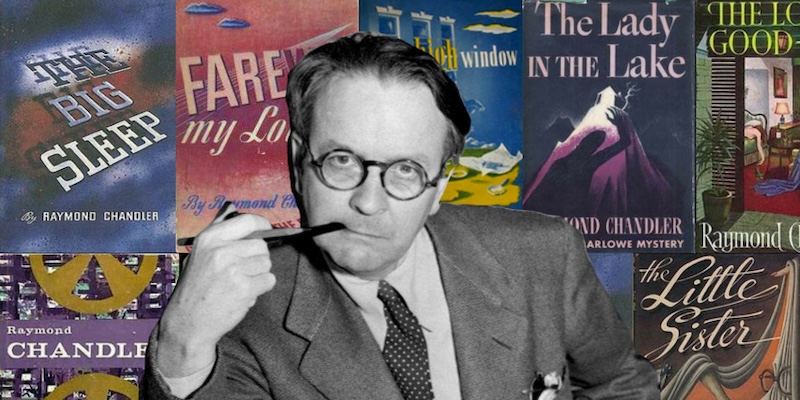
Today marks the 138th anniversary of Raymond Chandler’s birth, a figure revered as the patron saint of Los Angeles noir and perhaps the most celebrated writer in crime fiction. Across his nine novels, from The Big Sleep (1939) to Playback, published after his death (1953), the lens follows the hard-edged, whiskey-soaked private eye Philip Marlowe—Chandler’s iconic sleuth who gets tough treatment from screen legends such as Humphrey Bogart, Elliott Gould, and Robert Mitchum—and his navigation of the half-lit underside of Los Angeles. Our sister site CrimeReads hosts a wealth of fascinating Chandler coverage, and in tribute to this milestone we’ve chosen to present the inaugural critiques of each of Chandler’s novels, mirroring their approach for a fresh look at his early work.
*
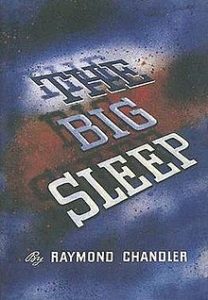
The Big Sleep (1939)
Dead men weigh more than broken hearts.
The crowd of characters in this tale tends toward the rough and the unsavory; many figures are cruel, and a few embody both traits. Philip Marlowe, the private investigator who both narrates and drives the plot, is resolutely hard—just enough to stand up to the greasy racketeers menacing the Sternwood family. The Sternwoods themselves, especially their daughters, repel any gentle overture. Marlowe earns a modest $25 a day plus expenses and saves every penny, remaining loyal to his employer even when lucrative shortcuts come calling. Throughout the narrative, he narrowly escapes becoming an eyewitness to two killings and narrowly escapes becoming a victim himself. The language can be abrasive—so much so that publishers resort to dashes in places—yet the book endures as a stark study in depravity, with Marlowe standing out as almost the sole beacon of decency in a corrupt world.”
–Isaac Anderson, The New York Times, February 12, 1939
*
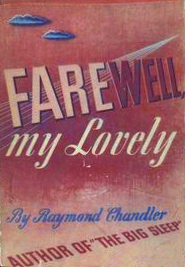
Farewell, My Lovely (1940)
It was a blonde. A blonde to make a bishop kick a hole in a stained-glass window.
This installment is characteristically tough, saturated with alcohol and a grim worldview that lingers longer than its moments of wit. Like many brisk thrillers, the plot often zips along with incidents arriving in rapid succession, and the connections between them aren’t always crystal clear. The central mystery isn’t the focal point; rather, what drives the passion is the sheer toughness with which the story is told. The when, where, and how of Velma’s fate may be obvious, and the identity of Lindsay Marriott’s killer may not warrant much suspense, but the real appeal lies in the brutal atmosphere Chandler conjures. The squalor of the investigation—Marlowe questioning the gin-drunk matron Jeanne Florian, the eerie presence of Mrs. Grayle, and the more dubious figures like Amthor the ‘psychic’ and Sonderberg the ‘dope doctor’—are all vividly etched. Yet the overarching thread is police corruption, portrayed with a grim skill that heightens the sense of dread.”
Jeanne Florian’s motives may be elusive, but Marlowe’s interrogation of that wine-soaked elder woman becomes a stark, sordid moment. The enigmatic Mrs. Grayle holds a genuine place in the narrative, while Amthor and Sonderberg function as marionettes of darker powers. The novel’s most persistent theme remains the murkiness of law enforcement, explored through a lens of noir unease and chilling precision.”
–Isaac Anderson, The New York Times, November 17, 1940
*
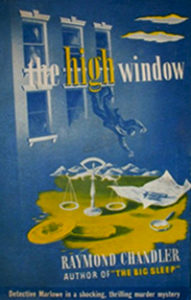
The High Window (1942)
She had eyes like strange sins.
There’s strong craft in the plotting of this outing, with Elizabeth Bright Murdock hiring Marlowe to locate a missing doubloon and a daughter-in-law who’s gone missing as well. Mrs. Murdock drinks port to ease her asthma—a formidable, self-reliant elder who keeps her own counsel and yields little to Marlowe. He nonetheless possesses the sleuth’s nose and the nerve required to pursue clues in Southern California’s less forgiving corners. There’s a poignant moment involving a secretary who comes and goes, and Marlowe’s feeling that he has crafted something nearly perfect, only to watch it slip away—the sense that he had “written a poem of value” only to forget it again. The book rises to a level beyond the ordinary, though the murders themselves are not rendered in any lyrical fashion—nor are the events from years before at the High Window.”
–The Montreal Gazette, September 26, 1942
*
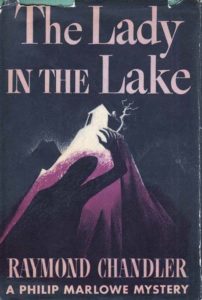
The Lady in the Lake (1943)
I’m all done with hating you. It’s all washed out of me.
I hate people hard, but I don’t hate them very long.
“Dynamic action that lands with a strong impact, paired with intense emotional drive, makes The Lady in the Lake a gripping thriller. Private investigator Marlowe unravels a case entwined with four particularly shocking murders. The narrative pushes forward with momentum, while the mystery itself remains deeply entwined with human motives.”
…
“Marlowe’s method of probing these unusual killings—closely tied to his personal connection to the cases—helps forge a thriller of the highest order.”
There are many vividly drawn figures along the way: the glamorous Kingsley’s secretary, a sheriff whose wisdom surpasses his appearance, a crude detective named DeGarmo who repeatedly complicates Marlowe’s path, a gossip-loving reporter, and a gallery of other robust characters. Chandler’s voice remains elusive to easy definition, a singular artistry that cannot be simply pegged as a derivative of Hammett or Cain. The prose glows with expressive beauty, witty exchanges, character development, and relentless pace, and The Lady in the Lake stands as a mature, thoroughly adult mystery that should keep you turning pages well past your bedtime.”
–Ray Gould, The Montgomery Advertiser, December 5, 1943
*
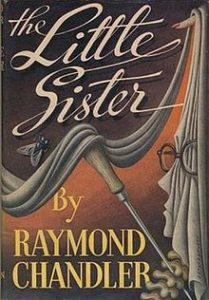
The Little Sister (1949)
She smelled the way the Taj Mahal looks by moonlight.
Movie-world glitz collides with criminal underworld in Chandler’s latest whodunit, The Little Sister. Marlowe remains a suave, hard-drinking lone wolf who throws off invitations and 38 revolvers with equal ease. As he tracks the younger sister’s elusive brother—the one who disappears in California—and wanders into the orbit of criminals and a glamorous star, a string of corpses, a spell in jail, and flirtations with a movie star and a quick-talking brunette follow in quick succession. If you’re a Marlowe aficionado, The Little Sister should satisfy your craving for a traditional mystery where justice eventually lands on the scale, and the living persist after the dust settles. Perhaps Perry Mason fans might feel a nostalgic pull here.”
–The Arizona Republic, October 2, 1949
*
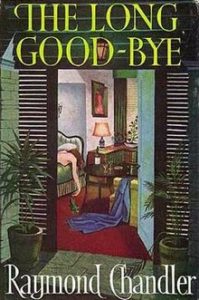
The Long Goodbye (1953)
The French have a phrase for it. The bastards have a phrase for everything and they are always right.
To say goodbye is to die a little.
Raymond Chandler, widely recognized as the premier creator of hard-boiled detective fiction after Dashiell Hammett, wrote comparatively little in his later years. After a productive run of top-tier novellas in the 1930s and four standout novels from 1939–1943, he published only two more novels in the following decade. The first, The Little Sister (1949), left some critics underwhelmed, though others praised it; the latest, The Long Goodbye (1953), more than makes up for that disappointment and leaves readers wishing Chandler produced more often. This outing moves away from his usual hard-crime focus and centers more on the inner life of Marlowe and the emotional and psychological strains of the upper-middle class. It’s a moody, contemplative volume in which Marlowe seems less a detective than a troubled man of forty-something seeking evidence of truth and humanity. The writing remains forcefully expressive, the plot is carefully drawn and surprisingly coherent, and the book is rich with vivid glimpses of minor characters and scenes. It’s among the longest private-eye novels ever written (exceeding 125,000 words) and stands as one of the best—likely to attract readers who might usually shy away from the genre’s front-runners.”
–Anthony Boucher, The New York Times, April 25, 1954
*
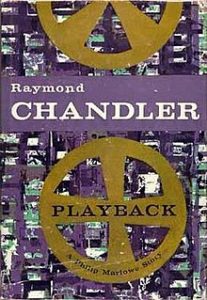
Playback (1959)
I’m not a young man. I’m old, tired and full of no coffee.
Fans of Chandler will recognize the pattern: a cool, confident voice, attractive women, a dash of philosophy, and the omnipresent figure of Philip Marlowe. This time, the mission starts as a routine tail job: keep an eye on a pale redhead who appears to be fleeing from something unknown. Marlowe’s attempts to identify her and uncover the source of her fear drive the narrative. While the central plot may feel somewhat unsteady, other elements compensate. The cast features memorable figures—the wealthy, polished criminal Brandon; the platinum-haired secretary Miss Vermilyea; Javonen, a former military intelligence man; and Noble, a somewhat seedy private eye from Kansas who could have wandered out of an earlier Graham Greene novel. Chandler’s strengths lie in his mastery of craft and clarity, guiding the reader smoothly from start to finish.
…
The problematic element is Betty Mayfield, the redhead, who remains the least convincing part of the story, fitting awkwardly into an otherwise plausible plot. Perhaps the author intended to craft a more fully drawn supporting character, yet she comes across as perplexing rather than complex. Still, most Chandler enthusiasts will turn to Playback to revisit Philip Marlowe. He remains unchanged on the outside—hard-edged, decent at heart, money-minded yet morally principled—an empathetic albeit morally scrupulous man navigating modern life with a gentleman’s grit.”
–The Age, April 11, 1959
*
A version of this post was published in 2018