
On our way to Dallas for Mom’s funeral, Dad handed me my very own disposable camera, twenty-four shots in total. I used two of them to glimpse the world outside the plane window, and I fancied the water below as if it were creatures forged from diamonds, gliding and colliding, shattering as they met.
The rest of the roll became a record of Mom in her casket. She wore a snug white dress and lipstick in a pink-orange hue. A wreath of lilies rested on her belly. In the envelope stashed under my bed, filled with Mom’s photographs, I have five pictures from when she was alive and twenty-two from that disposable camera of her after death.
I don’t recall the church portion of the service very clearly, but I remember the moment everyone stared at Mom’s body. The room was large and cooled by air conditioning, with green-and-purple carpet, and a long line of black-clad mourners moving past the corpse while they got to keep living.
One of the women said she was my aunt. She handed me a box of cheap crayons that broke if you pressed too hard. She ushered me to a corner where there were sandwiches and little bottles of water and she drew a word search on the back of the funeral program for me. The words were unfamiliar, like “solace” and “angel.” The only one I recognized was “paradise,” because of the pawnshop.
The aunt held my hand and showed me a display of Mom as a child—Mom biting into a big chocolate rabbit, doing a cartwheel, holding a parrot on her shoulder and laughing. I kept hoping the aunt would say Mom looked like me, but she never did, even though in some pictures Mom did look exactly like me. Then the aunt had to help replenish the sandwich trays for everyone, and she stood beside Mom’s casket as people hugged and cried. I longed to be hugged by all those people too, but when I moved toward the aunt, she handed me another word search and told me to sit in a folding chair far away from the mingling crowds.
Then someone announced that it was time for the family photo. Dad slipped into the other room with the sandwiches. He knew that no one wanted him in the picture. The women went to the bathroom to dab at their eyes, where their makeup had smeared from crying. I followed them, even though I wasn’t wearing any makeup. A photographer arranged a bright light and lined everyone up against the wall—tall at the back, short in front. I chose a position in the front. The aunt rested her hands on my shoulders as the camera flashed. Then she leaned toward me and whispered, “Could you go over there for a second, sweetheart?”
I crouched on the floor by the photographer, watching everyone else grin as though there were no corpse in the room and as if they hadn’t just kicked me, their own family, out of the family photograph.
Until that moment, I hadn’t shed a single tear all day. When the speeches about Mom came and it seemed like we were all meant to cry, I pressed my fingers into my eyes to coax the water out, but nothing happened. Sitting there on the carpet beneath the photographer’s flashing light, tears finally welled up in my throat. It felt like a bad moment to cry, with everyone lined up and staring at me. I practiced the breathing Kayla had taught me for stopping tears at school—inhale through the nose, exhale through the mouth—and kept breathing as I searched for Dad.
“Can we leave?” I said.
“You didn’t want to be in the family picture?” he asked.
“No, they didn’t want me to be,” I said, and then I cried, at last. Dad didn’t say a word. He picked me up. It was still a time when I was small enough that he carried me a lot. He ferried me to the car and we drove to a Denny’s with no other customers in it.
While we waited for our food, Dad built a card house from sugar packets. I tried to help, but I kept knocking it down; he never yelled. He just rebuilt it and kept inviting me to help again. Soon it stretched halfway across the table. We fetched more sugar packets from the next table and built little houses around the main one. Dad spun a tale about how we lived in the big house, a castle, and that we ruled the little houses. There was a pink wing for me and Kayla, a blue wing for Dad, and brown wings for Aubrey and Giselle. When the waitress brought our meals, she scowled at us—our sugar-sculptures were plenty unhygienic, apparently.
“We’ll buy them then,” Dad said. I remember thinking he sounded incredibly rich. We looked the part too, because Dad wore his black suit and I wore a black dress with tights, a ribbon in my hair, and a new bracelet from Paradise Pawn. I didn’t understand money back then. I knew the plane tickets had cost a fortune, and I worried about how we would pay for all the sugar packets, but the waitress’s expression made me happy. I imagined she believed two millionaires had just shown up at her Denny’s.
After Dad ate shiny eggs and sausage and I had French toast sticks, the waitress gave us a to-go box for our sugar packets. We carefully dismantled the castle and the houses, placing pink packets in one corner of the box, blue in another, yellow in another, and brown in another. Then we climbed back into the car and drove to a hotel parking lot.
“Get out,” Dad said, “and bring your sugar packets.” He looked at his watch and started counting down from ten. A spray of pink fireworks shot into the sky, followed by gold, twinkling, dripping ones, and then ones in the shape of smiley faces. It was the most fireworks I had ever seen. They seemed like Six Flags fireworks, but I felt as if they were meant for me. Dad ripped open a pink sugar packet and handed it to me. I poured it into my mouth, and it tasted like my teeth were coated with sweet sand. When I finished, Dad opened another packet for me, and then another one.
“Are you happy?” Dad yelled over the booms.
“Yeah!” I screamed. Then, as the noise faded and the sugar dissolved, I remembered that my mom was gone and I wasn’t supposed to be happy. I still wore my black clothes, sweat seeping through my tights, sugar staining the velvet of my dress.
“Why did you do that to me?” I asked Dad when we were back in the car.
“Do what?” he replied.
“Trick me into being happy. I’m supposed to be sad.”
“Babe, no you’re not. You’re eight,” he said. “No one who’s eight is supposed to be sad.”
__________________________________
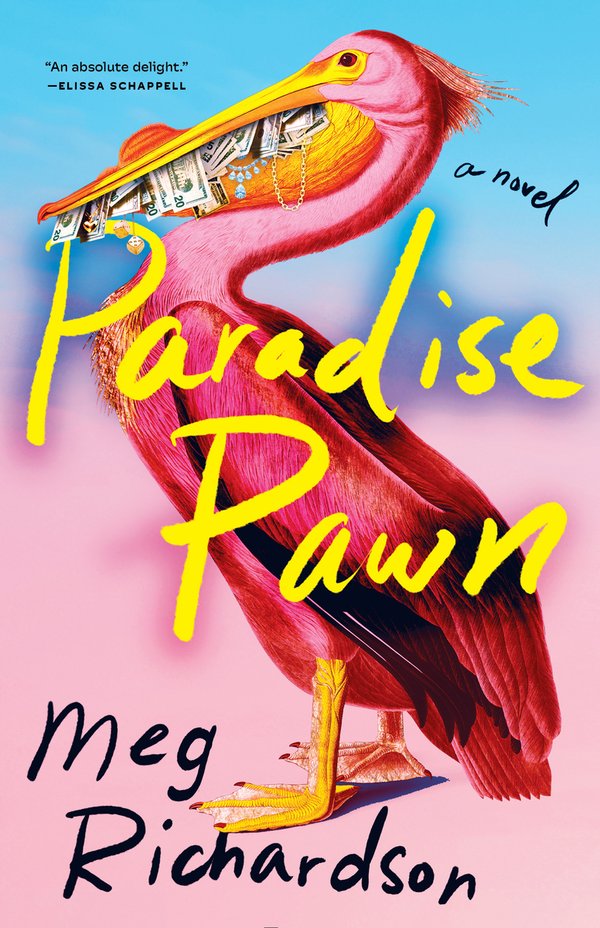
From Paradise Pawn by Meg Richardson. Copyright © 2026 Meg Richardson. Reprinted with permission from Tin House an imprint of Zando, LLC