
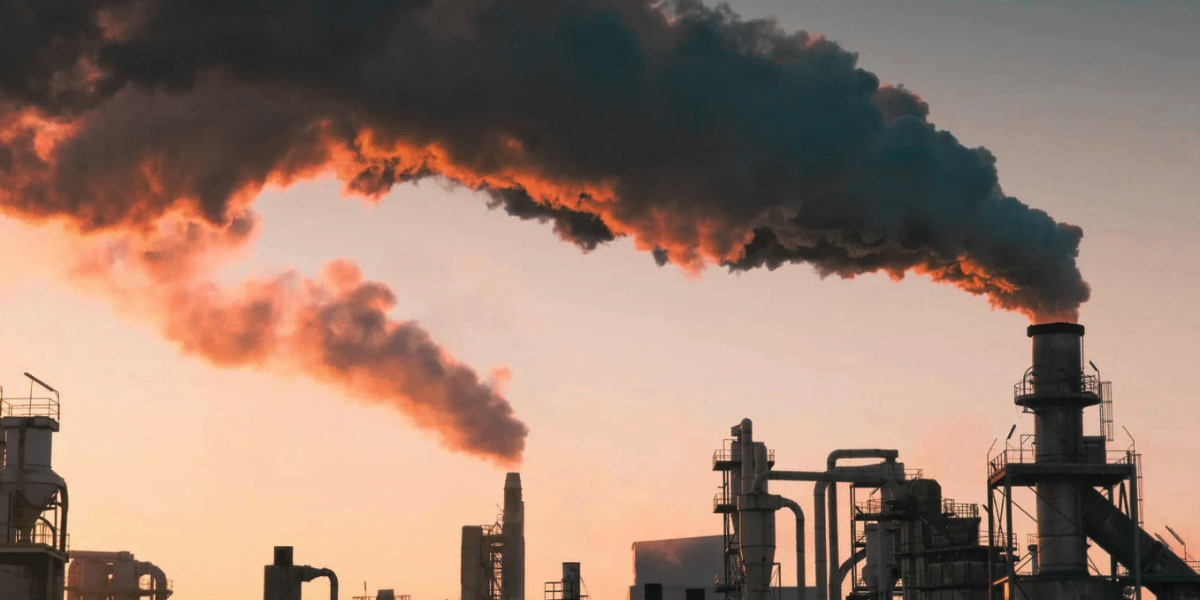
The global-scale devastation of the environment brought about by the explosive rise of worldwide capitalism has thrust the planet into a state of crisis. Since 1990, humanity’s fossil-fuel intake has reached a level that matches roughly half of all energy consumed throughout our entire history up to that moment. This enormous burn of fossil fuels is fueling climate change. Catastrophic events are occurring across the globe: Pakistan experiences major floods, California faces wildfires, droughts plague Africa, sea levels climb as glaciers and ice sheets disappear. Even in Japan, increasingly intense rainy seasons and powerful typhoons—along with other natural disasters—have made the effects of climate change unmistakable.
Diets centered on meat have sparked severe deforestation and a drastic global decline in biodiversity. A number of scientists argue that these trends contribute to the emergence of new viruses and the pandemics that follow.
Environmental ruin has now progressed to a point where full restoration is beyond reach. Many scholars, noting capitalism’s fundamental reshaping of the planetary environment, have adopted geological terms to describe the present epoch: the Anthropocene—an era defined by human interference with nature—or, more precisely, the Capitalocene.
Unsurprisingly, the Capitalocene is marked by extreme disparity. The voracious extraction of planetary resources by capitalism leaves a bill for future generations and for the poor in the Global South to pay. The ultra-wealthy, jetting around the world on private planes and luxury yachts, bear a substantial share of the responsibility, yet they resist accountability. Perhaps they assume the consequences will pass them by.
Ultimately, Marx clarifies, capitalism diminishes societal wealth for everyone.
One must ask: will humanity endure if its future is determined by the forces of capitalism? Will capitalism truly spark technological breakthroughs that avert catastrophe?
Marx’s ecological turn has its roots in the work of his contemporary, the chemist Justus von Liebig, who taught at the University of Munich and published the book Organic Chemistry in its Application to Agriculture and Physiology (better known as Agricultural Chemistry), whose seventh edition appeared in 1862.
Liebig harshly criticized the farming practices of his day, which rapidly exhausted soil in pursuit of high yields and profits, describing this inability to replenish land as a “robbery system.” He warned that continuing such methods would erode the very foundation upon which the nation rested, ultimately leading to civilizational collapse. Although this renowned chemist had previously praised fertilizer as a remedy for soil fatigue, his sudden reversal left a lasting impression on his peers.
Marx was not an exception. Liebig’s discussion of the soil-draining effects of modern agriculture captured Marx’s interest, and he produced a series of careful notes on Agricultural Chemistry. Later, in Capital, Marx cautions that soil exhaustion brought about by reckless exploitation of nature could threaten the material underpinning of society itself.
The same blind drive for profit that drained the soil in one instance has seized the nation’s lifeblood at its core in another. (348)
Marx’s digging into capital’s tendency to loot resources led him to see that soil depletion and the draining of human vitality share the same origin: the “blind desire” of capital for endless growth.
Moreover, in chapter 15 of Capital, Volume One, “Machinery and Large-Scale Industry,” Marx analyzes the vast landholdings that sustain capitalist agriculture. He notes that this looting by capital “disturbs” the metabolic relation between humans and nature while also deepening the divide between rural and urban workers:
Capitalist production collects the population together into great centers, and causes the urban population to achieve an ever-growing preponderance. This has two results. On the one hand it concentrates the historical motive power of society; on the other hand, it disturbs the metabolic interaction between man and the earth, i.e. it prevents the return to the soil of its constituent elements consumed by man in the form of food and clothing; hence it hinders the operation of the eternal natural condition for the lasting fertility of the soil. Thus it destroys at the same time the physical health of the urban worker, and the intellectual life of the rural worker. (637)
Agricultural production controlled by capital with the aim of maximizing profit in the shortest span of time leads to heedless monocropping (cultivating the same crops in the same soil year after year). Yet soil nutrients require time to recover. Capitalism may hasten processes, but natural cycles remain constant. A rift emerges between capital’s tempo and nature’s tempo, and the end result is soil exhaustion. The land’s fertility wanes, and harvests decline.
Marx also treated forestry as another illustration of the same mechanism. Trees take decades to mature, but capitalism’s impatience doesn’t permit forests to regenerate. Instead, capitalists fell entire forests in pursuit of profit, with little regard for natural regeneration cycles. As technology advances, the pace of deforestation accelerates, intruding into even the most remote wilderness. The resulting wastelands left by capitalism only grow larger.
Capital bears no accountability for soil exhaustion or forest destruction. Unable to align with the timing of nature, capital simply seizes whatever it can—transforming it into commodities to be sold—without concern for the future. Après moi, le déluge!—so goes the capitalist’s chant. While urban lifestyles become wealthier through consumption, rural regions bear the consequences in soil depletion and landscape degradation, diminishing the quality of life for those who live and work there.
Yet, as Marx notes in the earlier quote, urban workers who enjoy material goods are nonetheless compelled by capital to endure long hours at the cost of their health and welfare. Ultimately, Marx asserts, capitalism reduces societal wealth for all.
Marx analyzed soil exhaustion in the nineteenth century, but the plundering of nature persists today in somewhat different forms: from extracting fossil fuels and rare metals to ravaging the Amazon.
Just as industrial life in cities of the nineteenth century strained rural communities, the extravagant lifestyles enjoyed by the Global North rest on the impoverishment of those in the Global South. Après moi, le déluge—this mindset becomes even more explicit as we pass the environmental costs of present actions onto future generations. This is what is known as “externalization.”
In Brazil, the Amazon and the vast Cerrado have been rapidly converted into pastures and fields through clearing and logging, primarily to satisfy beef production for export to the Global North—the land is cleared to raise cattle and to grow the feed for them. Another example is the production of smartphones and computers, which relies on large quantities of rare earth elements mined in South America and Africa. These mining activities frequently involve human-rights violations, including forced labor and child labor—the ILO (International Labour Organization) estimates more than 50 million people are currently in conditions akin to slavery.
Externalization is also evident in Japan. Japan ranks as the world’s second-largest importer of timber, drawing in significant timber supplies from Southeast Asian nations such as the Philippines, Malaysia, and Indonesia, as well as from Siberia. Ironically, Japan is nearly seventy percent forested, with abundant native cedars and cypresses that go unharvested, while large quantities of inexpensive imported wood fuel domestic forestry decline. In this way, the lure of cheapness justifies deeper carbon emissions to bring in lumber produced through the destruction of forests abroad.
We’re so preoccupied with cost-performance thinking, diligently weighing the cost of a steak against the cost of a computer, that we lose sight of the true cost of the things we use to make our lives.
All of this is ultimately unsustainable. It reveals how the metabolic relationship between humans and nature has become severely distorted on a global scale. Marx anticipated this outcome, noting in an early draft of Capital’s third volume about a metabolic rift:
In this way, [large-scale landownership] produces conditions that provoke an irreparable rift in the interdependent process between social metabolism and natural metabolism, resulting in the squandering of the vitality of the soil, and trade carries this devastation far beyond the bounds of a single country (Liebig).
The endless drive of capital to commodify the entire world allows only a small fraction of the population to profit, and only over a tiny portion of the globe—this is the monopoly form (or, as the previous passage says, “large-scale landownership”). Globalization has broadened the rural-urban divide well beyond national borders. Yet while capitalism pursues infinite value growth, the planet is finite. Capital consistently externalizes its costs, but the world acts as a limit on such externalities.
After the collapse of the Soviet Union, capitalist globalization intensified further, spreading the environmental crisis as well; today we can assert that there is nowhere on Earth untouched by the crisis. Even nations like Japan and the United States, classic Global North examples, are not immune to climate change, as super-typhoons and extreme heat become routine. The metabolic rift has deepened to the point of no return.
The metabolic relationship between humans and nature once functioned as a cycle—a circle. But capital’s motion is one-way. It systematically takes from workers and the natural world while shifting the costs of this extraction to an imagined outside, in a similarly one-way process.
By contrast, ecological systems are intricately interconnected; a disturbance to one element reverberates through the rest, spreading disruption across the entire system. Capitalism pays no heed to such complexity and interdependence. Money enables us to assign a price to everything, rendering disparate things directly comparable and exchangeable. This convenience exists, yet it’s a simplification that can yield devastating outcomes, as it allows once-incomparable things—like different forms of social wealth and use-value—to be measured by the abstract standard of “value.”
The mutual interdependence of an ecosystem and the valorization of capital operate under two utterly different logics, and reconciling them is essentially impossible. Capital’s reductionist approach, which seeks to turn anything into a commodity and assess it only by “value,” cannot truly grasp the complex workings of an ecosystem that includes humanity.
The same applies to us as individuals. We become fixated on cost-performance considerations, weighing the price of a steak against that of a computer, to the point that we neglect the true cost of the things sustaining our lives. What went into producing that steak? How much carbon dioxide was emitted to raise the cattle, process its meat, and deliver it to us? We rarely pause to consider these questions.
It is precisely this kind of simplification that enables capital to grow so rapidly and comprehensively, widening the rift in our metabolic relationship with nature and fueling the current environmental crisis. We can no longer pretend the true costs of commodification and the valorization of capital are out of sight.
Do not misunderstand me—Marx did acknowledge that capitalism, in its own way, enriched our lives as well. Yet he also argued that its fixation on profits through relentless productivity—by any means necessary—hindered humanity’s capacity to safeguard collective planetary abundance for future generations. This stance is echoed in a famous passage from the preface to his 1859 work, A Contribution to the Critique of Political Economy:
At a certain stage of development, the material productive forces of society come into conflict with the existing relations of production or—this merely expresses the same thing in legal terms—with the property relations within the framework of which they have operated hitherto. From forms of development of the productive forces these relations turn into their fetters. Then begins an era of social revolution.
It is impossible to advance productive forces under capitalism without completely wrecking the planetary environment. We cannot manage the environment, a resource that ultimately belongs to no one, in a sustainable way as long as we operate within a system built on perpetual exploitation in the name of private ownership and profit. We’ve reached the point where capitalism itself has become the fetters on society’s progress.
Thus, Marx advocates for a revolutionary transformation that would bring about a radically different social order, a change urgently needed before the irreparable rift in the metabolic relationship between humans and nature destroys civilization for good.
__________________________________
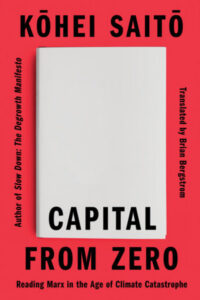
Excerpted from Capital From Zero: Reading Marx in the Age of Climate Catastrophe by Kōhei Saitō, translated from the Japanese by Brian Bergstrom. Published by Astra House. Text copyright © 2026 by Kōhei Saitō. Translation copyright © 2026 by Brian Bergstrom. All rights reserved.