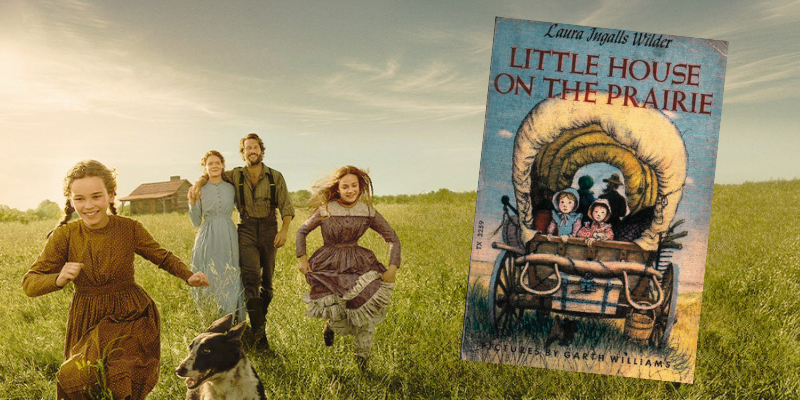
This month, a fresh adaptation of Laura Ingalls Wilder’s beloved Little House on the Prairie arrives on Netflix.
The revival lands at a fortuitous moment. In 2026, the discourse around traditional domestic roles reached a peak, and if Brooklyn’s streets are any guide, a prairie‑core sensibility isn’t easing up anytime soon.
Pioneer nostalgia has a habit of blooming when conservatives wield power, which isn’t happenstance. When cities are branded perilous, the ambitious are urged to strike out on their own across wide open spaces. To go west. Yet, as Dr. Paula Read mused in a recent Teen Vogue op‑ed, “Is there anything new to say that hasn’t already appeared in Wilder’s original nine volumes or the first television adaptation?”
In short: why would we ever exhaust the myth of the West?
*
Loosely drawn from Wilder’s own childhood, the original Prairie novels appeared during the 1930s. The first, Little House in the Big Woods, hit shelves amid the Dust Bowl, when—to quote a recent Times op‑ed by Glynnis MacNicol—the American heartland was especially “hungry for stories of resilience and hope.”
The Prairie books immediately became bestsellers and have never gone out of print. Marketed as suitable for families, the series painted an appealing, adventurous childhood and elevated the family unit as the central engine of social life.
All of this was intentional.
As Dr. Read cites and Anita Claire Fellman argues in her 2008 study Little House, Long Shadow: Laura Ingalls Wilder’s Impact on American Culture, both Wilder and her daughter Rose Lane (who co‑authored the first book) were skeptical of the New Deal and libertarian in outlook, yet they remained enthralled by the frontier thesis throughout their lives.
The books, published at the moment when a social-state framework was taking shape in America, portray the Ingalls as self‑reliant. The family flourishes in isolation, against the elements, and often despite their neighbors. The girls absorb this lesson again and again: to succeed in the wild, you must pull yourself up by your bootstraps.
The novels also gloss over critical history.
According to History, the fictional and real Ingalls family erected their house illegally on what was the Osage Diminished Reserve. Across the pages, the family echoes settler logic. When describing the land they claim, Ingalls wrote, “there were no people; only Indians lived there.”
In the 1950s, amendments were introduced to historicize this troubling phrasing and worldview. (More recently, the culture has undergone a deeper reckoning with Laura’s legacy—see MacNicol’s podcast.) Still, anti‑Native racism has proven stubborn to eradicate from the foundational text.
The first Little House television series—which rose in the wake of Vietnam’s aftermath—also tended to overlook the Native populations who lived on top of the Ingalls’ world.
That is, when it wasn’t recycling harmful stereotypes in updated language.
*
Personally, I grew up in a Laura‑fangirl household. Wilder’s books were among the first hardcovers I clung to. I recall feeling a sense of pride in their heft, captivated by the cover art. More than plot, I can still conjure the rhythms of frontier life that Ingalls brought to vivid life: candy made from tapping molasses trees and letting syrup freeze on ice.
I fell for their grit. The ingenuity, the tinkering, the quickness to invent. And I didn’t question the absence of neighbors or neighborly warmth; at six, seven, or eight, I was too drawn to the possibility of shaping my own world to worry about others. Who needs helpers?
The fairytale Laura offers is the one in which a harsh new world bends to one’s will.
Rebecca Sonnenshine’s new adaptation aims to correct lingering impressions left by the old series and show, while reconsidering some of Wilder’s arguments. (Critics have labeled it as “woke‑ification.”) This version makes clear that the family arrives to claim Osage land. A fresh cast of Osage and Black supporting characters enters to disrupt the thrive‑in‑isolation narrative. In 2026, the prairie is envisioned as a shared space.
And that’s not inherently bad. Broadening the historical scope of the West is a meaningful pursuit at a moment when Black and Native studies face threats in classrooms and in the halls of higher education.
Yet the question remains: is this the right vehicle to convey that context in the first place?
As MacNicol observes in her op‑ed, “for better and worse, [Little House] has come to dominate [italics mine] our understanding of the era of Western expansion in American history.” The verb fits, all too well.
“The show once again holds up a mirror to the nation,” MacNicol writes, offering guarded praise. The mirror may gleam a bit brighter now, but it still reveals only one thing.
(And the world isn’t new. That’s the problem.)