It seems almost unbelievable, yet the tall Petco cashier with the slick blond pompadour swears he’s telling the truth.
“A shortage?” I ask him, hoping the word might bend into reason.
He nods with the certainty of someone convinced he’s defending a bigger truth.
“All of them?” He nods again.
I study his name badge, thinking that if I can learn his name I might charm him into honesty, and somehow spared disaster with my son. The badge reads, HI, MY DOG’S NAME IS BETTY. I freeze, staring at the tag. Should I address him as “Betty,” or as “the Petco Cashier Whose Dog’s Name Is Betty”? It’s a ridiculous predicament, and I am not sure which option would make him confess more quickly.
He notices my scrutiny and adjusts the badge with a self‑conscious shrug.
“Nice name,” I murmur.
“What?” he asks, as if surprised by the compliment.
I worry he thinks I’m mocking him, so I blurtingly add, “The dog, your dog’s name, it’s lovable! Betty? Betty?” I point at his chest and repeat “Betty” until another Petco worker appears, a big man with uneven black eyebrows and, on his nametag, a parrot named Van Helsing.
“Trouble?” the man asks.
“No, not trouble,” I insist, pointing and laughing as if to prove I’m not rattled.
“This woman,” the cashier says, almost in a whisper, “is looking to buy some large crickets.”
“But there’s a shortage,” the other man retorts.
I decide to try one more Petco. It’s across the bridge, which means a thirty‑five‑minute drive and a six‑dollar toll, but I’m prepared to make the trip. It isn’t that I mistrust the folks at the first store—it’s that I cannot imagine a nationwide shortage of large crickets being real. They claimed it was a breeder problem, a national hiccup. It feels almost un-American to accept that they’re right.
As I edge onto the bridge, I picture every cricket breeder in the country—night after night of worry over tiny mating rituals, the endless cycle of births and deaths, the delicate balance of a world full of jumping, crunching bodies. If the supply falters, it seems like the world itself would buckle.
When I reach the second Petco, an older cashier—her hair pulled into a painfully tight bun and a cat named Rebecca in tow— repeats the same line. “A nationwide shortage.” She sighs, as though she’s said it a hundred times before.
I call my son from the car, hands shaking.
“He’s dying,” Noah says. “Copernicus is dying, Mom.”
I suspect there’s truth in his words. My son’s lizard looks thin and spends every minute hiding beneath a slat of wood. It’s because I’ve forgotten to feed him for more than a week. After work I used to rush to the Petco for crickets, but then Dave—my former partner—was in charge. Now that I’ve finally remembered, I can’t locate any large crickets. Of course.
“But there’s a shortage,” I insist.
“You’re lying,” Noah accuses, and then he hangs up.
In the ensuing quiet, I hear judgment in the absence of sound. Noah’s adult‑sized certainty cuts through me—Why did you promise Dave would stay in our lives forever if he wasn’t going to stay at all?—and I can’t tell him the truth behind it all. How could I have anticipated that one day I’d discover Dave entwined in a stereotype, his hand somewhere it shouldn’t be, with a college student who, even in her social media photos, has the awkward, untested look of a baby? Or that I’d barely summon the nerve to eject him from our lives? How could I have known?
So I cry and press the horn in a way that signals the universe’s chaos and cruelty. The Petco cashier with the cat named Rebecca taps on the hood of my car, a long line of carts jamming the edge of her aging body. “Dear?” she says, and I roll down the window.
I wipe my nose on my sleeve and meet her gaze.
“Maybe I could help you with some small crickets?” she suggests. “We do have those, I think. It’s the large crickets that no one has because they take so long to mature.”
I honk again—because why can’t the breeders figure this out? Why can’t the Petco staff foresee that I’d settle for small crickets as a substitute? Why not ask the right questions, such as Are there perhaps crickets of another size available? or Can I actually trust you with my life and my child, Dave?—and I follow her back inside.
Copernicus erupts into a frenzy at the sound of the small crickets sliding from their bag. Noah laughs, and for a moment I think we might have found a way back to calm. But then Noah kneels by the terrarium, wrapping his arms around himself in a protective, almost fragile way. His slender fingers graze behind his back, and I can’t read his expression to know what he’s feeling.
“Hey,” I murmur, settling beside him. I want to explain the breeder crisis, the impossibility of truly knowing another person, the inevitability of heartbreak, but once again I can’t find the words. I see my own reflection in the glass, but my face is unreadable, offering no help.
I doubt he would believe me even if I spoke plainly.
Still, I reach toward Noah, hoping to pull him closer. He opens his eyes and moves away.
I shouldn’t, but I go after him, sliding an arm around his shoulders. He darts to his feet and heads for the door.
“Where are you going?” I call after him.
He walks away as if he cannot hear me, or as if my voice is pushing him to leave. A little later, I hear the muffled sounds of the living room TV.
For a while I sit alone and watch Copernicus’s terrarium, imagining that Noah is here beside me. I don’t reach for him; I don’t beg to feel his skin against mine or hear his heartbeat. I stay with him in his anger, which will pass, and I accept that I have finally managed to feed Copernicus. Noah and I continue to observe the lizard’s pale pink tongue flicking out to lick up the tiny crickets.
Eventually Noah laughs again, and this time it’s a laugh that releases his anger—and, in turn, releases me. “There,” he says to us all, “that’s better.”
__________________________________
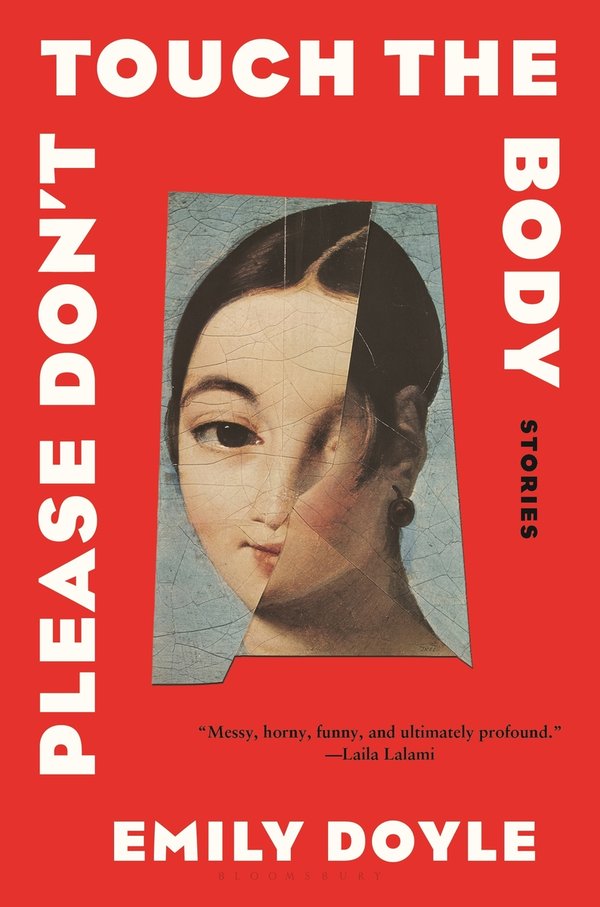
Excerpted from Please Don’t Touch the Body: Stories. Used with the permission of the publisher, Bloomsbury. Copyright © 2026 by Emily Doyle