
As a Haitian American, I have grown up hearing stories of resistance from my elders since I was three. The accounts were often shared through fairy tales, yet as I matured, the message grew more forthright. By adolescence, my relatives’ narrative centered on how much agency enslaved Africans in Saint-Domingue possessed in shaping what lay ahead. They were not to be pitied, nor were they to be viewed as anything less than courageous. This was a formidable tale, and I carry immense pride for my ancestors who fought in the Haitian Revolution, largely because their struggle advanced freedom for all.
In both past and present, my grandparents stood as paragons of integrity, not merely because they towered over me or could endure a rural life, but because they instilled in me a dignity that invites me to own my Blackness. Doubts about the price of rebellion surfaced during a second, more naive visit to Haiti as a teenager. I was thirteen, traversing the countryside, and I witnessed a nation marked by poverty and clear signs of malnutrition among children my own age. So I asked my grandparents, “Why is Haiti so poor?” They chose not to answer, partly because the history they had hinted at earlier clashed with the country I saw before me.
Prejudice is a marker of American society, eating through the soul of the country.
During my teenage years, the sense of shame about being Haitian lingered, as teachers framed Haiti as the poorest nation in the Western Hemisphere. That simplified history failed to illuminate how one of the Caribbean’s wealthiest colonies was transformed into poverty. It took years for me to seek out answers to my early questions. Centuries of debt and decades of structural adjustment programs have diminished Haitians’ lives today. My ancestors moved—under coercion and choice—and I have done the same. Moving within the Black Atlantic has granted me the perspective to see that the past’s enslavement and Haiti’s current material conditions cannot be understood separately. There are powerful links between eighteenth‑century bondage and present-day hardship.
Prejudice is a marker of American society, eating through the soul of the country. The disparities from slavery to Jim Crow continue to haunt Black life and have fueled Black insurrection. As the Antiguan-American novelist and essayist Jamaica Kincaid observed in her writings, the Afro-Caribbean experience is one of defeat, survival, and resistance. Kincaid chronicled the cruel realities of colonialism and even addressed a familiar literary figure with a pointed plea. Kincaid writes:
Dear Mr. Crusoe, Please stay home. There’s no need for this masquerade of a trading voyage, in which most often the goods traded are people like me, Friday. There’s no need at all to abandon your comfortable bed and your loved ones and embark on a ship that will likely be wrecked in a storm.
Though the letter is witty and blunt, Kincaid’s demand would presumably go unmet. Colonial authorities terrorized the Caribbean and the wider Americas, turning the region into a deliberate arena of anti‑Black terror directed by European agents—a stark reminder of the forced removal of Africans and their coerced labor on stolen Indigenous land. I was born in Miami during the Reagan era, a time when elites grew wealthier while Black people were vilified. Growing up Black in America defined what possibilities were available to me and which ones were denied. With each year, I learned the diverse ways Black people faced denigration. We were cast as welfare queens, at‑risk youths, and unworthy of higher education. These stereotypes were brutal, heartless, and inaccurate.
Black dispossession in the Americas fed European wealth, which rested on the unpaid surplus value extracted from enslaved Black people. This capital was not theoretical; it filled the pockets and vaults of merchants, banks, and other financial institutions that later funded entities like Barclays Bank (British), ABN AMRO (Dutch), and Caisse des dépôts et consignations (French), among others that still thrive today. For the British, profits from the transatlantic slave trade and Caribbean slavery flowed into land purchases across Britain, factory building in Manchester, library funding in Glasgow, and expansion of the shipping industry in Liverpool.
For many of us, historical and perennial suffering can be mended through reparations.
Eric Williams, the author of Capitalism and Slavery (1944), argued that British industrialization rested on empire, which “made the whole world her footstool,” clothing the world, exporting people and machinery, and acting as the world’s banker. The Dutch, via Hope & Co.—the precursor to ABN AMRO—was the leading insurance broker for slavery, handling claims tied to enslaved people and slave ships. An estimated six hundred thousand Africans were transported, and the Dutch West India Company, along with the Netherlands, benefited from low-cost tobacco, sugar, and coffee from plantations in Suriname.
For many of us, historical and perennial suffering can be mended through reparations.
In the case of the French, the Caisse des dépôts et consignations coordinated transfers totaling twenty‑one billion euros from the descendants of enslaved Haitians to the descendants of French enslavers from 1804 to 1946; activists have sued over this matter. Activists pressed not only for Haiti to be repaid, but for an examination of France’s relationship to its Caribbean territories—Martinique, Guadeloupe, French Guiana—and for greater income equality for descendants of enslaved people living in France itself.
No one inhabited a moral vacuum. Even individuals who did not own shares tied to the transatlantic slave trade benefited from capital generated by it, which was woven into various pillars of European society, including architecture, law, and schooling.
How do we write about the suffering inflicted? What does reconciliation look like? What do we owe? For many, reparations offer a path to repair and renewal. Across the globe, living conditions for many Black and working-class people remain precarious. From Luanda to Kingston, the global majority labor under perpetual debt, facing long-term joblessness, climate disasters, and inadequate healthcare. These patterns manifest slowly, violently, yet they have been challenged by individuals and groups seeking to heal the wounds of the past.
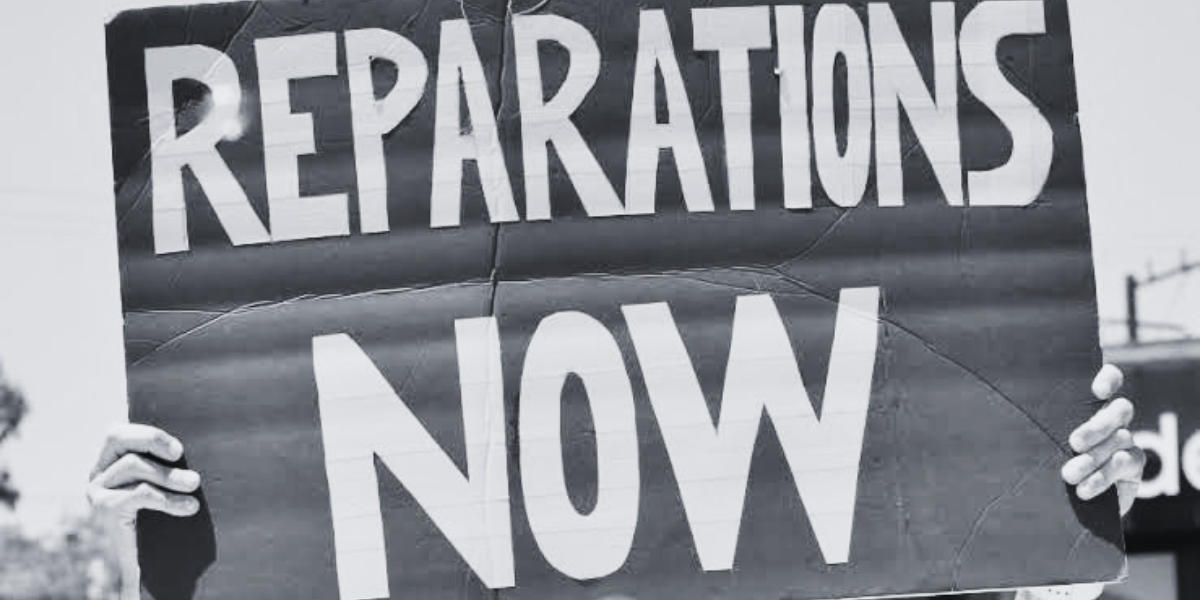
The word repair comes from the Latin reparare, meaning restoration and return. Like its roots, the term has come to signify both remedy and renewal—sometimes for tangible objects, but often for relationships as well. The case for reparations is not merely about economics or political pragmatism; it is about rebuilding communities, investing in social and cultural supports that offer care and restorative justice. Reparations go beyond a single act of recovery; they form a broad political project that aims to empower descendants of the enslaved to live fully and freely.
Reparations occupy a central place in my political imagination, closely tied to my desire for abolition. In essence, resolving harm should be approached with a holistic strategy—pursuing equity, and directly challenging institutions that continue to profit from slavery, colonialism, and the carceral state. Restitution may begin to ease the pervasive pain that many carry, providing an opportunity to loosen the grip of oppression through collective organizing and inclusive benefit for all, not a select few.
Black liberation, while diverse in its language, history, and methods, cannot be absent from any dialogue about history’s silences. As a historian, I comb archives for evidence of colonial crimes and the names of freedom fighters. Above all, the reparations movement—though it has long occupied a peripheral position—belongs to the Black radical tradition and represents my inheritance.
Sojourner Truth once declared, “There remains a debt to the Negro people that cannot be repaid; at the very least, acknowledgment and repair are required.” Slavery’s brutality could not be forgotten; African Americans needed compensation for centuries of hardship. They fed colonial America, helped enrich Europe, and had their African identities stolen. Yet, many people were still exploited and left with debts that endure today. Some Americans believe slavery is a distant past to be forgotten, while others recognize that past injustices continue to shape a divided and unequal society.
The earliest formal petition for reparations in the United States was pursued by Belinda, a formerly enslaved African-born woman. After her enslaver’s death, she petitioned the Massachusetts General Assembly in 1783, seeking a pension from his estate for her unpaid labor. The court ruled in her favor, granting her £15.12 per year—roughly equivalent to $373 today—from the royal estate, an extraordinary recognition for the era.
Throughout the United States, accountability for slavery’s harms remains unresolved, calling for a federal solution to a national problem.
Nearly a century later, after emancipation, Callie House, a formerly enslaved woman, led a campaign demanding pensions for Black Union veterans and direct compensation for Black Americans’ unpaid labor. Her efforts faced heavy criticism and legal challenges; the US Department of Justice accused her organization of mail fraud, and some prominent Black figures urged restraint and respectability. Yet for Belinda and Callie, compensation was a necessary step toward redressing exploitation and achieving justice. Their work demonstrates that reparations can be within reach for some, directly addressing the unfinished business of history.
Long before the civil rights era, Black labor leader A. Philip Randolph proposed a Freedom Budget for eradicating poverty in the United States, viewing it as a moral obligation rooted in the nation’s founding principles. Randolph, who organized the first African American–led labor union in 1925, understood that any fight for racial justice had to intersect with workplace reform. His ten-point plan later found support from the Southern Christian Leadership Conference, illustrating how Black religious groups sought to address wealth inequality.
In Martin Luther King Jr.’s A Testament to Hope, he wrote, “In these trying times, the Black revolution extends beyond securing rights for Black people; it compels America to confront its interconnected flaws—racism, poverty, militarism, and materialism.” King argued that the United States was infected by mechanisms of violence and domination. When he penned these words, he and many Black Americans faced the legacy of slavery and Jim Crow. They understood that Black liberation meant more than equal rights; it required challenging the capitalist systems that sustain racial inequality. Kwame Ture and Charles V. Hamilton’s Black Power likewise described how discrimination traps Black people in dilapidated housing and exposes them to exploitation by landlords, merchants, loan sharks, and biased real estate practices. Racism, they argued, is not merely an idea but a set of practical consequences shaping every aspect of life.
During the civil rights era, Black‑led organizations occupied every corner of society—leftist movements, faith communities, labor actions, and more—dedicating themselves to altering the political and economic landscape.
The call for reparations goes beyond simple interest on an unfulfilled forty acres and a mule; it seeks to address twenty‑first‑century racial inequality and the widening gap in wealth between white Americans and Black Americans, both past and present. More than that, the reparations movement seeks a sustained process of undoing the harm that has accumulated over generations.
There was an earlier template for reparations. In the 1970s, Boris Bittker, a Yale Law professor, argued in The Case for Black Reparations that reparations could be estimated by multiplying the Black population by the gap between white and Black per‑capita income. The figure he produced was about $34 billion in 1973. By the late 1980s, the reparations movement consolidated under the National Coalition of Blacks for Reparations in America, and in 1993 the NAACP endorsed reparations.
Two ideas have often narrowed public debates about reparations. First, reparations are commonly thought to be compensation solely for slavery; second, the struggle for Black liberation is frequently separated from Pan‑African and Pan‑American efforts to hold beneficiaries of anti‑Black oppression accountable, regardless of borders. Although not always central to popular narratives, the enduring racism faced by descendants of enslaved people lies at the core of this work.
Reconciliation and reparations programs in Africa have shown that one-time payments are not enough.
In the Francophone Caribbean, Mouvement International pour les Réparations emphasizes not only combating racism in all its forms but recognizing the specific damage endured by people of African heritage. The coalition regards the forced deportation and coerced labor of Africans as a crime that must be addressed today.
Reparations are not the preserve of Black people alone; as of 2021, support for reparations in the United States is rising among Black Americans while a sizable majority of white Americans oppose them. That year, Princeton Theological Seminary endorsed a $27.6 million reparations plan to aid descendants of slavery through a scholarship fund and educational program within the Princeton community. Across the country, accountability for slavery’s harms remains unresolved, underscoring the call for a federal remedy.
Since April 2021, the U.S. Congress has advanced HR 40, the slavery‑reparations bill, roughly twenty‑five years after its initial introduction. If enacted, it would establish a commission to offer an apology for chattel slavery and present Congress with recommendations on compensation for African Americans affected by centuries of discrimination. Although some advocate for a more sweeping program, Representative Sheila Jackson Lee has described this as a “path to restorative justice,” recognizing that equity concerns extend beyond chattel slavery to the fate of African artifacts seized during European colonial rule.
In late April 2021, Berlin’s Ethnology Museum agreed to return Benin bronzes and carvings seized in 1897 during European colonization. Germany is not the sole European nation in possession of Benin artifacts; others include Scotland, England, and France.
Reconciliation and reparations programs in Africa have shown that one-time payments are not enough.
Following nearly a decade of civil war, Sierra Leone established a Truth and Reconciliation Commission in 1999 that recommended reparations including free health care, education, and pensions for the severely wounded and survivors of violence. Instead, the Commission distributed modest payments of $1,000 to about 30,000 registered survivors, a move that fell short of addressing long-term structural problems. In Kenya, Mau Mau veterans won a settlement in which the British government would distribute £20 million to about five thousand survivors.
The compensation plan aimed to redress only a portion of the injuries caused by the British colonial administration’s mass deportations and land seizures tied to tea plantations. When survivors pressed the government to honor the settlement, the response was resistance, underscoring the ongoing struggle for comprehensive reparations on the continent. The Caribbean Community and Common Market (CARICOM), a fifteen‑member bloc, has studied how slavery and colonialism continue to cripple the region’s economy. The group established a reparations committee with a ten‑point program focusing on debt cancellation, psychological reparations, public health justice, and an African‑knowledge initiative to deepen regional solidarity. All of these efforts would strengthen the Caribbean’s social fabric and begin to undo the daily humiliations Black people still endure in the region. The reparations movement today is sociologically vital; it is not charity but a debt owed to a community’s dignity.
Racism cannot be separated from the assault on public services, rising poverty, and joblessness. Reparations represent one potential remedy to repair centuries of calculated dispossession. While some may find the idea abstract, many believe that investments in mental health care can help heal collective trauma. Imagine redirecting funds from militarization and policing toward parks, freely accessible childcare, and community spaces for art and gathering. Reparations embody a transformative vision—one that looks beyond incremental reforms and toward abolitionist approaches that reimagine society.
Repairing Black lives means building new social ties beyond the prison–industrial complex. Advocates of abolition have called for a shift away from punitive measures toward a framework of racial repair, advocated by thinkers like Ruth Wilson Gilmore, Mariame Kaba, and Derecka Purnell, which would involve defunding policing, reallocating resources to social services, and prioritizing community care.
The case for reparations rests on a broader horizon than individual harm; it envisions a real and ongoing project for racial reckoning. This is a vision that would allow Black people to rest, to exercise agency over their labor and time, to move freely, and to gather across communities. Most of all, it aspires to create a world in which Black people finally receive what they deserve.
How should we articulate and imagine the path to racial justice? Focusing on the future is our aim as we excavate both involuntary and voluntary memories of those who live and those who have passed. As a historian, I study the departed so I can better advocate for the living.
In a country built on the free labor of Black people and where only 1.2 percent of the population holds a PhD, a no‑strings‑attached scholarship can improve the living standards of working‑class families.
Thus, the idea is to dream of Black liberation not as an impossible dream but as an achievable destination. It means keeping Black resistance alive daily, even amid acts of racial violence. It requires learning about histories that have been erased, stolen, or ignored, and it means building collective power and adopting new strategies, or blending some old ones—with repair, restitution, and reparations at the core.
From the efforts of Belinda and Callie to the ongoing demands of living survivors of Jim Crow, Black women have long pursued financial redress as a route to justice for racial discrimination. In the modern reparations discourse, the 1988 Civil Liberties Act—granting reparations to Japanese Americans for their internment during World War II—serves as a landmark precedent.9 After its passage, Representative John Conyers introduced a 1989 bill to “establish a commission to examine the institution of slavery and the ongoing racial and economic discrimination against African Americans and its impact today.” The proposal—HR 40—echoed the unfulfilled vow of forty acres and a mule. As of this writing, it has yet to yield a federal reparations program for Black Americans.
Yet, researchers and activists have worked diligently to quantify the damage. In their work From Here to Equality, William A. Darity Jr. and Kirsten Andrea Mullen initially pegged reparations at $7.95 trillion, and after adjusting for the vast Black‑white wealth gap, they estimated $10.7 trillion—roughly $267,000 for every descendant of enslaved Black Americans.
In 1994, the Florida legislature, under Governor Lawton Chiles, enacted a Rosewood massacre reparations measure, granting $2.1 million to survivors and establishing a college scholarship fund for descendants tied to the tragedy. It marked the first instance in the United States of a legislative body acknowledging a community’s historical discrimination and attempting to provide material assistance to its members. Since then, hundreds of students have benefited from the Rosewood fund.
The initiative’s spark came not from state officials but from Rosewood descendants who demanded accountability and security for their families’ futures. Washington Post journalist Robert Samuels, reflecting on the emotional weight of reparations for Rosewood descendants, wrote: “What can a scholarship do for a historic injustice? For Carter and her family, reparations changed the frame of a painful past. The Rosewood story no longer ends with a frightened child fleeing through the woods; it continues with graduates’ gowns and diplomas, perhaps the family’s first PhD.”
This is no small achievement. In a nation built on Black labor and with only a tiny share of people holding PhDs, a no‑strings scholarship can meaningfully improve life for working‑class families.
In 2001, Oklahoma enacted the Tulsa Riot Reconciliation Act, creating a memorial and a scholarship fund for victims. That same year, New York’s Assembly established a commission to quantify the debt owed to African Americans, proposing redress for the enduring economic and social effects of slavery. The commission largely stalled, unable to deliver funding or authority. Yet the turn toward reparations gained momentum with the 2020–2021 wave of antiracist protests and reparations task forces across the United States.
That same year Chicago launched a $5.5 million reparations fund for victims of police brutality under Jon Burge. Georgetown University students pressured the administration to earmark an endowment equal to the proceeds of an 1838 slave sale used to hire Black professors, and they successfully renamed Mulledy Hall (then freed from its namesake’s legacy) as Freedom Hall. In Evanston, Illinois, the city introduced a program to provide reparations for Black residents hurt by housing discrimination, inspired by local restorative housing initiatives.
The 2008 financial meltdown pushed Black communities to imagine how to undo present harms. Ta-Nehisi Coates’ 2014 The Case for Reparations reframed the discussion, arguing that not only slavery but the long trace of dispossession through segregation and housing policy required redress. He framed housing discrimination as a national tragedy—policies that systematically denied wealth to Black families and locked them into cycles of debt. His piece helped render reparations as a matter of national responsibility, not merely a sectional concern.
In the wake of Coates’ piece, debates spread across the left—some conservatives, some socialists, some reformists—about whether reparations could be a project for the broader political left. Political scientist Cedric Johnson offered a critique grounded in a particular strand of social democracy, arguing that reparations are rooted in Black nationalist politics that often neglect class. He suggested that addressing material needs would require a broader class analysis. Others argued that reparations could mobilize a broader agenda for public investment in health care and education, while Keeanga-Yamahtta Taylor insisted that reparations must not be reduced to a policy menu but seen as a reminder of slavery’s central role in wealth accumulation and the structure of class in slave societies.
Even as left debates roil, the reparations movement has produced honest spaces to discuss ongoing material dispossession and the real-world implications of systemic racism. Reactions within Black communities have varied; some worry a payout could be hard to implement, others doubt that money alone can cure anti‑Black violence, and some Black elites fear a challenge to their relatively privileged status. A broad coalition—ranging from nominal Black nationalists to prison abolitionists and the incarcerated—has driven the reparations conversation forward.
Pan‑African groups have framed reparations not as civil damages but as a set of remedies addressing moral injuries. The 1993 Pan‑African Congress on Reparations in Abuja laid groundwork for the 2001 United Nations World Conference against Racism in Durban. Hilary Beckles notes that European powers often treated slavery as a legal enterprise rather than a crime against humanity, complicating attempts at redress. Adom Getachew emphasizes that grassroots Afro‑Caribbean and African movements have inspired one another in pressing for accountability beyond national borders. Since 2013, CARICOM has led a robust reparations campaign, demanding that Europe acknowledge the unpaid debts owed to descendants of enslaved Africans.
In 2019, Glasgow University committed £20 million toward reparative justice following revelations of its ties to Scottish slave traders, opening a partnership with the University of the West Indies to raise awareness of Caribbean slavery’s legacy. A related collaboration between Harvard Medical School and the Lancet Commission on Reparations and Redistributive Justice examines what Black people are owed in medicine, both historically and currently.
In 2020, the Movement for Black Lives introduced the BREATHE Act as part of its broader program to secure reparations for policing violence. The reparations movement remains dynamic, reflecting ongoing demands for structural repair across local and global contexts. It is a project aimed at remedying intergenerational debt and building a different social order.
The reparations movement has proven nimble and incisive, with transnational currents shaping its trajectory. The Rhodes Must Fall campaign—originating at the University of Cape Town—spurred campus‑level movements worldwide, challenging Cecil Rhodes monuments and the persistent underrepresentation of people of color in higher education. Activists Roseanne Chantiluke, Brian Kwoba, and Athinangamso Nkopo argued for more than representation: they pressed for the return of stolen artifacts and for substantive reallocation of resources to redress colonial legacies. Their work framed reparative policy as something more than symbolism; it was a call for concrete changes in policy and practice.
It’s no surprise that dreams hold such significance in Haitian culture, because they are larger than us; they give us dignity and the tools to fulfill our humanity with purpose.
In an interview on the Jemele Hill Is Unbothered podcast, activist and author Alicia Garza asserted, “Hashtags don’t build movements; people do.” She added that we must refuse to accept the status quo and pursue a political path that provides clarity and urgency, drawing on the wisdom of our elders. That clarity deepens when we engage with Black radical traditions, which anchor abolition as a strategy to dismantle oppression and imagine a world without police, prisons, borders, or debt.
In the nineteenth century, Black radicals spearheaded a form of abolition that intersected with Pan‑African movements and, at times, Black women’s liberation. Abolition was more than a justice tactic; it enriched the Black radical tradition with texture and depth. As Tobi Haslett writes in n+1, “Disbanding departments isn’t enough; simply closing prisons won’t suffice. Incarceration and policing have become the state’s reflexive response to murder and sexual violence, but also to homelessness and addiction—the social decay that plagues those living in poverty.” He argues that redistributing wealth and resources is essential to remedy current racial inequities.
“The past,” James Baldwin writes in Notes of a Native Son, “is what makes the present coherent, and the present will stay dangerous so long as we refuse to face it honestly.” Belinda’s and Callie’s spirits endure in present demands for racial repair.
In May 2021, at 107 years old, Viola Fletcher, a survivor of the Tulsa massacre, testified before Congress, seeking compensation and justice for the destruction that erased a thriving community and curtailed future opportunities. She stated, “Our country may forget this history, but I cannot. I never will, and other survivors do not. When my family fled Tulsa, I lost the opportunity to pursue education. I never completed school beyond the fourth grade. I have not earned much money.” Fletcher connected her personal loss to broader financial harms, highlighting how the violent displacement of her community left lasting consequences.
My grandparents rest side by side in a small Haitian village, where their graves absorb the Atlantic’s salty wind. They neither finished school nor opened bank accounts, and they could not read or write. They lived close to the land and clung to the histories passed down to them. When others pity or worry about Haiti’s wealth, it can be tempting to accept impoverishment as inevitable or to focus on how far I have come from a working-class background. This narrative, though comforting, fails to expose the people, institutions, and circumstances that originally caused Haiti’s poverty. More importantly, collective guilt does not undo damage. We deserve more, and an honest discourse about reparations, restitution, and repair must be part of our healing journey.
In my family, the Haitian Creole word for dream, rèv, is a proactive beacon, promising something more. For a long time, I believed our dreams were narrow, disconnected from reality, and thus easier to dismiss. Yet I later understood that rèv embodies anticipation, spirituality, and everyday life—an expression of something larger. As one cousin wrote in our group chat, “It could be anything—an answer to prayer, clarity, and also a warning.” Rèv can reveal hidden traumas and broken relationships, but it also signals renewal—a vibrant force that captures the evolving wonder of our imagination. It’s no accident that dreams hold such weight in Haitian culture: they confer dignity and the tools to pursue our humanity with purpose. Growing up among Black Americans in Seminole territory, I have inherited the value of dreams as well.
In 1951, Langston Hughes published the compact poem “Harlem,” which uses allegory to explore Black Americans’ struggles, potential, and resistance. The central question asks, “What happens to a dream deferred?” For Hughes, Black Americans’ ability to realize their dreams hinges on more than social momentum; it depends on turning dreams into ambition. The poem is rich with meanings, yet its core inquiry remains vital for anyone who has felt discouraged from pursuing their aspirations.
Dreams may be a universal, profound experience that leads us into the subconscious to uncover truths. “The dream,” Toni Cade Bambara writes in The Salt Eaters, “is real, my friends. The failure to make it work is unreal.” Set in 1970s Georgia, the novel follows Velma Henry, a disillusioned civil rights activist who, despite the fear that accompanies Black people facing poverty, witnesses a stubborn determination to resist racial oppression.
Even when Black people sometimes feel battered and discouraged, their dreams have consistently challenged the dynamics of racial capitalism in America. This resilience threads through the culture, especially in the spoken word. Black sages have demonstrated that Black rage will not be silenced; instead, it often transforms into creative assertion. My thoughts linger on the many tender dreams that ground grief, longing, love, and living.
In recent years, Afrofuturism has grown considerably, aiming to place African Americans within a vivid, forward-looking narrative grounded in salvation, struggle, and imagined escape. The revival of the Marvel Black Panther franchise sparked a chorus of interpretation among intersectional theorists, leftists, and postcolonial scholars about the political tenor of the comics, as Christopher Lebron notes in the Boston Review.
Much of Black history demands reflection—the recognition that the people and stories we study were real individuals with hopes, fears, flaws, and love. As Toni Morrison writes in The Source of Self-Regard, “Our lives are deeply entangled with the past—its manipulations—and we cannot erase it by willful forgetting.” In other words, some histories remain incomplete, scarred by gaps that show up in people’s faces and actions. Some of those histories are still unfolding, and 2020 forced many—my family, friends, and comrades—to confront how to expose and challenge today’s reactionary and anti‑democratic realities.
Crafting this book amid a global pandemic was an uneasy and unpredictable journey. I oscillated between mourning and dreaming, moving through periods of isolation as I shifted living spaces, absorbing the resonance of global unrest. The rise of an empowered police state and the brutal manifestation of Black suffering left me enraged. With limited support in Berlin, I navigated the emotional weight of being Black in this world while seeking a path to survival.
The true fight is for self-determination and restitution; anything less is unacceptable.
Writing became a route to restoration, a process of healing from generations of dispossession. As a person inhabiting multiple diasporas, I am threaded with ironies. I cannot escape the reality of being raised poor, Black, and Haitian. I cannot escape the heavy burden of student debt despite academic achievement. I cannot ignore how Black life remains endangered in a society that pretends that white‑collar careers will save us or that middle‑class status guarantees financial security. This is the myth that has long sustained us. Like many Black Americans I know, homeownership and debtlessness remain out of reach. My disillusionment grows from being part of various African diasporic communities that have suffered under capitalism’s weight, been undervalued, and been harmed by it.
For a time, I believed leaving these shores would free me. I have always yearned to depart from places that constrained me, to recreate a life where my intellect and dreams are respected. My family’s recent migration stories—post‑emancipation—influenced my urge to flee the United States after the current president took office. I sought freedom in a place that claims to face its past. I was mistaken. In Germany, where I now reside, anti‑Blackness remains widespread. Therefore, every country must recognize its own legacies of anti‑Blackness, even if its inhabitants think they did not participate in the transatlantic slave trade, chattel slavery, or racial apartheid that shaped my ancestors and their descendants.
Freedom is an ongoing struggle, and it cannot be achieved in isolation. The injustices faced by Black people serve as a gauge of how undemocratic and divided the world has been and continues to be. Yet, as these injustices scar our bodies and souls, they also fuel our resistance. Assata Shakur reminds us that oppression can be broken through love, support, and care, and that the Black radical imagination remains unquenched even when lives are at risk. As a member of the Black Liberation Army, Shakur faced COINTELPRO, the U.S. counterintelligence program that targeted Black power activists through wrongful convictions and murder. She fled imprisonment to seek political asylum in Cuba, where she lived until her death in 2025. Figures like Assata created spaces of freedom and contributed to Black feminism. Here is an excerpt from Assata’s words:
r/evolution means the end of exploitation. r/evolution means respecting people from other cultures. r/evolution is creative.
r/evolution means treating your mate as a friend and an equal. r/evolution is sexy.
r/evolution means respecting and learning from your children. r/evolution is beautiful. r/evolution means protecting the people, the plants, the animals, the air, the water. r/evolution means saving this planet. r/evolution is love.
The writer Kiese Laymon has observed that the struggle against oppression involves every aspect of our bodies and beings. As a historian, I recognize that the histories fed to me in my early education often neglected the suffering of the oppressed. My political education occurred through experiences living in Berlin, New York, and Miami.
Africans and Black people more broadly have demanded compensation for the bodily harms they endured and for the theft of people and resources. Reparations act as redress—compensation for grievances, and healing of wounds.
Any global effort to rectify racial inequalities must reckon with the vast wealth amassed through the exploitation of Black labor—unpaid work, physical abuse, torture, and even genocide. The genuine struggle centers on self-determination and restitution; anything less falls short of justice.
__________________________________

From Tending to Our Wounds. Used with the permission of the publisher, Haymarket Books. Copyright © 2026 by Edna Bonhomme