
Two different kinds of zero appear in Chinese counting, effectively two forms of nothing: one absolute void that I suppose marks the universe’s outer limits, a realm where no particle has ever existed; the other is the symbol ling 零, which signals the faint traces left behind, akin to humidity lingering after a storm. A vacancy defined by what remains of the past and how it used to be.
During those quiet days, every moment carried ling; a gap where something had once stood. Yet this isn’t a reminiscence of that stillness; it’s the account of a single, unending night.
When I was offered a position in London, the worst had already unfolded, and I found myself standing at Atocha station. In those early summers of 2020, strolling felt like a novelty you could never tire of. Each day I wandered with no plan, often ending up around Moncloa, Atocha, or Príncipe Pío. The major hubs hosted all the movement we’d missed: crowds of travelers, latecomers, coffee-bearing waitstaff; even the central pond’s Atocha turtles would climb onto rocks, then slip back into the water. From the bench I sat, I could observe them—slow, Jurassic in pace—some basking, others drying in the sun. A man approached with a broad grin and a shopping trolley full of leaflets. He had been watching me and offered one of the small folded flyers that bore a photo of a group of children in a meadow, among white doves, gazing up at a cloudy sky where a single beam of light peeked through. I gave him a puzzled look, and he pointed to the flyer’s text: What is life. Without a question mark and in the same Telepizza font. With the certainty of mystics, he declared that he was there to rescue me. I thanked him for his well-intentioned effort, but no thanks—that salvation had already reached me, as had it reached him and the rest of us who happened to be in Atocha that day. He stared in confusion, and I, seizing on an announcement over the public address system, pulled out my phone. I instinctively opened my emails: they were offering me the London job. To pull away from the mystic at that moment would have meant pulling away from Madrid. I could simply stand up, but leaving Atocha and leaving the country seemed to be one and the same action.
Sometimes decisions like finishing a meal with dessert or choosing between coffee or tea, or whether to eat white or wholemeal bread, take longer than a life-changing choice. I wondered what two options this visionary with his deluded pizza-flier would choose between. When a choice presents itself, don’t we all instinctively spin the wheel of fortune?
A cluster of American women hauled heavy suitcases, tourists swiveled around with their phones held high as antennae, and a swarm moved under the shadow of an umbrella. Movement inevitably overtakes us all.
*
In my new job at WorldTrans, I was based in the London office but required one week each month in the Scottish office. On the penultimate Sunday of every month, I would ride the sleeper to Edinburgh, waking up there on Monday. I stayed in a petit hotel until Friday afternoon, then returned to London. I often arrived somewhere exhausted, my legs swollen and my spirit flattened, as if energy had drained into the limbs. Those were long nights, and unlike previously, a sense of buoyancy did not arrive on its own; I had to summon it.
London had already welcomed me once before, when I had lived there during a writing course in English and worked as an au pair. That stretch of cold sandwiches, worn carpets, and a lighthearted mood felt like a parenthesis—real, yet without concrete roots or gravity, almost as though it hadn’t truly happened.
This period stood apart, and soon I returned to Madrid, where life resumed its more ordinary pace. I pursued a master’s degree and took on freelance translation work among other things; it was precarious, but in the quiet solitude of those months, translating offered the feeling of companionship. During that time, the quiet microscopic adversary emptied the streets, turning them into a movie set from which the cameras had vanished. And we, the onlookers, watched the collective tragedy unfold from our homes, doing what was necessary to keep moving, speaking in whispers, exhaling just enough, and swaying a little. The entire world held its breath as if underwater, pretending to not exist, so ambulances wouldn’t discover us.
After those still days, silence, fever, and loss receded. A stretch that had felt so elastic eventually ended, and eager to move again I found myself back in London.
Even though every story eventually ends, none of them ends completely; they tangle and weave gradually, just like these fragments, slowly forming a broader tapestry.
*
Of all the train journeys in this narrative, the one that stands out most likely happened because I forgot to bring a book. Reading on night trains has long been a sanctuary for travelers—the moving carriage can shelter you, comfort you, act as a lantern, as Walter Benjamin argued. Even an airplane can cocoon you with a book in hand. When the lights in the compartment drop, your own little world is lit by the reading lamp, while the dark outside glides by. That night, I had no book with me.
When the next station was announced—the sole stop on the night route—I left the compartment and went to the dining car, where a waiter with a fringe was moving languidly, serving tiny gin bottles and little cans of tonic. He traversed the length of Great Britain more often than I did, and perhaps he had grown to resent the nonstop rhythm of stations and movement.
The compartments allowed seats to slide together into a bed, but that would require the consent of everyone in the carriage, and even if granted, lying beside strangers would feel odd. Those nights typically passed with passengers sitting upright, avoiding direct glances in the intimate, claustrophobic space of the small cabin. That night, I was alone in my own compartment; I had imagined my only company would be the dimness outside and the gin warming my stomach. But I was mistaken, because upon returning to the carriage, a story awaited me that would soon intertwine with mine.
At the previous stop, two men traveling together had boarded. They faced my seat and offered me smiles as I entered. I wondered what their connection might be. They seemed too civil to be relatives. They could be friends, though one was significantly older, yet there was a hint of a student–mentor dynamic between them. The younger one might be a favored graduate student. I had encountered several relationships built on that pattern: a man eager to be heard as he begins to fade away, and a younger man who desires to be chosen from a select group. They were American and were discussing a novel; the younger man did most of the talking.
“I don’t think your book’s success rests on the scandal alone,” he ventured. “There are many reasons readers pick up a story. It sold quite well in the weeks before Donovan Seymour’s article, and anyway—who cares about the motive? The point is that people are reading it.”
The older man stared out the window, a melancholy air about him, as if so many battered writers have done. In the waning light, the outside world hardly exists; he could only glimpse his own reflection, maybe causing him a touch of despair. I estimated he was around sixty, though his aura made him seem older. He hadn’t replied to the younger man’s cheer, and at times he appeared to notice the image he presented to me, as occurs with strangers.
We leave home, tell stories, laugh, and uncork bottles of wine with whomever consents to join us. The days drift by until we catch a glimpse of ourselves reflected in another’s eyes. The gaze of others becomes a kind of mirror you cannot escape, like those old carnival mirrors that distort your face in strange ways. No reflection is truly objective, and yet we seldom see our own face except as a mirrored inversion. It felt to me as though the professor experienced a fragment of this confusion when he glimpsed himself in the eyes of an unfamiliar woman.
The student tried to persuade him that many books have found success despite, or even because of, some scandal. I listened as I pretended to study a magazine tucked in the compartment.
“I don’t care about sales figures,” he replied. “What matters is that the book is cloaked in gossip—it’s almost a reality show, a bestseller with a heart that beats for TV. In the end, the novel itself will be forgotten, eclipsed by that article.” His sorrow felt sincere to me, and I wondered if he was genuinely despondent rather than playing the part of a crestfallen writer.
The younger man regarded him curiously. “But is it true?” he pressed.
“True about what? What Seymour wrote?”
“Yes. I’d thought most of the charges were invented. If that’s the case, wouldn’t you sue him for libel?”
My eyes rose from the magazine, and I saw in the professor a trace of gratification in my curiosity. My gaze, cautious yet eager, asked whether this particular rumor was accurate. The younger man watched him, expecting an answer, even throwing a glance my way in annoyance; I had intruded on their exchange, albeit silently. I could have left them to speak freely, but I had already started listening, and it is true what they say about ears lacking eyelids: listening ends only when sleep.
The professor looked at me for the first time: “And you? Do you also want to know whether what Donovan Seymour wrote holds any truth?” He offered his hand with a smile I had little time to interpret. “Terence Milton—delighted to meet you.”
__________________________________
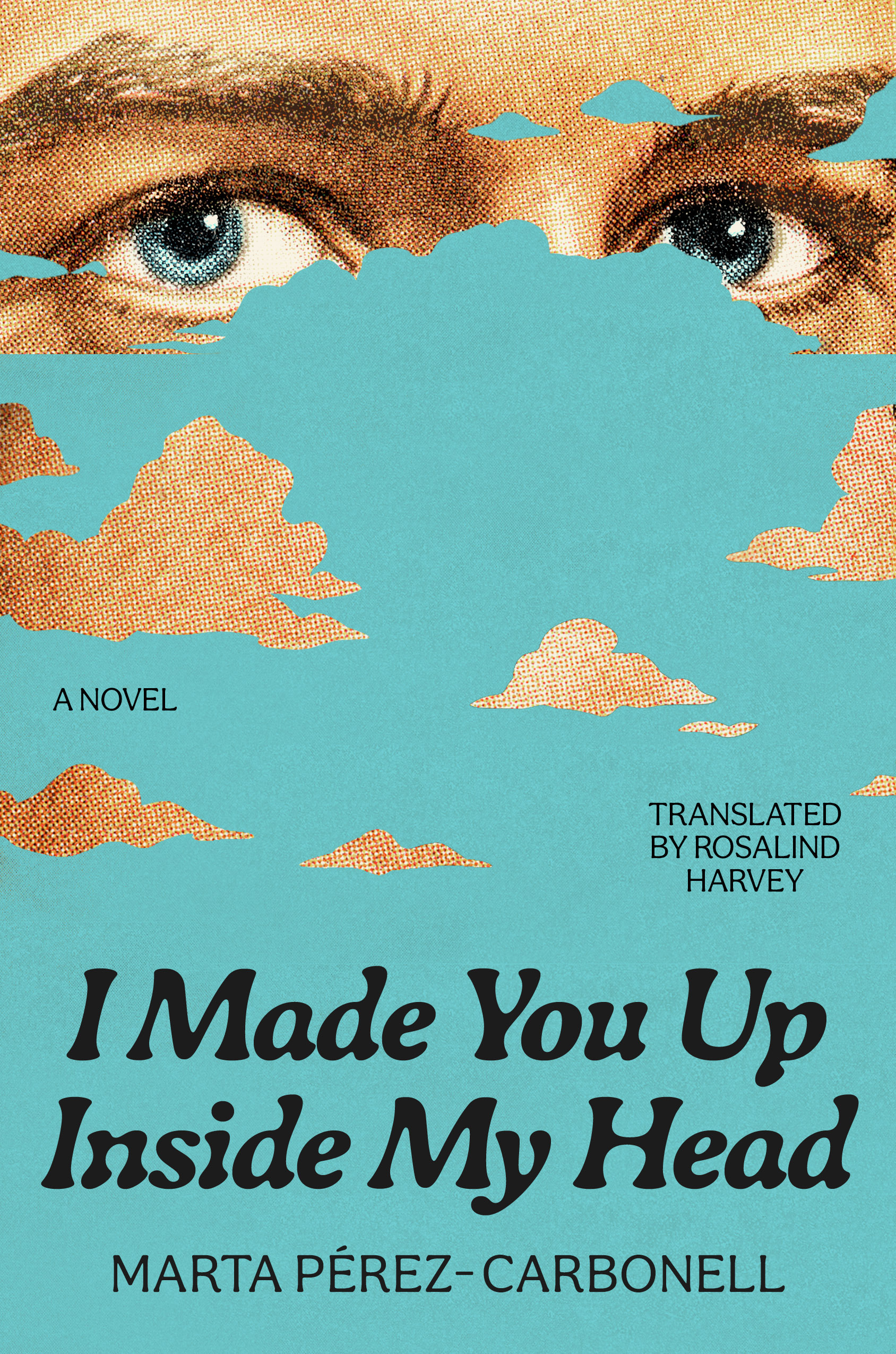
Excerpted from I Made You Up Inside My Head by Marta Pérez-Carbonell, translated by Rosalind Harvey. Copyright © 2026 by Marta Pérez-Carbonell. Excerpted by permission of Riverhead, an imprint and division of Penguin Random House LLC, New York. All rights reserved. No part of this excerpt may be reproduced or reprinted without permission in writing from the publisher.