
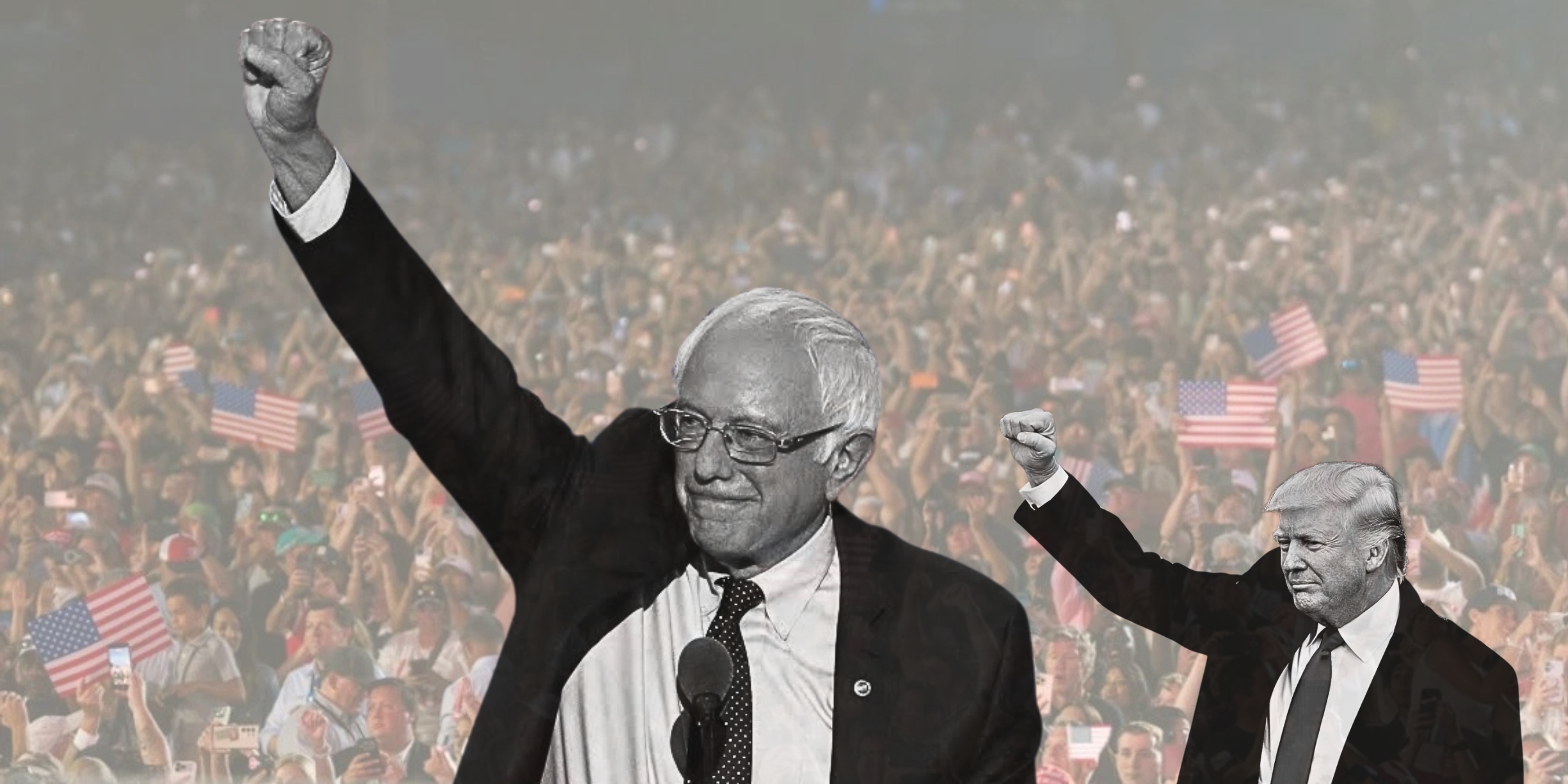
If you happened to catch the moment just right on June 16, 2015, when Donald Trump announced his bid for the presidency, you might have come away with the impression that he was delivering one of Bernie Sanders’s campaign speeches. Standing on a makeshift platform after stepping off the gilded escalator inside Trump Tower in his Manhattan complex, he condemned American healthcare prices as a “disaster,” vowed to defend Social Security, and promised to become “the greatest jobs president ever.” He pledged to boost infrastructure spending in a way that would bring blue-collar work back to the nation. What now seems almost comical in retrospect was his critique of money’s sway over politics: “I’ve watched the politicians. I’ve dealt with them all my life,” he declared. “They’re controlled completely by the lobbyists, by the donors, and by the special interests, completely.”
Setting aside the scathing vitriol aimed at immigrants, progressives, and Obamacare, the similarities to Bernie’s message become evident. Yet when Trump voiced these ideas, they weren’t the result of a long-evolved, heartfelt conviction rooted in progressive advocacy. Lacking any deeply held ideology—apart from exalted views of his own greatness—Trump was offering voters a claim to business savvy. Here was a man who had coached amateurs on The Apprentice, whose name adorned The Art of the Deal, and who, as Fran Lebowitz famously noted, presented himself as “a poor person’s notion of a rich person.” As events showed, Trump’s defining talent turned out to be a remarkable capacity for naked opportunism and a ravenous appetite for power.
Bernie was no mere observer of polls or a chameleon candidate; the core of his campaign rested on the progressive convictions he had nurtured and fought for across more than twenty-five years in government service and a lifetime as a democratic socialist.
In hindsight, however, what mattered most was how he framed these traits to appear as the outsider candidate who could draw in independent voters tired of both parties—an approach that ultimately helped him defeat Hillary Clinton, even if he did not win the popular vote. Trump’s team recognized how Bernie’s populist rhetoric, his renegade status, and the grassroots appeal to disaffected voters resonated, and since the Democratic Party showed little interest in leveraging that energy, they cleverly chose to harness it for their own march to the White House. Trump understood that he was appealing to Bernie’s potential voters in all three of his presidential campaigns. As he told a TV interviewer in 2024, “Last time,” referring both to 2016 and 2020, “we had a lot of Bernie supporters.”
Clear enough, they weren’t all Bernie supporters. The movement’s large contingent of young people and many of the progressive enthusiasts who turned out for Bernie in primaries did not align with Trump. Yet a sizable share of the independent-minded, working-class voters Bernie drew to his platform with his chief economic message was the same demographic that the older Reagan Democrats had once represented.
With a profound sense of distrust, disappointment, and alienation, many of these voters had drifted away from the Democratic Party. A portion of them participated in the 2016 Democratic primaries, and many cast ballots for Bernie. But in the general election, they swung toward the Republican nominee, seeking change. Trump’s populist rhetoric spoke to that yearning, and Bernie’s defeat in the primary left him able to exploit it as he moved toward the presidency.
Bernie was not merely a facts-and-polls organizer; the heart of his movement lay in the progressive ideals he championed after decades of public service and a lifelong alignment with democratic socialism. In almost every respect, Trump stood in stark opposition: no political track record, no history of activism, and a pattern of exploiting others for private gain. The one thing Trump did possess that Bernie did not was an apparently endless reservoir of wealth acquired through inheritance, exploitation, and greed. Was there a more cynical conduit for the imperative to “make America great again”?
When Trump entered the political arena, wrapping his lack of policy detail in a narrative that cast the American people as virtuous against corrupt elites and migrants, the media quickly labeled both men with the same tag. “Populism and voter discontent defined this political moment,” NPR observed that August. By March 2016, The New York Times Magazine posed the question: “How can Donald Trump and Bernie Sanders both be ‘populist’?”
Good question. How could two men so diametrically different—aside from gender and age—be cast as the same political archetype? The label felt lazy, in part because pinning down what populism actually is proves slippery. There’s broad disagreement about whether populism constitutes a coherent ideology in its own right. Or perhaps it’s simply a framework for organizing political life around class, without entirely adopting Marxist doctrine. Maybe it’s just a rhetorical tool politicians wield to advance their own aims.
What is indisputable is that populism centers on a rift between “us” and “them,” whether this gap is economic—regular people versus financial elites—or cultural, attacking immigrants, minorities, or the so-called ivory-tower intellectuals who populate universities and much of the Democratic Party. Bernie would point to oligarchs; Trump would target immigrants, liberals, Democrats, Obama, Hillary, environmentalists, and foreign interests as drains on American prosperity.
Yet within these polar modes, American populism encompasses a wide spectrum of ideologies, including many time-honored “isms”—socialism, communism, and even autocracy. Since the 1830s, when Andrew Jackson positioned himself as the first true American populist, most candidates don’t advertise themselves as “populists” even as they deploy its rhetoric.
Several historical figures would fit the bill. Huey Long, the Louisiana governor from 1928 to 1932, embodied many traditional populist traits: magnetic charm, a fierce defender of the “common man” against wealthy interests, a readiness to label dissenters as part of the problem, and political success built on dividing and proclaiming an “I alone can save you” message. He pursued a presidential bid against Franklin D. Roosevelt in 1936, but an assassin’s bullet cut his campaign short.
Roosevelt himself used populist language when denouncing “economic royalists” and the privileged dynasties. Across the twentieth century, figures such as George Wallace and Ross Perot emerged, and some have argued that Ronald Reagan also employed populist tactics. Viewed this way, Bernie and Trump appear as two faces of the same populist coin, but not because Trump shared Bernie’s genuine commitment to the “good people” in the eyes of his followers. Whereas Bernie’s movement elevates the many against a small, wealth-hoarding elite, Trump’s populism tends to divide and exclude. “The United States has become a dumping ground for everyone else’s problems,” he proclaimed when announcing his candidacy, pointing the finger at immigrants as those problems.
Trump could not have been more explicit about who belonged to his “us” and who were the “them” causing suffering.
I have little doubt that Trump kept Bernie’s rising momentum in mind when he entered the race. Bernie’s crowds in Iowa had become famous, and the pundits were buzzing about “Bernie-mentum.” That likely explains why Trump arrived with talking points Bernie had developed over years of campaigning: escalating healthcare costs, disappearing jobs, and the precarious future of the social safety net. He recognized that the concerns Bernie highlighted in speech after speech resonated with an electorate still reeling from the 2008 financial collapse.
Yet he also understood his conservative audience. So when he amplified the public’s anger about a fading American dream, he directed that ire at immigrants, Mexico, China, and the “morally corrupt” and “incompetent” officeholders, among others. While Bernie called for collective struggle and mobilization, Trump cast himself as the uniquely qualified person who could rescue the nation from within.
Never mind that Trump embodied exactly the sort of elitism and wealth accumulation Bernie had railed against. The dramatic ascent on that gilded escalator was not irony but a visual assertion of his résumé: behold my wealth and power, and thus an immunity to outside pressure. He was explicit that day: “We need a truly great leader now. We need a leader who authored The Art of the Deal.” He added, “I don’t need anybody’s money. I’m using my own money. I’m not dependent on lobbyists. I’m not dependent on donors. I don’t care. I’m truly rich… That’s the kind of thinking this country needs.”
I wouldn’t go so far as to claim Bernie directly inspired Trump’s populist ascent. He did, however, draw inspiration from powerful populist figures around the globe—Viktor Orbán in Hungary, Narendra Modi in India, and Jair Bolsonaro in Brazil, not to mention historical precedents like Margaret Thatcher. Trump blended into and amplified the global surge of a political class that scholars increasingly describe as “authoritarian populists.”
As the name implies, these leaders deploy populist rhetoric cynically as a path to power. Their ideology feeds on a nativist impulse and a hostility to diversity. They assume the mantle of liberators of the “true people” whom the corrupt political establishment has allowed to be exploited by outsiders—immigrants, LGBTQ+ people, and any minority that is a convenient scapegoat. Crucially, as political scientist Stuart Hall described when coining the term in 1979 to analyze Thatcher, authoritarian populism represents an “exceptional form of the capitalist state,” in which the outer show of liberal democracy persists even as real power concentrates in the hands of a few—or even a single person.
Trump did not hesitate to spell out who qualified as part of his “us” and who constituted the “them” responsible for Americans’ misfortune. “People who live here legally love Donald Trump,” he proclaimed at a Pittsburgh rally, urging stricter immigration controls. He blamed Barack Obama and his liberal allies for soaring healthcare costs, and he labeled Clinton as the most dishonest political figure of the era. While gesturing toward the line of TV crews and reporters behind him, he proclaimed, “These are the most dishonest people. These folks are far worse than the politicians.”
The pivotal—and then incendiary—facet of Trump’s 2016 campaign lay in his foreign policy stance. Here, too, he manufactured a xenophobic inversion of Bernie’s rhetoric. From the moment Bernie declared his candidacy, he distinguished himself from Clinton by opposing the Iraq War. “I voted against the war in Iraq,” Bernie told reporters in April 2015. “And not only did I vote against it… many of the statements I made at the time proved to be correct.”
If only someone as sharp and charismatic as Trump had been in charge back then, everything would have been different.
Clinton’s support for the Iraq War remained one of her most significant liabilities, and Trump used it to inflame opposition to Clinton and to redirect conservatives’ anger toward “the other”—not Mexican migrants this time, but Muslims. In his campaign launch, Trump claimed he had opposed the war, insisting that he “saw all the right predictions about Iraq.” The truth was otherwise: the record shows that he supported invasion in 2002. In a 2002 exchange with shock jock Howard Stern, Stern asked, “Are you for invading Iraq?” and Trump replied, “Yeah, I guess so.” I’m tempted to reuse that clip in a general-election ad now, given what followed.
But as events proved, Trump’s relationship with truth has always been fluid, and during the 2016 campaign he opportunistically used the preposterous claim that he opposed the war to lay blame for Middle America’s woes on ISIS. ISIS, he insisted, was why gas prices were high and why people felt unsafe in their suburban neighborhoods. If only someone as clever and magnetic as Trump had been in office then, he suggested, everything would be different.
His first campaign video, released in January 2016, put the decline of America at the feet of Democratic leaders and Muslims: images of Obama and Clinton were replaced with mugshots of two alleged Muslims as police sirens wailed in the background. “The politicians can pretend otherwise, but Donald Trump calls it ‘radical Islamic terrorism,’” an unseen narrator intoned. “That’s why he advocates a temporary ban on Muslim entry.”
In April 2016, at Brooklyn’s Prospect Park—the largest crowd of his campaign to that date—Bernie assured his backers that Trump would not prevail. “The American people will reject a candidate who insults Mexicans and Latinos, who mocks Muslims, who belittles women, veterans, and African Americans,” he argued. “We are not beholden to Wall Street or the billionaire class or corporate interests. We aren’t taking their money. We’ll do it a different way.”
A week later, Trump echoed Bernie’s critique in a tweet linking to a video that showed him speaking from within one of his glass-fronted offices in Manhattan: “The Establishment and special interests are destroying our country.” He vowed that “we’ll work with the establishment, but they won’t control what happens anymore. We’ll control it, and that will be good for you.” The resonance was unmistakable.
Yet it wouldn’t be good for “you” unless you happened to be a billionaire tech magnate or a pliant follower. The claim that his wealth shielded him from influence was laid bare even before the Oval Office became his.
I am not the only one who thinks Bernie would have won.
Today, the United States’ middle and working classes are confronted with greater food insecurity, diminished economic mobility, and higher medical costs than in 2016. And when a real threat emerged with the COVID-19 pandemic—and despite Operation Warp Speed—Trump repeatedly failed to shield the populace, prioritizing GDP over lives and health. Yet he blamed China, as if that explained everything.
Viewed in hindsight, 2016 was a contest that rewarded the outsider, and Trump’s victory over Clinton in the general election appears almost inevitable. It seems likely he would have faced a stiffer test against Bernie. The Republicans coalesced around their outsider, while the Democrats undermined their own candidate. Had Bernie won the nomination, that Prospect Park claim in April 2016 about Trump’s invincibility might well have been proven true.
One more piece of evidence, just days before November’s vote: Gravis Marketing conducted a poll paid for by a Democratic lawmaker who supported Bernie. The survey of 1,600 respondents found Bernie leading Trump 56–44—a double-digit margin that would have translated into a landslide in a general election, and could have forced down-ballot Democrats to ride Bernie’s coattails in crucial states such as Michigan and Wisconsin. Even if circumstances would have shifted had he faced Clinton, it’s reasonable to think the electoral map would have looked different.
I’m not alone in that view. In a retrospective that many describe as startling, even Trump’s own pollster suggested Bernie could have captured the white working class—precisely the group that tipped the 2016 race to Trump. “What do you think happens in Sanders versus Trump?” the moderator asked. “I think Sanders beats him,” replied Tony Fabrizio, Trump’s lead pollster, without hesitation.
__________________________________
From How the Democrats Screwed Bernie by Tad Devine. Copyright © 2026 by Thomas A. Devine. Reprinted by permission of Simon & Schuster, LLC.