
When I was twenty-one and finishing my final year in college, pursuing a degree in musical composition, my friends started calling me “The Youngest Spy in the World.” I let the nickname slide, embracing it as a kind of second skin far cooler than the one I’d crafted for myself: Aspiring Composer. It felt, even then, like something you draft in pencil until you’ve produced something worthy of ink.
They teased me, sure—perhaps with a touch of envy about a part‑time job I’d recently walked away from—though the joke hid a deeper curiosity about the possibility that one of us might already be living a life layered with unseen subplots. Beneath the predictable grind of crowded lectures, overpriced textbooks, and subpar cafeteria fare, there seemed to be a quiet extra story forming. (That Thursday’s entrée had been so aggressively overcooked that I wasn’t sure whether I’d eaten the fillet or the sole of a shoe.)
The truth was, there was no way to prove I actually was The Youngest Spy. There was no Google in those days. This was late ’80s Hartford, Connecticut. Before the internet. Before hostesses stopped asking, “Smoking or non?” Before toothbrushes resembled sneakers.
There I sat in our campus computer lab, polishing my résumé, weighing whether to include the spy stint at all. On the plus side, it hinted I’d once worked for a famous company embedded in the rarefied realm of classical music—the very world I hoped to breach after graduation. On the minus side, the job hadn’t endured. And, alas, none of mine ever did. My résumé until then looked less like a career path and more like a string of polite evictions. And looming larger than anything else was the internship interview at the local classical station, Allegro FM, where I hoped—almost prayed—to land the gig and, with luck, keep it. Because if anyone asked about that “spy” job, I’d be bound by conscience and a stubborn inability to lie convincingly to admit that it had, among other things, involved lap dances. From strippers.
As I typed and retyped that role onto my résumé, my finger kept instinctively erasing it—like a judgmental little assistant within my head refusing to let the job become part of my professional narrative. I could already picture the radio-station interview room: brief smiled nods followed by the carefully phrased, “Well, that’s… certainly a unique experience,” delivered with the same tone you’d use to compliment a child’s finger painting—then sliding the résumé into a folder marked “Absolutely Not.”
The internship interview, arranged as a favor by the dean of my music program, was scheduled at Allegro FM, home to Bertram Bobker, the station’s voice for more than four decades. Now past eighty, the man behind the voice remained sharp and fully lucid.
Enchanted by Bertram, I was the kind of devotee who could wear his image on a T‑shirt and tattoo his quotes on my forearms. Just as EF Hutton, when Bertram spoke, people listened. He spoke with a refined Boston cadence, where the “W” and the “H” in words like what, when, and why sounded almost individually articulated—deliciously precise, as if butter had a flavor you could taste. He could take a debate about strophic interludes found in medieval motets and make it sound gripping. And he was also a comic genius. I remember driving back from my parents’ home in New Jersey to Hartford, listening to him on the radio, and his riff on the difference between classical music and the Classical era. He quipped: “Besides the Rococo influence and the inventions of the piano and the smallpox vaccine, you can’t discuss the Classical era without mentioning the Industrial, French, and American Revolutions. Okay, I’ve mentioned them.”
I laughed so hard I had to pull over, clutching my sides. Landing this internship and the chance to work—or even share the same air—with Bertram felt like the moment a teenage Bill Clinton met JFK in the Rose Garden, or the moment I glimpsed Mary Tyler Moore in a Paramus department store and momentarily forgot how language works.
Beyond Bertram, securing this job would place me inside the sphere I truly wanted to inhabit. Not as a composer—yet—that dream still flickered in the margins of my notebooks and dim corners of my ambition. But this would bring me into proximity; it would be a sort of professional osmosis. I wouldn’t yet live the life I dreamed of, but I’d be close enough to hear it humming in the next room, waiting for someone like me to tap on the door.
All my previous, ostensibly music-related jobs were so far removed from the target world they felt more like they belonged in a windowless basement three ZIP codes away, staffed by failed balloon artists and one guy who thought “Rhapsody in Blue” was a deodorant.
Take, for instance, a freshman-year gig at a music shop where the manager claimed the job was to play piano during lunch so customers would linger and shop. I asked to play guitar instead, the instrument I actually played best. He looked at me as if I’d committed a typesetting error in a love letter: small, ruinous, and hopeless to fix. I agreed to piano, then.
For a couple of weeks things seemed promising, performing passable takes on tunes like “The Entertainer” and “Heart and Soul.” Then one day, he returned with complaints about my repertoire and insisted I perform Beethoven’s “Für Elise” from opening to close, each rendition in a different key, as if that would fool customers into hearing something fresh. “Modulation equals innovation,” he said with a smile that suggested he’d long since surrendered to the elevator music of his own life. I managed the original key—A minor—but then flubbed it so badly in G♯ minor that I was let go before the final chords.
My sophomore year began with a glimmer of hope when I answered a help-wanted ad to arrange for a bandleader named Johnny Novak. He offered a hundred dollars per arrangement. With rent, textbooks, groceries, and the quiet humiliations of adulthood looming, I said yes without asking what kind of band Johnny led. Desperation, after all, tends to skip the fine print. It turned out to be a polka outfit, Johnny at the helm with what might have been the world’s largest accordion—something I might have found charming if I hadn’t been the one trying to arrange “Pinkalinko Polka” for an instrument I could barely lift, let alone compose for. Add in horns, drums, bass, and the creeping realization that I had no clue what I was doing. Johnny fired me after three arrangements and didn’t even pay for the third, which he deemed unplayable. True, I couldn’t play it. But I did think he should have earned his chops too.
The whole experience drained my enthusiasm for months, and I paged through the classifieds as if scanning my own obituary. I answered jobs with the same mixed hope and mourning I felt about their possible disappearance. My pride, once upright and starched, sagged like an old coat on a peg. Still, somewhere inside that collapsing tent of ambition, I kept going because, stubborn as I was, my Sears Discover card’s collection agency showed no mercy for my increasingly delicate artistic experiment.
Then, one day, I spotted an ASCAP posting on my music school’s bulletin board. The description was vague—something about being a music aficionado capable of beating a drop‑the‑needle test. I recall only that you had to be twenty-one and they paid twenty-five dollars an hour. Considering I’d just spent ten hours cobbling together one pathetic polka arrangement for Johnny and this gig paid nearly five times what I made pumping gas in high school, I was unbelievably eager. So, when ASCAP called from their New York offices and invited me in for an interview, I hopped a train from Hartford faster than you could say “Pinkalinko Polka.”
Among other functions, ASCAP collects royalties for songwriters and composers whenever their music is played in stores, restaurants, bars, malls—any public venue. The organization hires teams that scrutinize radio playlists and figure out which of their clients are getting the most airtime. Based on complex calculations, millions are distributed each quarter to members worldwide, including classical composers whose fortunes occasionally ride on the fame of pop icons like Michael Jackson and Madonna.
Of course I didn’t know any of this beforehand. The night before the interview, driven by coffee from a vending machine and a rising panic, I buried myself in the library, reading every possible article and vaguely related entry I could find. I emerged at 3:00 a.m. with a halfway decent grasp of performance rights, a page of talking points, and the fear of being asked to define a “blanket license” aloud.
I faced Susan, an ASCAP HR representative, in a nondescript office so bland it felt almost designed on purpose. As she finished a call, my gaze drifted to the windows behind her. Lincoln Center lay just beyond, its white stone and glass shining like a temple. I couldn’t shake the ache for that world to turn toward me. I imagined my own music filling those grand spaces someday. It wasn’t merely a dream; it was a hunger—a quiet ache in my chest. I could almost hear it—the hush before the downbeat, the audience waiting, the swell of strings. It was maddening to feel so close and yet know that the moment hadn’t arrived, that no one inside knew I belonged there yet.
My eyes wandered to the towering concert posters in their glass cases along the street, among them Mozart’s Symphony No. 31—one of his most celebrated works.
Ah, Mozart.
Waiting for Susan to finish her call, I recalled the first time I truly encountered his music—there’s hearing, and there’s hearing that rewires your brain in an instant, transforming sound into an intimate listening experience.
Freshman year, my first girlfriend Jennifer suggested a weekend trip to Boston. The course we’d taken, Music Theory and Analysis I: Diatonic Harmony, sounded grand, though in practice it mostly meant Jennifer raising her hand with the fearless confidence of a cliff diver named Helmut.
She became the person I’d eventually exchange mixtapes and, perhaps, firsts with—though not necessarily in that order or with equal finesse. She possessed a quiet intelligence, a penchant for car snacks, and a calm detachment that compelled me to sit a little straighter, as if I’d seem more date-worthy if I stopped slouching.
The drive was unremarkable in its own way—long, hopeful, with the radio bouncing between heartbreak ballads and gospel-tinged anthems as if to decide whether to console or convert us.
At one point we found ourselves in Harvard Square, the air thick with bookstores and stale gum. A theater was showing Amadeus, Miloš Forman’s film. We bought tickets, settled into our seats, and somewhere inside the film, my life cracked open as if a fortune cookie had shattered with too much truth. In a scene where Salieri reads Mozart’s Serenade No. 10 for Winds in B-flat major and describes the music as if sharing a private confession with God, I didn’t breathe for two minutes. That music, and F. Murray Abraham’s exquisite portrayal, didn’t just strike me—it unstitched me. Every counterpoint, every piercing harmonic turn felt like a direct message from a higher plane. It wasn’t merely beautiful; it was devastating in its clarity and purpose.
By film’s end I was a wreck, tears streaking down my face like threads from an old garment, Mozart’s life slipping into a common grave after such luminous brilliance. Without Jennifer’s help, I’d have trouble finding my way back to the subway. My body moved, but my mind remained suspended in those chords, still awash in awe. It felt as if something inside had been exposed—some delicate nerve or long-dormant ache I hadn’t known I carried. Back in the Back Bay, where our youth hostel stood, I headed to Tower Records and bought every Mozart record I could afford, not pausing for second thoughts. I needed to inhabit that sound, to live inside it for as long as possible.
Back at ASCAP, waiting for Susan, I remembered returning to Hartford and hiding in the campus library, devouring Mozart’s scores one after another, along with biographies, hoping to soak up his genius through proximity.
And then I reminded myself of what the man had achieved by my age. At the same moment I was interviewing for ASCAP, Mozart had already produced thirty symphonies, innumerable sonatas and concertos, and nearly a dozen operas. Operas! Full-length works! My ears didn’t know much about opera at the time. To my untrained sense, the plots felt like a sitcom misunderstanding stretched to breaking point, only with heartbreak, vengeance, and a soprano capable of shattering glass. But even so, how could any teenager boast nearly a dozen such works? If only there’d been Google then. But that era hadn’t yet arrived, when customer-service lines swell with questions and speculation.
And yet there I sat, at the same age, with almost nothing to show for it beyond a handful of student pieces performed by fellow sleep-deprived colleagues on campus, or an evening of original songs I’d performed at my grandmother’s nursing home in Florida—a screen‑advertised night titled “An Unforgettable Night of Song” that, in hindsight, sounded more memorable for what the residents failed to remember than for the performances themselves.
My gaze returned to the Lincoln Center poster for Mozart’s Symphony No. 31. The piece was born during a so-called triumphant job-hunting venture in Paris, which, of course, never came to pass. Not only was there no job and no triumph—just another symphony added to Mozart’s staggering catalog—but his mother, who had accompanied him from Salzburg, fell ill on the long journey by horse-drawn carriage and died not long after they reached Paris.
I shifted in my chair and caught a hopeful glance from Susan, who was signaling “one more minute” with a practiced smile. Then, in a moment of quiet desperation dressed as restraint, I did what any rational person would when financial security hangs by a thread: I appealed to fate for mercy—specifically, a gentler destiny in New York than the one Mozart endured in Paris.
Finally, she hung up and explained ASCAP’s long history. She described that when outfits like clothing stores or eateries didn’t pay their annual music licensing fee, a freelance observer—someone like the job I’d applied for—would be deployed to record every song performed during an evening. The resulting playlist served as evidence to compel payment. In many cases, after years of nonpayment, ASCAP would sue and take the matter to court. The playlists I’d be gathering would often decide the outcome. Interestingly, the establishments most prone to delinquency during that era were strip bars.
“So let me make sure I’ve got this right,” I said, once my eyebrows settled back into their natural place. “You’ll pay me twenty-five dollars an hour to sit there and watch dancers take their clothes off?” I tried to sound professional, but it came out as if I were reading a lottery ticket twice.
Susan’s mouth pressed into a thin line. “There are drawbacks to the job as well.”
“Really?”
“The bars tend to fill up with rowdy truckers when they’re drunk. There’s a lot of cigarette smoke, which can be tough for some. And the music is extremely loud. You might end the night with ringing ears. It’s not for everyone.”
I hadn’t considered the negative sides, dazzled as I was by my own twenty-one-year-old certainty.
“Also,” she added with a tighter smile, “to avoid drawing attention, you’ll need to tip the dancers. Some of the performers might sit on your lap briefly while you’re tipping. It’s a matter of how comfortable you are with that kind of situation.”
I nodded as if signing a formal contract. Somewhere in the back of my brain—just beyond the place where I stored my Social Security number and a dizzying index of every Beatles tune and the cut of its composition—my mind began assembling a mental reel of what a night would entail: women, sequins, sultry moves, dollar bills, the whole glamorous, terrifying tableau of a shark cage dive. Beautiful creatures circling, glittering in the water, and me, barely legal, barely breathing, clutching a crumpled bill like a weapon—or a prayer.
Susan studied me as if deciding whether I’d flinch. Then, with the calm of someone who’d already tested ten terrified students that month, she pressed on. “Sometimes you’ll also need to buy drinks. Some places require a two‑drink minimum. We’d prefer if those were sodas instead of liquor so you can stay focused on the job. You can also order food, which often counts toward the drink minimum. The tips, the drinks, travel expenses to and from—you can be reimbursed as long as you keep receipts. You’ll need receipts.”
She cast a look that said receipts aren’t necessary for singles and then offered a Tic Tac as a kind of sedative. I declined. My breath was manageable; my bank account wasn’t. My roommates had already lent me money to cover last month’s rent, their generosity delivered with a laid-back assurance that only made it worse. They shrugged—“Just repay us when you can”—but the word when hovered over me like a deadline wearing mercy’s mask. I resented how grateful I was, and how broke I remained, and how those two states multiplied in silence.
Whether Susan was subtly steering me away or simply prepping me for what lay ahead was hard to tell. She smiled. But some people smile while lying. Others smile because they know you’ll say yes. When she finally asked if I needed a moment to think, to weigh my options (as if I had any), I told her no. I didn’t hesitate. It was the largest paycheck I’d ever seen for anything, period. A part of me felt elated; another part, dizzy with the unknown, trembled at the thought of what I’d signed up for. But as I shook her hand, the part of me that had never stepped inside a strip club, let alone clocked in to one, started to panic quietly in the shadows. This was happening. To me. On purpose.
__________________________________
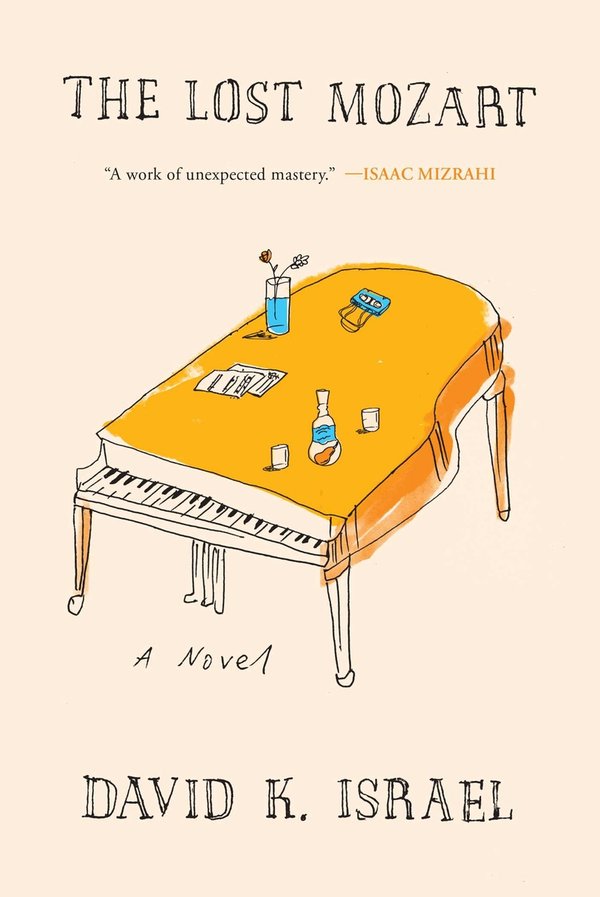
From The Lost Mozart by David K. Israel. Used with permission of the publisher, Regalo Press. Copyright © 2026.