
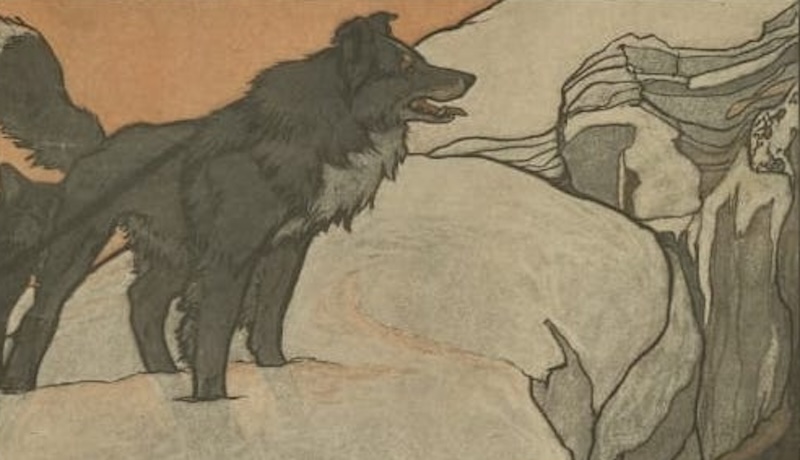
They tread a landscape imperiled by the wreckage of human activity, yet they gravitate toward their own kind—fascinating in their solidarity and, at times, devastatingly self-destructive. They read human odors, collaborate with people to endure, curl up to guard their human companions, and occasionally strike. But above all, as the perceptive canines narrate their journeys through a fractured world, they emerge as thoughtful witnesses to human fragility.
In Paul Yoon’s forthcoming novel, Etna, a mixed-breed shepherd speaks with a spare, impressionistic calm tinted by nostalgia as he recollects being ripped from a tranquil farm to fight in a global war where he is trained to be a stoic killer. Yet Etna looks with tenderness on the vulnerable American soldiers who command him. “Perhaps every person carries their own song,” he muses, “as if it were another heart, much like the way the men in my unit sang to themselves, headphones on at night.”
In John Berger’s King: A Street Story (1999), King physically defends a vulnerable elderly homeless couple stranded on a street, yet his most enduring support comes from listening—he lets them recall the security they once possessed, letting their memories form a lifeline. And in George Saunders’ tragicomic short tale, “Fox 8” (2013), the canine-narrator, who shares canine lineage with the human audience, grows besotted with a nearby family yet becomes painfully disillusioned when workers with hard hats clear-cut his forest home.
I found these tales quintessentially American—a chorus of male figures forming bonds on a formidable frontier. Yet the modern hinterland is not pristine wilderness but a man-made wasteland. When Etna’s close companion and handler Jason is killed after years of brutal combat, Etna resolves to find his coastal puppyhood home, a journey across a landscape scarred by refugees. To his refined senses, rain tastes like jet fuel and the air is heavy with the stench of detonations, while the ground is littered with bones and dried corpses.
Etna’s imagined ancestry traces back to Jack London’s Buck, the canine hero of Call of the Wild (1903), pressed into labor as a sled dog in the Alaskan Klondike under a ruthless regime until rescued by the compassionate prospector Jack Thornton. Beside the campfire, Buck grows to cherish his master.
Call of the Wild stands as a field study of civilization’s clash with primal instinct. In close third-person narration, London presents Buck as torn between the easygoing roots of Santa Clara Valley and an ancestral feral drive he discovers in the nighttime Alaskan woods. London links this condition to the feverish zeal he detects behind men’s domesticated façades. “This ecstasy, this oblivion to life,” London writes, “comes to the artist, swallowed by fire; it comes to the soldier, war-mad on a ravaged field.”
While Yoon likewise sketches a bleak view of human society—one that inflicts catastrophic war upon itself—nearly every named human in his pages remains sympathetic, all victims of an offstage political regime that drafts them. Like Etna, they are sensitive beings shaped by a brutal environment. Jason’s quiet rapport with Etna—“as if he were gently but firmly guiding a line of string”—reveals a tenderness. Etna senses Jason’s loneliness; watching the soldier play piano in an abandoned house, Etna imagines that perhaps the human voice is trying to speak through the instrument the way he tries to speak to Jason.
Etna communicates telepathically with Soojin, a near-supernatural dog whisperer, though she’s the one who first abducts him for war and names him after the Sicilian volcano. Ultimately, Etna’s deepest bond is with Hong, the itinerant medic who tends to his emaciated, shrapnel-scarred body.
Saunders’ “Fox 8” presents a contrast to Yoon’s and London’s works, functioning as a suburban fable in which the narrator connects with humans from a distance. He absorbs human culture with fascination, to the point of writing his own story after watching parents read bedtime tales to their children (he apologizes for any “werds I spel rong”). He is moved by the human kindness—an affectionate kiss at bedtime—that makes him yearn to hold the infant and dream of one day going to college with the child.
Yet, after gaining our sympathy for this eager, innocent narrator, Saunders jolts us. Together with his companion Fox 7, Fox 8 investigates a new shopping plaza creeping into their forest home and is struck by the rituals of human consumption, noting their surroundings as “a splendor no fox could entirely curate.” When they depart, construction workers kill Fox 7 for sport, and Fox 8 returns to find his clan’s den missing. While another fox clan eventually takes him in, the care feels more like a temporary buffer against a mounting human nihilism.
The final act features a moral missive from the canine narrator to the “Yumans,” asking, “How could the same species who made that loveable mawl make Fox 7 look the way he did that day I first saw him?”
These canine narrators assume a Greek chorus-like function, taking part in a mounting catastrophe while maintaining a critical, outsider’s vantage. They testify, question, and mourn the myopic, self-destructive choices of humans who fail to scrutinize themselves. “Why did the Curator do it so rong,” Fox 8 laments, “and make the group with the greatest skill the meanest?”
When a narrative preserves a dog’s viewpoint throughout, readers are kept outside human consciousness, even within the third-person framework of Call of the Wild. The ensemble of eccentric, quarrelsome dogs often dominates the stage, eclipsing the more peripheral human characters until Thornton’s entry.
In King: A Street Story, which Yoon cites as an inspiration for Etna, the narrator remains in constant dialogue with Vico and Vica, the couple he shelters, while also acting as a careful sentinel for a homeless community living beneath a highway overpass. Across the novel’s 24 hours, he serves as a stabilizing ear for the distressed, quarrelsome pair who rehearse their past as if they were in a Beckett play. “I make people feel that whatever they tell, I’m hearing it for the first time,” he explains, ensuring that their fragile histories remain preserved. Like Etna, the narrator’s senses grant him piercing perception. “Humans possess seven layers of skin,” he notes curiously. “Water has five, and I can distinguish each one with my tongue.” He isn’t a spiritual healer, but he absorbs Vico’s and Vica’s pain by listening to their testimony. Fox 8, Etna, and King collectively evoke the impression of extraordinarily intelligent, compassionate extraterrestrials who aspire to rescue humans from their own self-inflicted wounds.
These canine narrators assume a Greek chorus-like role, participating in a mounting catastrophe while maintaining a discerning outsider’s stance.
Yet, despite their quiet tenderness and their rich inner universes, both King and Etna speak in a restrained, almost detached register. King bears the marks of years spent on city streets, while Etna bears the trauma of mass violence, emerging as a deeply scarred, emotionally numb survivor. The young dog snatched from a peaceful family life, forced to sever neck and arteries in moments of brutal necessity, recounts his tale in a flat, unembellished voice: “All the men we were with killed other men and sometimes animals, and I killed, and Fuji killed, and the other dogs killed.” Yoon’s prose mirrors the stark detachment found in Remarque, Hemingway’s World War I fiction, and Tim O’Brien’s Vietnam narratives. Etna’s terse, declarative sentences—short statements, repeated rhythms, and a muted cadence—reveal the mental calculus of those who endure ceaseless, aimless war. This pared-down style lays bare the psychological toll of violence on those who survive.
But Yoon enriches this neutral tone with lively, intelligent exchanges among Etna and his animal companions (Etna can converse with all species, though Soojin remains the sole human). The animals debate, banter, and even probe questions of faith together, featuring a swearing cat, a grumpy donkey, two singing horses, and a bird fond of Socratic discourse.
By steering Etna’s journey toward a homecoming, Yoon rekindles the pastoral nostalgia that has long underwritten the canine tradition of human–dog duels with the harsh wilderness. London’s Buck memories the brightness of his California roots, though the recollections gradually fade as primal instincts take command. King—the urban wanderer—remembers carefree woodland days, claiming those memories express a universal canine longing. Etna clings to a prewar Edenic memory as his compass, hoping for a coastline that may yet be real, or perhaps a fragile vestige of a primordial impulse. The catastrophe that surrounds him raises the question of whether such a sanctuary can exist at all, or if it merely reflects a naïve longing or a remnant of primal memory.
Yoon undertakes the literary challenge of reimagining familiar tropes and a narrative device that risks becoming predictable—the sagacious animal narrator, a return to innocence, the unleashing of primitive savagery in the wild, and the intimate, masculine bond between human and dog forged around a communal fire. At times, the author seems to skirt well-trodden ground, but he carves out fresh territory by crafting a fully realized protagonist whose war-scarred inner voice feels almost human while staying convincingly canine. Influenced by Berger, Yoon elevates the idea London first introduced—that a perceptive dog might grant a singular lens onto human character—into something more nuanced. Yoon expands this eccentric dog-narrator’s nose-to-ground vantage, which is at once domestic, vigilant, and faintly wild. Etna is not a prophet in a fallen world, yet by refracting fragments of their collective hopes, fears, impulses, and possibilities, he offers humanity a singular reflection.