
Long ago, though not so distant in memory, a woman defied her father by giving her heart to another man. The sting of that rebellion burned more intensely because of the divide in rank between the two men who carried her blood. She descended from a Kalabari war-canoe chief on the Niger Delta, and knowing her father’s sacred standing as head of a founding clan, she should have learned, as the folk song about her affair would later declare, to keep her heart from wandering and her body under control with a roaming dancer who had no canoe to call his own. Her kin sharpened their blades and hissed at their chieftain’s misfortune, but the community’s auxiliary women—co-wives, half-sisters, and elder matriarchs along the Sombreiro River—joined forces to soothe the old man’s ego and dull the warriors’ thirst for vengeance by reminding everyone that Akaso, the supreme goddess who presided over their pantheon, frowned upon needless bloodshed. In the mournful love ballad still sung by Iriawo dancers in the concrete town that sprouted from that island, the peaceful voices of those valiant women outlived their goddess, whose supremacy was already being eclipsed by Jehovah and his crusading legions of white men.
The father was Chief Wariboko, a raider whose hat always seemed cocked at an angle, feared long ago by neighboring villages for the slave trade that funded his wealth both at home and abroad. The beloved daughter who wounded his pride in his autumn years was Tekena, the first of her name. The name of her runaway lover, who vanished into the creeks after getting his lover pregnant, endured in the song for generations, yet he never saw their child, never returned to that mangrove island where the boy grew up under his grandfather’s tired gaze and eventually inherited all the customary rights and honors of his mother, along with her reputable family name, after she died early from a stingray’s strike while fishing for mudskippers. When the British governor-general formalized the name Nigeria, a label some say arose from Niger area, others hint at a missing g—for the diverse nations they had pressed into one colony—the eight-year-old son of Tekena, first of her name, still played clapping games in that remote fishing village under the supervision of his schoolteacher uncle, who had become the new head of the Wariboko war-canoe house.
The child’s name was Jamabo Wariboko, the stranger who took refuge. He carried his father’s dancing legs, his mother’s stubborn resolve, and the fighting spirit of a boy toughened by playground bullies in a village whose kinship structure revolved around the war-canoe house of a formidable patriarch and his clan—an arrangement that included kin, trading partners, hired workers, and captured slaves. Jamabo’s fate was to repudiate any insinuations about inherited weakness and to establish a war-canoe chiefdom through his own financial enterprises, honoring forebears who had once been notorious pirates. Yet the fusion of swampland, rainforest, savannah, and desert into the Nigerian colony had reshaped everyone’s destiny, including Chadwick, the colonial-educated uncle who now led a family once devoted to slavery as they tried to fit into a Christianized order. When Chadwick was sent to the budding port city of Port Harcourt to oversee a missionary school, he left behind his ancestral stool and feathered crown, the symbols of nobility, but carried along his church-wedded wife and their five children, as well as his teenage nephew, who had never ventured beyond the sheltered world of his birth, the crude oil-rich waters around his mother’s grave.
Guided by his stern uncle, Jamabo completed the rest of his schooling and earned a James Aggrey scholarship to Columbia University in New York, where he lived for six years before taking a position in Trinidad. After twenty years of travel for work and leisure, also visiting his birthplace to choose a wife and build a home over his mother’s grave, he settled back in his homeland at independence as part of the educated middle class—citizens who returned from abroad to replace Queen Elizabeth’s civil servants. Inspired by the bloodless expulsion of the old rulers who had cobbled together and named their country (a Nigeria with no intrinsic meaning in any local language, yet kept along with the English language of their education), the new leaders toasted to fresh beginnings with blood-red French wine swirling in crystal goblets from Germany, and feasted on bone-white porcelain with Sheffield-sourced silver, never realizing that the crumbs they tossed to their guards and housemaids would not sustain but rather inflame a ragged populace still unsure where they belonged in the new order. Not everyone could share Jamabo’s luck—an orphaned son of a noble matriarch whose slave-trading father had valued lineage enough to ensure the grandson would inherit the Nigerian future he himself had stolen from countless others.
And what a future it became for the revelers of that newborn nation. The old politics of their many centuries-old cultures, briefly paused by European warships, resumed with a vengeance, their ferocity sharpened by the broken space created by forced nationhood. Igbo, Yoruba, and Hausa—the three largest of more than three hundred ethnic groups—proved decisive in the torrent of military coups that preceded and followed the civil war. Famine, greed, refugees seeking asylum in the very lands they had fought to leave, the lament of Europe underdeveloping Africa, and the unending drumbeat of Nigerian trauma—these are the tunes that accompanied the nation’s awakening. We all know the familiar refrain about how Europe underdeveloped Africa, so the question remains: why retell the Nigerian agonies of those who were “the wretched of the earth”?
Nigeria, like Jamabo, emerged as an accidental offspring of a reckless romance between insiders and outsiders. Jamabo learned this truth too late to escape, choosing instead to endure in a life shaped by compromised ideals, as did many bourgeois figures who found that sheer numbers could not overcome the adversities rooted in a country built on fragile compromises. His devotion to civil service drained his vitality and eroded his means by a thousand cuts. He came to understand that his job would not sustain him unless he cooked the books. His code of islander justice—formed under the blows of bullies protected by his father’s influence—clashed with a justice system that prioritized who had influence over who was innocent. Such deception produced only poisoned fruit, swelling overseas bank accounts for the candidates who seeded duplicity into the soil of the nation’s dreams. For Jamabo—descendant of a fearless mother; a scion of Kalabari heroes who traded blackness for whiteness and were rewarded with trinkets; a son who had done everything to prove he was unlike the roaming dancer from his mother’s song—it was a horror to realize that his homeland would never prosper. By the time he died at sixty-nine, his world had shrunk to his wife Dakoru and their three children, his closest kin, the same insular boundaries of his colonial childhood.
What you don’t know becomes the only thing you know, an overjoyed widow would declare one day to her long-lost grandchildren, the boy and girl their mother had brought from Lagos to visit her on her deathbed.
__________________________________
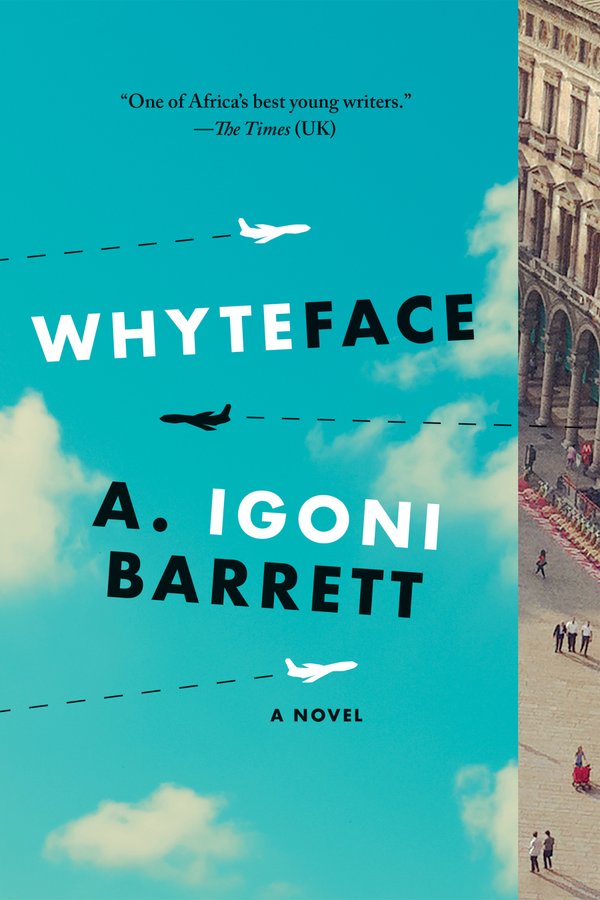
From Whyteface by A. Igoni Barrett. Copyright © 2026 by A. Igoni Barrett. Reprinted with the permission of Graywolf Press, Minneapolis, Minnesota, www.graywolfpress.org.