
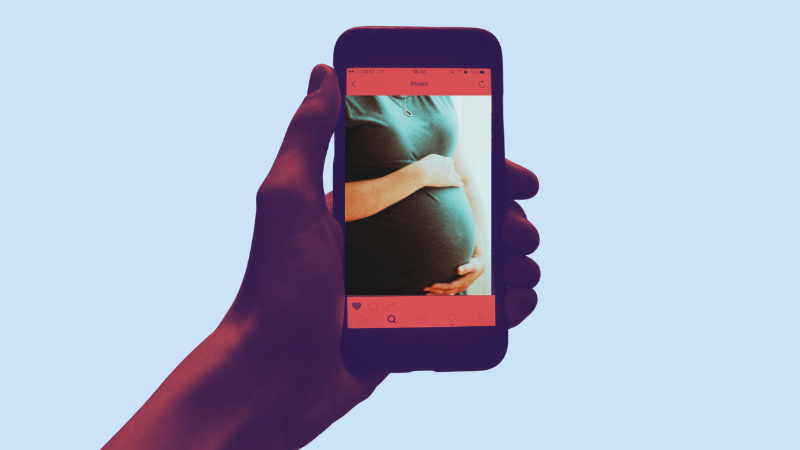
For well over a century now, families have sported rows of rictus grins for the camera, but the subgenre of family portraiture (and, later, video clips) dedicated to conception, gestation, and birth is very much a product of the social media age. Pregnancy announcements, “bump” portraiture, and gender reveals are all visual conventions that were born with social media.
Part of this is coincidental; cultural norms and infant survival rates changed dramatically over the course of the twentieth century. Pregnancy announcements perhaps would have been popular during the early days of still photography, but because of the persistently high rates of pregnancy loss and infant mortality well into the middle of the century, it wasn’t customary to turn reproduction into a public spectacle. There was simply too much risk involved. Grief was too bound up with reproduction to allow for much celebration until an infant was safely past their vulnerable first few months on earth.
Attitudes about women’s bodies also conspired to keep pregnancies shrouded behind modest, tentlike maternity wear. Women’s bodies and the fetuses they carried were not entirely their own; they belonged to husbands, and a family’s respectability depended on the maintenance of a strict boundary between public and private. Showing off a bump was hardly fashionable until the early ’90s. When Demi Moore appeared naked and seven months pregnant on the cover of Vanity Fair in 1991, the public was not ready. Many newsstands censored the issue’s cover, as though it were pornography.
Of course, when it comes to bodies on screens, there are always rules about what to represent, and how.
Representations of pregnant bodies were utterly transformed in the thirty years following Moore’s famous cover. Pregnancy went from being a private experience to a public display—an opportunity to demonstrate physical fitness, sexual desirability, wealth, and moral rigor through disciplined adherence to health recommendations. It’s hard to overstate the degree to which the pregnant cis female body has become a vessel for late modernity’s most cherished, stubborn fantasies about femininity and power. Even as birth rates fall, a pregnant body remains an object of nearly pathological fascination.
But it’s also much simpler than that—a matter of a match between a biological phenomenon that has become more public as health conditions and birth rates have changed and a communications medium that loves a visual surprise: a bump, a reveal, an unplanned reaction. With a built-in countdown accompanied by telltale visual signs, a pregnant body is a perfect subject for social media. Viewers are invited to scrutinize—is she or isn’t she?—and then to watch the body transform, to surprise even the pregnant person. Every pregnancy feels somehow unprecedented, and social media is a medium that creates novelty out of ordinary life.
Of course, when it comes to bodies on screens, there are always rules about what to represent, and how. Displaying pregnancy the “right” way has become as rigidly codified as pregnancy was tightly controlled and hidden a century ago. This is a rare circumstance in which more open representation has not necessarily translated into more freedom of behavior. Pregnancy is hyperscrutinized on social media, which in turn has given rise to a set of stringent visual conventions. Pregnancy offers social media audiences an opportunity to surveil a gradual transformation like amateur naturalists, and it elevates a routine biological process into a spectacle of status and economic fitness.
Fat women, for example, are not given the chance to perform pregnancy the “right” way on social media. The visual form demands a stark contrast between the protruding belly and the slimness of the rest of a woman’s body. The need to emphasize this contrast is often why pregnant women pose with their hands in the “bump hands” position, framing their midsections so as to avoid any possible misreading by the audience: I am pregnant, but I am not fat. Bump hands are code for the “right kind of pregnancy.” They’re a gesture of victory on the brutal playing field that is having a body in public.
But the rigor with which the rules of permissible pregnancy are maintained makes them impossible to ignore.
Pictures abound of small pregnant bodies that conform to the ruthless rules about how healthy women are supposed to look (and behave), but women with bigger bodies often completely disappear from view when they become pregnant. This self-enforced seclusion reinforces a shared visual language on social media. Pregnancy, like family happiness, is meant to look a certain way. Since we began using these digital tools, we’ve been telling the story of pregnancy the same way, and every time we re-create its narrative with images, we further consecrate it.
Women whose bodies don’t align with the ideal don’t enjoy the elevated status that social media confers on small-bodied pregnant women. Often, women who can’t flaunt “fit” pregnancies hide themselves from social media altogether. Likewise, the postpartum period is fraught for many women; there is, for one thing, a stubborn cultural fixation with “bouncing back” and quickly returning to a prepregnancy size. For the countless women who either never bounce back or bounce back slowly, social media can add a layer of shame.
Rochelle, a twenty-five-year-old teacher’s assistant whom I met in New Orleans, was expecting her second child. She hadn’t shown her body on social media since her first pregnancy. “Becoming a mom and going through postpartum and stuff, I am not ready to show myself as who I am now,” she told me. “I feel like I’ve changed. My body has changed. I have to get comfortable in who I am again, and then I’ll post myself again.”
The years since Moore’s Vanity Fair cover have seen a complete one-eighty in how pregnancy is represented in media. Previously, it was a site of strictly enforced feminine modesty, but now it’s a site of physical fetish. We idolize women who “carry a basketball” while their upper arms remain as slender as a child’s. Posed pregnancy photos often have more than a hint of sexual energy, as women are given tacit permission, per the norms that currently govern social platforms, to reveal their bare bellies as long as their skin is stretched taut, with no excess fat showing. One could argue that this is progress; at least pregnant women are permitted their sexuality rather than being immediately shunted into the category of sexless matrons. But the rigor with which the rules of permissible pregnancy are maintained makes them impossible to ignore.
Throughout the first twenty years of our history as digital storytellers, family-life representation has continued on the same trajectory that started with the fantasy-family home videos first made by amateur filmmakers in the 1920s and ’30s. This era, which we could call the “say-cheese” era, is giving way to a new age of visual storytelling characterized by an orientation toward what we can call, broadly speaking, the “big reveal.”
The big-reveal era was technically born on YouTube in 2008, when Jenna Karvunidis, an American blogger, shared what’s considered to be the first-ever gender-reveal video, in which she and her family cut into a cake with an inner layer of pink icing and all reacted with surprise that they would be welcoming a girl. For the next seven years, YouTube was the primary place where videos were shared, and editing tools were not quite as accessible as they needed to be for most people to create content. Videos were the domain of professional vloggers and bloggers.
That began to change in 2015, when media companies started to “pivot to video” in response to pressure from Facebook and advertisers. Although this pivot is associated with a seismic media shift away from writing and toward video content, one can also see its impact in the things that everyday people shared on their own social platforms beginning around this time. Just as writers were being laid off en masse from media companies like MTV, Mashable, and Vice Media, ordinary people around the world were experimenting with video as a new way to tell stories on social media. Starting with Vine (which was sold to Twitter in 2012, resulting in its dissolution) and gaining traction with the wide adoption of TikTok in 2018 and finally Instagram Reels in 2020, video offered new affordances for telling stories of reproduction.
The appeal of big-reveal content lies in its promise of authentic human emotion.
Video allows for the capture of emotion in one essential way that still photography can’t compete with: It can reward suspense and document surprise, and it can invite viewers to experience surprise vicariously. This is the essence of big-reveal content, which has come to set a certain tone in social storytelling about family reproduction.
Big-reveal content includes marriage proposals, pregnancy and gender reveals, and emotional reunions at airport arrival lounges. This type of content is based on generating an affective commodity of sincere surprise. Sincere emotion—surprise in particular—has become a crucial X factor for creating engaging social media content in an era of increasingly crowded and noisy social media feeds. A decade ago, someone sharing a special memory on Instagram would have been doing so for an audience of friends who were using social media with the intention of consuming precisely this type of content. It was an effective marriage of form and content, a place to share important moments with people who were predisposed to care.
Today, our social feeds contain at least as much advertising as content created by our chosen networks. These networks have ballooned to include celebrities, brands we like, meme accounts we follow, local personalities from our communities, and suggested posts based on what our friends consume. It’s a roiling stew of stimulation, and it’s a lot for the average person to try to compete with in terms of capturing the attention of a friend mid-scroll.
Platform algorithms have evolved to jerk our emotions around like marionettes. It’s an affective onslaught, and a quiet little family picture is simply not going to register amid all the spectacle. Big reveals operate to compete within the dizzying churn by making a spectacle out of commonplace family reproduction. They are a consequence of the ever-intensifying emotional terrain of social media, in which we are continuously baited in bids for our attention.
The appeal of big-reveal content lies in its promise of authentic human emotion. Decades of scrolling have dulled our senses somewhat; this is inevitable. After years of seeing enough photos of fabulous wealth and horrible tragedy, these types of images cease to shock us. It’s getting harder and harder to get through to us at all. But the big reveal offers the promise of something “real” that “happens.” It’s all that most of us are really looking for when we’re scrolling. It’s all that most of us are really looking for at all, really.
In this way, big-reveal content commodifies authentic human emotion. As big reveals continue to occupy an important place in the lexicon of family storytelling on social media, their tropes are manifesting off-screen. Although I haven’t found any studies to back this up, I am confident through anecdotal observation that young children are learning to exaggerate their reactions, probably as much because of the affective patterns they are picking up from YouTubers as from family members, but the source code is the same: Having internalized the challenge of attracting and holding attention, we instinctively know that bigger reactions are more eye-catching than subtler ones. The content that we create and consume is teaching us what kind of behavior gets attention, and big-reveal content is among the major ways these lessons are transmitted.
__________________________________
From The Story of Your Life by Kathryn Jezer-Morton, published by Viking, an imprint of Penguin Publishing Group, a division of Penguin Random House, LLC. Copyright © 2026 by Kathryn Jezer-Morton.