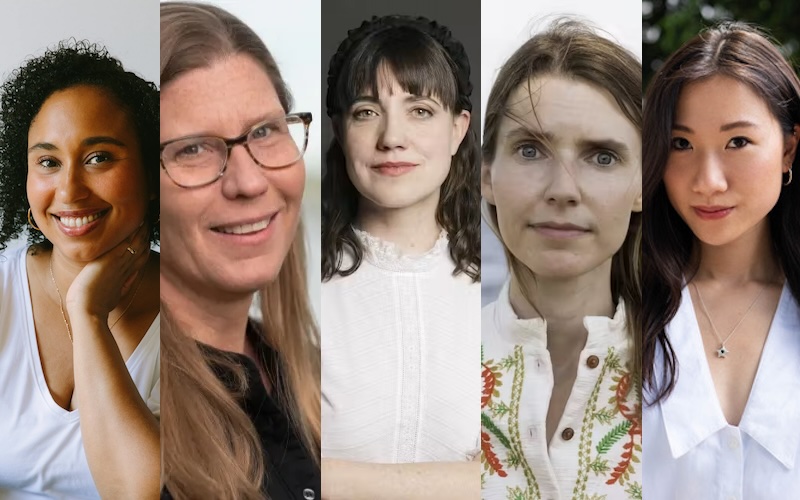
The Lit Hub Author Questionnaire is a monthly interview featuring seven questions for five authors with new books. This month we talk to:
Naima Coster (Take What You Can); Elizabeth Jannuzzi (Sober Mom); Emily McBride (Queen Mab); Katy Simpson Smith (The Maltese Version); Stacey Yu (Kitten)
*
Without summarizing it in any way, how would you describe the core focus of your book?
Naima Coster: Deep friendships; the ache of motherhood without it; hunger and longing; appetites and desire; loyalty tested by sexuality; troubled marriages; feeling stretched between poverty and wealth. Rich and poor, extravagance and consequence. The settings span Brooklyn and the South of France, with water—the sea—at the center of it all.
Elizabeth Jannuzzi: Cleverly concealing a vodka bottle (behind the food processor, inside riding boots). How to derail your life and still pull off dinner. A reluctant person’s guide to the twelve steps. Maintaining marriage while undergoing a personal transformation.
Emily McBride: Folklore creatures—foxes, moths, fairies. Parenting within a framework of capitalist realism. Street art, academic rivalries, and the small but vital ritual of drinking hot tea for mental clarity. Overeating while breastfeeding. Fragmented family histories.
Katy Simpson Smith: The immense, intricate, sensually charged gap between thinking you know and actually knowing.
Stacey Yu: The end of childhood; the sense of being completely out of place; the smell of cats; motherhood; the gap in work ethic within relationships; the social dynamics of care; surprising, devastating mistakes; surprising, exhilarating, life-changing connections.
*
Without explaining why and without naming other authors or books, can you discuss the various influences on your book?
Elizabeth Jannuzzi: Svedka vodka. The neon sign that reads “Sin Will Find You Out” on a Hell’s Kitchen street I’d see in my twenties after leaving the bodega with a six-pack and cigarettes tucked under my arm. “My Own Worst Enemy” by Lit. Church basements, aluminum chairs, coffee in foam cups. The wisdom of my sponsor. Daffodils along wooden fences in springtime.
Stacey Yu: Works of art that render the strange, oppressive, and beautiful landscape of childhood; narrators with distinctive voices I’d follow anywhere; novels that center intimate, complicated parent–child relationships where the parent acts as a steadfast anchor in the plot.
Naima Coster: Friendship-centered novels, stories about women and the outdoors, estrangement, grief, attachment theory, and New York City restaurant life.
Katy Simpson Smith: White lies. Diacritics. Heather and spurge. The Chicago Transit Authority. Cubist art. Online patient portals. The archetypal bestselling author whose mysteries make for good bedtime reading with a partner. Night swimming.
Emily McBride: Early Gothic writers, fairy tales and their reimaginings, Victorian era dramatizations on Masterpiece Theatre, Modernist influences during the post-birth pursuit of self-improvement, living among Catalan writers and their influences, translated literature, and balancing strands from the 19th, 20th, and 21st centuries.
*
Without using complete sentences, how would you describe what was happening in your life as you wrote this book?
Emily McBride: A new baby—bemusement and ambivalence—chaotic short piece, then returning to work. A second newborn—planning and plotting, returning to work, first draft. A global pandemic—second, third, and fourth drafts. A third baby—fifth draft. In between, plenty of worry, catastrophizing, wine, and nursery rhymes.
Naima Coster: Growing and raising children. Pregnancy loss. Sleepless nights. Teaching. Rebuilding a body changed by birth. An ocean of love and more love.
Elizabeth Jannuzzi: Reclaiming my sobriety after five years. Older, more self-sufficient children. A solid, supportive marriage. Growing confidence that I had a story worth telling and the ability to tell it.
Stacey Yu: Falling deeply in love, yet still discovering that love doesn’t cure everything.
Katy Simpson Smith: Questioning and un-questioning love; a pandemic; a few pregnancies.
*
What are some words you dislike when readers and reviewers apply to your writing?
Katy Simpson Smith: “Bad.”
Emily McBride: I’m not fond of “lyrical” or “poetic.” I aim for nice prose, but those terms imply a cryptic reverence for language that isn’t how I think about writing. I also push back on “harrowing” or “sad.” I see it as more political than purely emotional.
Stacey Yu: “Weird.” Not necessarily despised, but I question what it truly implies.
Elizabeth Jannuzzi: “Brave.” I truly dislike that descriptor for writing about my alcoholism and recovery. Would it be brave to talk about diabetes? Why is it brave to tell you I attend AA meetings? Please don’t tell people they’re brave merely for sharing their lives.
Naima Coster: Full of questions but short on answers. I understand turning to books for insight—that’s why I read and write—but isn’t the best we can do to study something honestly and wonder aloud?
*
If you could pursue a different career (disregarding education and talent requirements), what would you pick?
Stacey Yu: A baby-clothes designer.
Katy Simpson Smith: I’ve lately felt drawn to applying to Harvard Divinity School. The course catalog excites me—“American Heretics,” “Sacrifice: Theory and Praxis,” “Animals, Trees, and the Unseen,” “A Poetics of Difficulty,” “Early Christian Demonology.” I want to grapple with Big Questions and discuss them with others, perhaps finding shared paths toward good. (If we’re doing it right, maybe that’s what writing is, too.)
Naima Coster: A midwife. Birth is transformative, terrifying, and miraculous. I’d love to accompany others through it.
Emily McBride: I’m not quitting writing as my day job. Yet, if I were choosing a new path, it would be something useful that connects me with a broad range of people (for material material).
Elizabeth Jannuzzi: I’ll say when my writing becomes my main work. Right now I’m a nonprofit program director—lucky, it’s a nonprofit that supports writers, but I’m not a career memoirist… yet. If not writing, perhaps professional photography. My husband swears my phone photos demonstrate strong composition!
*
Which craft aspects feel strongest for you, and what would you like to improve?
Naima Coster: I excel at portraying inner life and stepping into a character’s consciousness as well as their bodily experience. I’d like to strengthen my ability to craft the middle portions of narratives.
Stacey Yu: I think I’m strong in voice and phrasing. Dialogue could use work. I’m a somewhat awkward speaker; I can’t record voice notes without sounding as though I’ve never spoken in full sentences.
Katy Simpson Smith: I’ve always been attentive to sentences and cadence. I’m still wrestling with plot, but I’d like to believe this is my most intricate, twist-filled book yet.
Elizabeth Jannuzzi: My forte lies in sensory detail—placing readers inside the moment, then stepping back to reveal my thoughts and feelings, then adding reflection to show transformation. My struggle is knowing where to end a scene or when to end a story. I could keep writing about my life indefinitely because the thread continues, and as we say in AA, it’s progress, not perfection.
Emily McBride: I’m pretty good at editing. I’m creative and comfortable experimenting with scene structure, sentence length, and point of view. My goal is to sharpen my sense of humor. I can do wordplay and witty dialogue, but I’d like to craft a scene whose humor comes from what happens within it.
*
How do you manage the potential arrogance of believing anyone would care about what you have to say?
Elizabeth Jannuzzi: In recovery, one learns that a very personal story can help another alcoholic who’s fighting the same battle. So I share mine in hopes that someone reads it, thinks “me too,” and feels less alone. The broader truth is that I love personal stories. I want to know your whole life—where you’re from, what your parents are like, what motivates you, and what you had for lunch. If I want to know that about others, I assume people want to know that about me. Grilled cheese, by the way.
Emily McBride: I don’t spend much time thinking about it.
Naima Coster: My writing process is already so filled with self-doubt and self-critique that, by the time I finish a piece, I’m overdue for a sense of pride.
Katy Simpson Smith: That’s an easy one; I no longer assume anyone is interested at all. Every reader feels like a surprise, a gift, a little extra bonus. Still, I hope to revisit that sense of hubris someday.
Stacey Yu: Is it wrong to admit I’ve never paused to consider it before? I carry many writing insecurities, but why people should read it isn’t one of them. As a reader, my appetite for other people’s work and ideas is basically endless. I view other readers that way too: their interest isn’t a token to be spent on me or someone else, but a lasting quality that brought them to my book and, hopefully, to many more in the future.