
The prisoner’s hand ached. He hunched over his desk in the chill of the Bastille’s towers in Paris, drafting on a scroll that stretched nearly forty feet, assembled from a mosaic of scraps he had glued together. The conditions of his work were far from ideal, yet they were workable enough for him to endure.
As a nobleman, the inmate enjoyed certain privileges within his cell—clothes, tapestries, a stock of books and perfume, and even a private housekeeper. Still, he understood that what he was putting to paper might threaten those comforts. So, every night he would roll up his manuscript, place it in a copper tube, and conceal it within a crevice in the wall to prevent the guards from discovering it. And with good reason. For his tale recorded his most debauched thoughts and desires.
Across thirty-seven evenings in the autumn of 1785, the prisoner—Donatien Alphonse François, better known as the Marquis de Sade—carefully created in secret what he believed to be “the most impure tale ever told since the world began.”
Set within a secluded medieval fortress hidden in the Black Forest of southwestern Germany—but drawing on Sade’s own Lacoste castle as a model—the narrative follows four wealthy libertines who embark on a grueling 120-day orgy. The plot is driven by the abrasive stories told by a cadre of strict procuresses, who recount their perversions or “passions” ranging from the mild to the lethal. The libertines’ escapades involve the sexual abuse of abducted victims—most of them children, including some related to the men. The bad actions spiral into grave harm, with the victims subjected to brutal mistreatment and murder, and darker forms of sexual violence.
Art can be dangerous—but the very gatekeepers of supposedly depraved art can also be dangerous.
This narrative unfolds with a cold, almost clinical precision. Sade presents it with a wry humor, framing it as a sensuous “banquet.” Today the work is known as The 120 Days of Sodom.
*
The Marquis de Sade was deserted by his parents at an early age. Brought up by servants and educated by an uncle, Sade was a spoiled youth with a volatile temper and a taste for rebellion. He attended the Lycée Louis-le-Grand, one of Paris’s most esteemed schools, where he endured regular beatings that left a lasting imprint—an experience that fed his lifelong fascination with pain and domination. After completing his education, he served in the Seven Years’ War as a colonel of a Dragoon regiment. Upon his return, Sade married Renée-Pélagie de Montreuil in 1763, a match arranged by his father.
Some people view marriage as a stability; for Sade, it became a stage for his most scandalous fantasies. His notorious sexual indiscretions in Paris led to exile at Lacoste in 1768, a residence that would become the stage for his most daring libertine experiments. There, Sade and his wife—steadfast in their partnership—lived an extreme life of intrigues and sexual exploration. There were orgies, including a notorious episode in which Sade is said to have poisoned two sex workers using a potent aphrodisiac. There were also acts of homosexual activity that brought severe consequences, including capital punishment in absentia for Sade and his companion Latour.
Most infamous was the so‑called “Little Girls” affair, in which Sade abducted five fifteen-year-old girls for sexual abuse at his castle. The case became a public sensation in Provence, and Sade is reported to have reveled in the notoriety: “I pass for the werewolf of these parts,” he remarked. He evaded French justice by seeking refuge in Italy, but years later, after similar crimes there, he was arrested and imprisoned at the Château de Vincennes by royal decree, held under a lettres de cachet. When Vincennes was dissolved in 1784, Sade was moved to the Bastille at age forty‑five.
Four years after he began his audacious novel on that long parchment, Sade sparked a riot among other prisoners at the Bastille by shouting to a crowd outside his window that guards were slashing the throats of inmates. Once order was restored, he was relocated—“naked as a worm”—to an asylum outside Paris. The move meant he could not recover his manuscript, which had been hidden in his cell wall. Then, ten days later, revolutionaries stormed the Bastille. Hearing of the looting and upheaval, Sade believed his secret work had been lost forever. He wept “tears of blood” in his grief for his vanished masterpiece.
Remarkably, the scroll had not vanished. It had been saved just before the siege by a man named Arnoux de Saint-Maximin. After passing through the hands of a Provençal aristocrat and later a German devotee of erotica, the manuscript finally appeared in print in 1904, released by Iwan Bloch, a Berlin sexologist. Bloch, who used a pen name for the publication, contended that Sade’s extremities should be seen not as obscene but as scientifically and anthropologically meaningful. He wrote that The 120 Days of Sodom stands out as unlike anything found in classical or modern literature.
Bloch was not alone in appreciating Sade’s art. Through much of the twentieth century the novel circulated in private pressings for wealthy patrons, often produced under pseudonyms to stay under the radar. In the mid‑century, the publisher Jean-Jacques Pauvert published a large French edition of Sade’s works, including The 120 Days of Sodom. Like Bloch, Pauvert viewed Sade’s work as a crucial medico‑legal artifact; his edition was the first major commercially available French edition, with most copies sold to professionals in the medical world.
Artists, philosophers, and historians began to recognize aesthetic, cognitive, and political value in Sade’s writings. Simone de Beauvoir disagreed with his ethics, but in 1955 she defended the publication of his work on existentialist grounds, arguing it possessed philosophical significance. In 1957, Georges Bataille celebrated Sade’s fearless portrayal of human desire, while cautioning that reading Les Cent Vingt Journées de Sodome could provoke a visceral reaction: “No one, unless completely deaf to it, can finish The 120 Days of Sodom without feeling ill.”
Around this period, avant-garde artists and writers drew on what Alyce Mahon calls the “Sadean imagination” to critique political extremes—from fascism to terrorism—and to subvert traditional gender roles by centering the sexual body in art as a form of social resistance.
Eventually a shift occurred. In a landmark British court case in 1960, Penguin Books was cleared of criminal liability for printing an uncensored edition of D. H. Lawrence’s Lady Chatterley’s Lover, a work long condemned for its frank language. Although the novel had circulated in private editions in Italy and France, the UK verdict—echoed in a similar American case a year earlier—encouraged mainstream publishers around the world to distribute works once deemed obscene, including Sade’s.
Many hailed this as a watershed victory for artistic freedom, ushering in a broader reevaluation of literature and art that could tackle controversial or offensive themes. Today, the original manuscript of The 120 Days of Sodom is valued at several million euros and is deemed a French national treasure. Some critics have even described Sade as France’s Shakespeare.
*
Since the middle of the twentieth century, societies across the globe have undergone a sweeping transformation in attitudes toward obscenity and immorality. In the realms of art, literature, cinema, and television, expressions once deemed indecent or immoral have become commonplace, especially in Western cultures. Where it would once have been rare to encounter explicit depictions of vice, sex, blasphemy, and gruesome death, today it would be unusual to pass an entire day without facing one or more of these forms of expression.
For those who actively seek out transgressive material, the supply seems inexhaustible. With pornography accessible on laptops and smartphones, people can view images and videos that would have made Sade blush. While some genres aim to promote a more egalitarian approach to sexuality—respecting consent and avoiding patriarchal conditioning—others revel in portraying horror, including real sexual violence and death. Many of the acts that Sade described in his prose are now reproduced in high-production videos that can be streamed for free.
This shift in values and accessibility has profoundly altered the story of art. From Alfred Hitchcock’s Psycho (1960) to Vito Acconci’s Seedbed (1972), from explicit music videos like Cardi B and Megan Thee Stallion’s “WAP (Wet-Ass Pussy)” (2020) to dark true-crime dramas such as Ryan Murphy and Ian Brennan’s Monster: The Ed Gein Story (2025), audiences now celebrate themes that were once deemed immoral. Where medieval English Christian art faced threats from the Lollards who viewed image-worship as pagan, we now encounter art that deliberately pushes boundaries: Christ depicted in defilement, blasphemous imagery, or sacred figures reimagined in provocative contexts. Even apparel—like a Cradle of Filth shirt bearing illicit messages—could spark controversy as fans wore it publicly during the 1990s, sometimes drawing legal trouble.
Depravity does not always appear how we might expect it to. It can hide in plain sight like a wolf in sheep’s clothing.
For some, these works amuse or thrill; for others, they provoke deep unease. It is said that so many visitors to The Exorcist were overwhelmed by intense reactions that theater staff had to hand out smelling salts. And a very small subset has turned to violence in response, as seen in the terrorist attacks on the offices of the French magazine Charlie Hebdo in 2011, 2015, and 2020, motivated by the magazine’s satirical depictions of the Prophet Muhammad.
Today, violence has become a staple in many art forms, especially video games. The Grand Theft Auto series is notorious for its depictions of drugs, sex, and brutality, including interactive scenes of torture. In 2006, Japan released a controversial title called RapeLay, which centers on a male protagonist who stalks and sexually assaults a mother and her young daughters. Such examples show how far conversations about decency and freedom have traveled.
As art and its creators cast aside old restraints, political leaders and commentators have routinely argued that unlimited freedom of expression jeopardizes society. In the 1960s, the British activist Mary Whitehouse championed a crusade against what she called a “permissive society.” While she is often criticized for anti-sex education campaigns and her prejudice against LGBTQ communities, some now view parts of her critique as prescient: her push contributed to laws like the 1978 Protection of Children Act, which criminalized child pornography.
Whitehouse’s influence culminated in the so‑called “porn wars” of the 1970s and 1980s. In contrast, feminists such as Andrea Dworkin argued that pornography dehumanizes women and fuels violence, while others—like Angela Carter—saw porn as offering a space for women’s autonomy and sexual freedom. The debate endures. People still debate whether contemporary works such as WAP represent female empowerment or a regression in women’s progress, with commentators like Ben Shapiro and James Bradley voicing sharp critiques about its societal impact.
Often these disagreements rest on questions of taste and prejudice, yet they gain weight when artworks are seen as contributing to real-world harm. Critics worry that easy access to pornography and the sexualization of popular culture affect young people’s expectations of sex; they fear that the glamorization of violence and crime in films, games, and music videos can inspire imitation. Many civil-rights advocates also argue that public displays celebrating imperialists, slave traders, or racist leaders reinforce ongoing inequality and damage the dignity of marginalized groups.
There are more targeted cases too. In the 1980s and 1990s, certain white-supremacist circles cited William Luther Pierce’s Turner Diaries as an influence on their hate crimes and acts of terrorism. The novel portrays a violent uprising and race war and has been credited with shaping white nationalist sentiment in several countries. After the 2012 Colorado cinema massacre, rumors—later shown to be unfounded—that the attacker was inspired by the Joker character from The Dark Knight movies persisted, illustrating how people often link grim art with real violence even when the evidence does not support the connection.
Public attitudes have sometimes been inconsistent. In the 1990s, sexually explicit images of women faced censorship in some contexts, while museums crowded with nude paintings did not shield women from being judged for what they wore. The broader arc suggests a complicated relation between art and morality, a tension between freedom and restraint that continues to shape debates about what counts as acceptable culture. The overall takeaway is that depravity can surprise us, often appearing in places we did not expect and without obvious warning.
___________________________
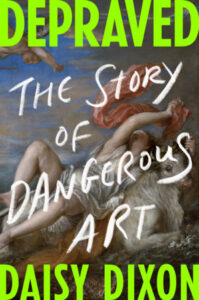
From Depraved: The Story of Dangerous Art by Daisy Dixon. Published by Viking, an imprint of Penguin Publishing Group, a division of Penguin Random House, LLC. Copyright © 2026 by Daisy Dixon.