
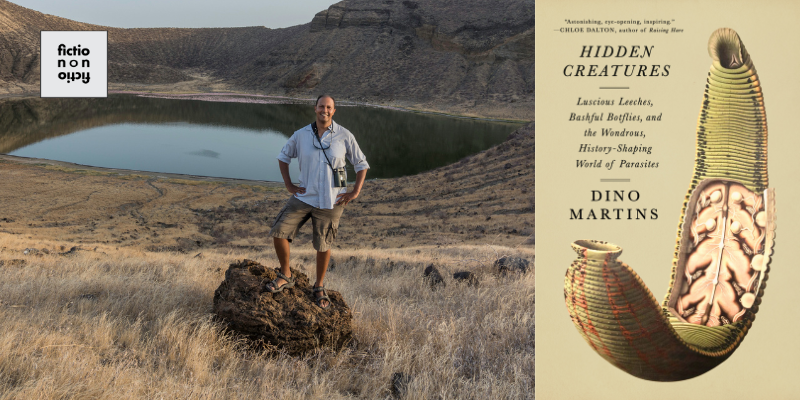
Entomologist Dino Martins joins co-host V.V. Ganeshananthan and Whitney Terrell to talk about the Cyclospora outbreak that has sickened thousands of people across the U.S., as well as the New World screwworm that has been affecting the cattle population. Martins, the author of a new book called Hidden Creatures: Luscious Leeches, Bashful Botflies, and the Wondrous, History-Shaping World of Parasites, discusses the benefits and dangers of parasites and reflects on his own lifelong interest in bugs, beginning with his childhood in Kenya. He explains how living alongside other animals has taught him to observe the world differently. Martins reads from Hidden Creatures.
To hear the full episode, subscribe through iTunes, Google Play, Stitcher, Spotify, or your favorite podcast app (include the forward slashes when searching). You can also listen by streaming from the player below. Check out video versions of our interviews on the Fiction/Non/Fiction Instagram account, the Fiction/Non/Fiction YouTube Channel, and our show website: https://www.fnfpodcast.net/ This podcast is produced by V.V. Ganeshananthan and Whitney Terrell.
Dino Martins
Hidden Creatures: Luscious Leeches, Bashful Botflies, and the Wondrous, History-Shaping World of Parasites • Grasses of East Africa • Turkana Basin Institute
Others
Fiction/Non/Fiction Season 7, Episode 45: Jasmin Graham on Understanding Sharks • Fiction/non/Fiction Season 9, Episode 7: Kathryn Nuernberger on Mutualism, Climate, and Finding Family at the End of the World • Alien (1979) dir. Ridley Scott • The Fly (1986) dir. David Cronenberg • Stand by Me (1986) dir. Rob Reiner
EXCERPT FROM A CONVERSATION WITH DINO MARTINS
V.V. Ganeshananthan: It’s funny how we’ve somehow crafted a sequence of nature-focused episodes where we claim a creature carries a frightening myth, yet we invite an expert to explain why that fear isn’t quite warranted. We already did sharks. Your book also inventories a parade of supposedly adorable parasites—fleas, ticks, and tapeworms—though Cyclospora, which has dominated headlines here and has us wary of our lettuce, is microscopic. Which parasite in your book does Cyclospora most resemble? How does it survive and reproduce?
Dino Martins: Cyclospora isn’t a major concern in many regions of the world because many of these organisms are a regular presence in daily life. They’re more or less part of the backdrop. I’d compare it most closely to certain intestinal worms that reside in the guts and stomachs of various hosts, including people.
Cyclospora stands out as a highly specialized parasite. Its life cycle can only be completed by infiltrating the cells lining the intestine. It must enter a host cell to finish development, and it belongs to a large group of apicomplexan, Coccidia-type protozoa. It is related to the parasite that causes malaria, which is currently attracting a great deal of attention, and rightly so. It’s quite terrifying.
Even I find it hard to call it cute, yet it deserves our respect because this tiny, spore-forming little thing can devastate entire populations. A central message of my book is to illustrate how extraordinary these organisms are and how influential they can be.
Whitney Terrell: So my impression—perhaps not as precise as yours—is that Cyclospora is transmitted mostly through water contaminated with feces. What does that say about the safety of our food system? Is this a common issue, or are we seeing a decline? Has anything shifted, or is this simply a sporadic outbreak we can forget?
DM: In most contemporary outbreaks, the underlying driver is our own actions—what we do to the planet, our farming methods, how we dispose of waste, and how we overwhelm ecological processes that would normally balance, filter, or assimilate these things, especially when the environment around them is rich with other life.
Yes, it appears foodborne in this instance, but the larger point is that many parasites we once believed conquered—after antibiotics, antiparasitic drugs, pesticides, and other chemicals—are staging a remarkable comeback. They aren’t merely returning; they are reasserting themselves in a striking fashion. They seem to say, “You thought you’d rid us, but here we are, and we’re coming for you.”
WT: That doesn’t sound cute at all! It comes across as rather aggressive.
DM: It is. I think part of nature is being both endearing and fierce.
VVG: So endearing, marvelous… You include a remarkable chapter titled “Marvelous Maggots” in the book, and the New World screwworm, which has been infesting cattle in the southern United States, seems to me like a maggot. Is that a fair characterization? Could you explain that outbreak?
DM: Indeed, and I both adore and loathe the New World screwworm in equal measure. There’s also an Old World screwworm that’s just as terrifying. In essence, yes, they are maggots—the larval stage of a fly species that lays eggs on animals, usually on an open wound or scratch, though some can penetrate intact skin.
Unlike most maggots, these develop within living flesh. As they feed, they chew away at tissue, creating large, oozing wounds. Interestingly, some secrete a chemical that humans can’t detect but that lures other flies to lay eggs there as well. They are parasites, certainly. They’re chilling to look at, yet they are widespread.
Historically, this parasite was very common in parts of North and Central America and caused major problems. It was tackled in a remarkable way: scientists devised the sterile insect technique, sterilizing many male flies and releasing billions of them so that matings produced no offspring. This strategy defeated the screwworm and allowed the Texas beef industry and other livestock sectors to rebound. What we’re seeing now is a resurgence, a reminder that we can’t completely repel nature with technology and culture alone, and we must also consider factors like how densely livestock are kept and other global changes at play.
WT: I’ve heard about these screwworms from a neighbor who works for the FDA; he warned me this would return, and soon enough the news followed. My question is, when these maggots cause open wounds in cattle, do those wounds cause death, or do they primarily lead to infection, or what exactly harms the cattle once the screwworm has laid its eggs?
DM: The wounds are extremely painful and uncomfortable. They fester and become infected very quickly, and the infection then spreads through the animal. The affected animal grows weak, withdrawn, and dehydrated. During times when screwworms were abundant, vast areas were dotted with carcasses bearing festering wounds, and deer populations were driven nearly to extinction in parts of North America by the screwworm, a fact that seems almost unimaginable today given deer’s current status. Another facet of parasites is their ability to track, manipulate, and in some cases suppress the numbers of their hosts.
Transcribed by Otter.ai. Condensed and edited by Vianna O’Hara. Photograph of Dino Martins by Liam Frederick.