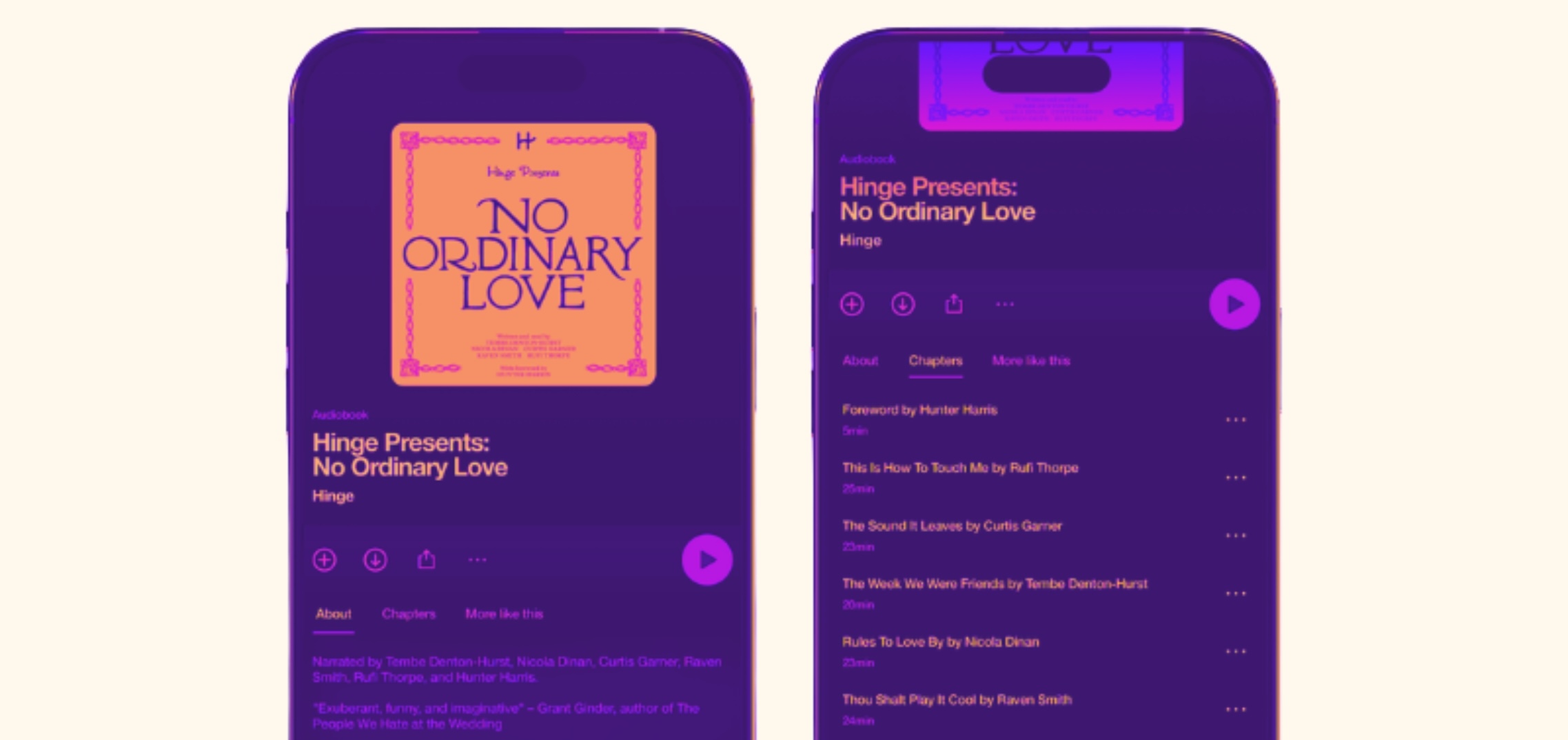
On Monday, Hinge—yes, that Hinge—released a free audiobook comprised of five original short stories inspired by the dating sagas of real Hinge couples. The five pieces were written and narrated by a sparkly cohort of contemporary authors: Tembe Denton-Hurst, Nicola Dinan, Curtis Garner, Raven Smith, and Rufi Thorpe.
This project represents the latest iteration of the dating app’s No Ordinary Love series, which has spotlit writing on romantic themes across two previous volumes and a Substack.
Previous issues have invited the likes of Roxane Gay, R.O. Kwon, Brontez Purnell, Isle McElroy, and Oisín McKenna to riff on romantic themes. Stories in the latest (audio)book aim to get daters to “say how they really feel in a dating culture built on playing it cool.”
All well and good, as lit mag news goes. But what’s curious is the growing bevy of literary talent on the Hinge masthead. For this anthology slots into a peculiar new modern phenomenon: the unlikely alliance of dating, apps, and literature.
*
Last fall may have brought us the first of these signs, with the launch of AFM, a buzzy magazine published by the kink-friendly app, Feeld.
Billed as “an arts and literary magazine exploring sexuality and relationships through essays, fiction, poetry, conversations and visual art,” AFM’s first two issues featured a multigenerational cross-section of cool literary kids. (As well as some distressing wild cards.)
Open an issue and one can find Nan Goldin, Carl Phillips, and James Ivory sharing scenic space with Orlando Reade, Tony Tulathimutte and Haley Mlotek.
Last year our own Julia Hass attended their second issue launch, where she observed that the party was “in short, a fantasy—in the way that Feeld itself, or any dating app, promises you a fantasy.”
Fantasy, as thematic umbrella, can help us understand the appeal of projects like No Ordinary Love—at least from a digital marketing perspective. In our tech-mediated times, a date and a book theoretically offer two kinds of live, intimate experience.
And as the AFM and No Ordinary Love architects understand, if everyone is out here craving the sensual, the live—but also, escape!—prose that appeals to the desiring body may well enchant two birds with one…seed.
We must also consider the commercial angle. Romance is the fastest growing genre in publishing, and it’s currently carrying the rest of us piddly genres through anti-literary sea change on its lovey dovey wings. But despite the evident craving for stories about L-O-V-E, literary fiction has struggled to master the art of the crossover.
Lately, we can look to the rise of small presses like 831 stories for a fresh playbook. This up and coming “romantic fiction” house aims to bridge a cultural gap by lifting romance into the chic literary space from which it’s long been siloed.
Featuring a stable of hep-coded freelancers and cultural critics turned romance writers like Carrie Wittmer, Alexandra Romanoff, and Upasna Barath, the imprint is expanding ideas around what a romance novel can look like. And ditto the chic color block covers, on the design front.
As with AFM and No Ordinary Love, both the branding and the masthead are sending dog whistles here. Namely? That romance can be cool.
But does coolness preclude fantasy? Hasn’t this, in fact, been one of the romance’s biggest crossover problems, historically? That the earnestness the genre requires galls us cynics, who love to hide in our books, away from all those pesky bodies in the first place?
On the other hand, we really are starting to hate those screens.
Camille Sojit Pejcha, author of the popular Pleasure Seeking newsletter, offers a third way to join the life of the body and the life of the mind. The trendsetter has also spent the past few years intuiting a timely connection between stories and sex—if not exclusively stories about sex.
This spring, Pejcha hosted her second, successful “Night of Desire,” a reading series catering to the up and coming New York literati that occurs in an actual bath house.
As the hostess told Page Six of this unlikely social event of the season, “the idea of the event was to bring sex back to the city’s literary scene.” Which assumes these bedfellows are natural in the first place.
“We wanted to bring back what’s missing in today’s literary world,” Pejcha went on, to reporters. “The in-person, hedonistic element that used to drive creative scenes in New York, where the city’s thinkers and makers rubbed shoulders in a real-world setting instead of discoursing about it online.”
Making reading and writing—and, in Hinge’s case listening—sexy is the shared fantasy here. And an endeavor worth supporting, absolutely! But as with all experiences one must eventually buy, it is worth noting who benefits from the bottom line of your desire.
The apps can be an ironic place to pour one’s hope in meatspace. But at least today, No Ordinary Love is free.