The celebrated figure in literature and journalism, Ed Park—whose output spans novels, journalism, short fiction, and editing—continues to publish with striking speed and quality. His latest novel, Same Bed Different Dreams, earned a Pulitzer finalist nod, a distinction he attributes in a lively interview to much of the work being written while he kept vigil at his sons’ hockey practices. Following that achievement, Park released a collection of short stories titled An Oral History of Atlantis and, in the current season, The Repairer of Reputations, which he describes as “a work of weird horror.” Nestled between these two books is Three Tenses: A Transmission from the Nineties, a creation born from a draft Park had stored away on a floppy disk and then forgotten for several decades.
Park has taken the project he began in his twenties and transformed it into something particularly noteworthy, blending elements of autobiography with fiction through 1,500 concise entries. These pieces cover moments ranging from observing a man who is transporting an aquarium full of books to the odd experience of choosing the prettiest nail clipper in a shop. Publishers Weekly awarded Three Tenses a star, noting that Park intentionally suppresses a traditional narrative arc in favor of stray meditations and insights that converge to reveal his endlessly inquisitive, slyly humorous worldview. The review asserts that the collection offers an engrossing and enchanting journey into the mind of a developing writer. Park also generously annotates his to-read stack with the warmth of a guide leading you through his eclectic art collection, so I’ll step aside and let you enjoy the tour.
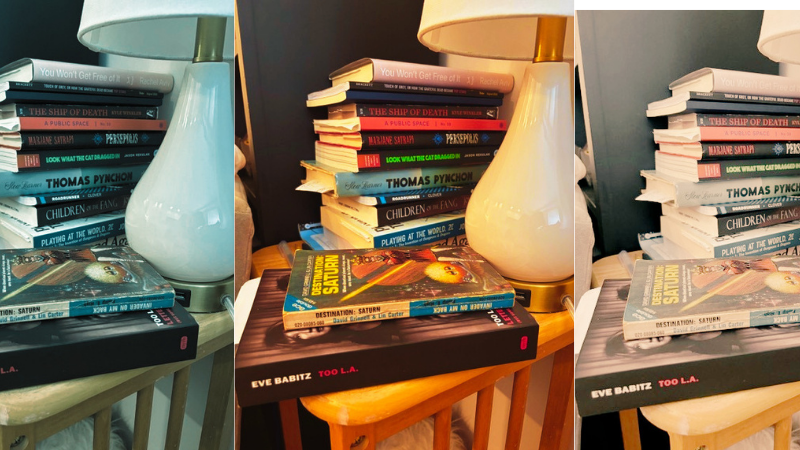
Park remarks on his TBR pile, “This stack rises higher than usual, though not by a great amount. The nightstand itself is a modest piece I’ve lugged through many apartments—I’m not sure where it comes from. When I read in bed, I sometimes attach a small clip-on reading light to the back cover. (I also read on Kindle, though I can’t locate it right now.) There are also a few pens here, which, in theory, I use to capture dreams while they’re still fresh. Usually I tell myself the dream is so fascinating that I’ll surely remember it, then I return to sleep and promptly forget it.”
*
The New Yorker – March 2, 2026
At the bottom of this stack sits an older issue of The New Yorker. This one hails from March and features Rachel Aviv’s searing profile of Gisèle Pelicot, which I read, and thus I’m comfortable discarding it.
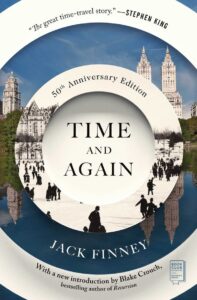
Jack Finney, Time and Again
Following that, Jack Finney’s 1970 novel Time and Again, which I had sent to my father for his 59th birthday during the ’90s. I’m not sure if he ever opened it. I retrieved it from Buffalo (the city where my parents reside and where I was born) during a recent trip and cracked it open again only two weeks ago. A curious note: the narrator, a commercial artist, mentions moving to New York from Buffalo. (Had I known this earlier, I might have slipped in a reference to it in Same Bed Different Dreams.)
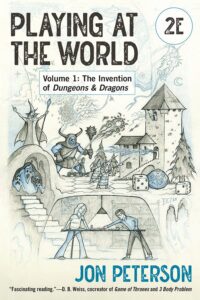
Jon Peterson, Playing at the World Volume 1: The Invention of Dungeons and Dragons
Playing at the World is the inaugural installment in Jon Peterson’s exploration of Dungeons & Dragons and the broader sphere of role-playing games. For around the last couple of years, I’ve been drafting a piece on RPGs largely in my head. This volume supplies a wealth of detail about the various miniature-warriors, their newsletters and meetups, and how these subcultures helped spark the creation of D&D. An extraordinary scholarly achievement! I own the second Peterson volume somewhere, though I haven’t begun it yet.

John Langan, Children of the Fang
Above this volume rests John Langan’s 2020 collection Children of the Fang. Horror enthusiasts revere him as the author of The Fisherman; I also cherish the short piece “On Skua Island” from his debut collection.

Joshua Clover, Roadrunner: A Song by Johnathan Richman and the Modern Lovers
Next up is a Duke University Press volume examining the Modern Lovers’ “Roadrunner.” Penned by the late Joshua Clover, who once contributed to my pages at The Village Voice, this book unravels the different versions, offers a psychogeographic tour of Massachusetts, and situates the track within and beyond historical frames—truly brilliant. I have fond memories of Clover. For some reason, we once went to see The Da Vinci Code together in New York. He also attended my very first Berkeley reading for Personal Days. It was refreshing to reconnect with a familiar face so far from home. Interestingly, he was the first person I photographed with my earliest flip phone. Our paths diverged over time. I’ve long been a Jonathan Richman admirer, knew this book was forthcoming, but I ended up missing it. I’m grateful to my friend David for recently gifting me this copy.
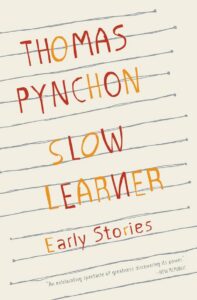
Thomas Pynchon, Slow Learner
Another friend, Lucas, sometimes brings me tomes he discovers on a well-known literary table in Queens—a place famed for turning up new volumes daily. Behold this superb edition of Pynchon’s Slow Learner. I recall reading the author’s introduction years ago: witty and self-effacing enough to raise concerns that the stories themselves might not live up to the hype. (I think Nicholson Baker mentions this in U and I.) I jumped to the last story, “The Secret Integration,” which I enjoyed, and I also appreciate the book’s slender trim and the quality of the paper used.
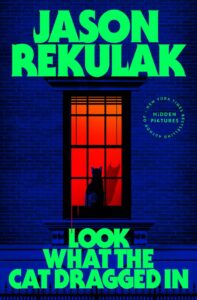
Jason Rekulak, Look What the Cat Dragged In: A Novel
I’m a devoted completist of Jason Rekulak—having followed his work since my days as an editor when I chased down his debut novel—so I’m eagerly awaiting his forthcoming Look What the Cat Dragged In. (The design by Will Staehle, who also crafted the covers for Three Tenses and my two earlier titles, is superb.) This installment embeds a comic-book flavor through the misadventures of a mysterious cat named Godfrey within the main text.
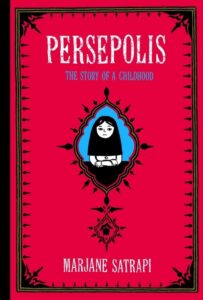
Marjane Satrapi, Persepolis
Speaking of graphic novels, I revisited Marjane Satrapi’s Persepolis after her premature passing earlier this year. It starts powerfully from the very first page and panel. Satrapi’s command of the drawings and the exactness and emotion in the writing are evident throughout. Even though her death prompted me to revisit Persepolis, I’m glad to be reminded of the scale of her achievement. It remains a landmark work within its medium for good reason.

A Public Space – Issue 33
Next up is the latest issue of A Public Space, a publication I’ve only begun to explore. A standout remark from Astrid Seme reads: “In ancient Greece, there was no clear separation between words and sentences… This made aloud reading awkward because the reader had to infer pauses from context. Aristophanes of Byzantium, who served at the Library of Alexandria, devised a system of dots to indicate the length of pauses.”

John Brackett, Touch of Grey, or How the Grateful Dead Became Pop Stars
Thinner than a full issue, more like a softly resting blanket, is John Brackett’s monograph Touch of Grey, or How the Grateful Dead Became Pop Stars. I suspect this is the point where I admit that, unexpectedly, I’ve grown into a devoted Deadhead over the past year. A notable aspect of the Dead catalog is that much of it originated with non-performing composers, notably Robert Hunter, who collaborated primarily with Jerry Garcia. (John Perry Barlow contributed to/with the recently passed Bob Weir.) “Touch of Grey” is a Hunter piece that he performed solo for years before it entered the Dead’s repertoire, where it evolved even further.

Kyle Winkler, The Ship of Death: A Novel
Kyle Winkler’s The Ship of Death deepens the RPG theme—a novel told through a sequence of documents tied to a rare, chillingly malevolent game crafted by a shadowy designer. It evokes the vibe of Harry Stephen Keeler’s dossier-style mysteries, such as 1936’s The Marceau Case. Each chapter appears in the form of a distinct document. Sometimes this approach feels like the only honest way to present a work of fiction: it should consist of words that could conceivably be written down for nonliterary purposes. If that sounds odd, you can ask me about it later.
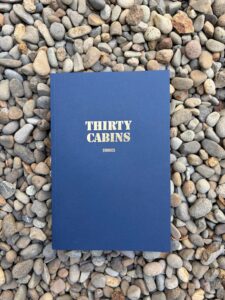
Thirty Cabins: Stories Anthology, ed. Josh Riedel
Thirty Cabins (the spine conceals the title) collects a suite of stories compiled by Josh Riedel and inspired by cabin plans published in the 1920s. He invited me and 29 other writers to craft a tale inspired by one of the designs. I chose “Cabin in the Clouds,” hoping it would push me to finish a story I’d been toying with for a larger project—a haunted ski lodge, a gateway to Lovecraftian ice entities. I drafted six (at least) different openings for this tale, but ultimately scrapped them and produced something that feels like a foreboding preface for the collection as a whole (my story opens the book): a nameless visitor nears the titular cabin, perhaps programmed like the Manchurian Candidate. A Grateful Dead song, “Dire Wolf,” pulses on the car radio, with the haunting line, “Please don’t murder me.”

Rachel Aviv, You Won’t Get Free of It
I picked up the aforementioned Rachel Aviv’s You Won’t Get Free of It at her recent book launch. She has revised some of her most acclaimed New Yorker pieces for this collection (including a masterful profile of Alice Munro), revisiting and reframing them from the vantage point of motherhood. It’s hard to believe, but more than twenty years ago, Rachel was my intern during my tenure as editor at The Voice. She wrote extensively for me there—book reviews, as well as Education Supplement pieces—before continuing her career elsewhere.
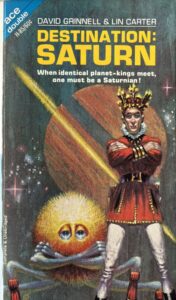
Philip E. High, Invader on My Back / David Grinnell & Lin Carter, Destination: Saturn
In front of the stack sits a compact set. On top rests an Ace Double spotted by the earlier mentioned Lucas on the Queens table. I’m smitten with this science-fiction flip-book format, a style I even wove into Same Bed Different Dreams. This particular copy features Philip E. High’s Invader on My Back on one side (“They dared not look at the sky!”) and Destination: Saturn by David Grinnell and Lin Carter on the reverse. I’m not asserting I’m in a Lin Carter phase, but I’ve been using one of his short stories in class—“The Doom That Came to Sarnath”—which I rate highly—and I recently bought a book he coauthored on Lovecraft’s Cthulhu mythos and Conan of Aquilonia, co-written with L. Sprague de Camp. Carter’s portion here shows a goofy Kelly Freas painting and a charmingly rough-edged tagline: “When identical planet-kings meet, one must be a Saturnian!”

Eve Babitz, Too L.A.: Letters Never Sent (But Some Were)
Underneath this sits Eve Babitz’s Too L.A., which carries the intriguing subtitle Letters Never Sent (But Some Were). I wish the book were clearer about which letters were destined to be shared and which were not, yet it remains a deeply addictive read. As Deborah Shapiro noted on Substack, it functions as a West Coast counterpart to my late friend Duncan Hannah’s ’70s diaries, 20th Century Boy. I’m not in the business of spreading gossip, but I enjoy reading old gossip; it rarely harms anyone.