I never fretted about reaching forty. As the years past, fifty felt worth celebrating. At fifty-five, a neighbor captured a photo of me standing beneath a sign that matched the speed limit and we shared a chuckle.
Then came sixty.
In the months leading up to my birthday, a creeping dread settled in. I dreaded turning sixty. I did not want that number on a card. I didn’t crave a party. I wanted to ignore the day entirely. I resisted the inexorable advance of time, convinced that if I pretended it wasn’t happening, it wouldn’t.
For context, my life is a beautifully woven, fortunate tapestry. My three children are thriving and married to partners who help them grow, I remain passionately in love with my husband, and I’m blessed with three delightful grandchildren, with another on the way. We reside in a stunning corner of the country. My career as a novelist thrives, and my thirtieth novel, Hollow Bones, is scheduled for release this September. By most measures I’ve spent the better part of six decades building a legacy others would envy. Yet the mere thought of turning sixty could spark tears at the drop of a hat.
I did not want to turn sixty. I didn’t want to read that number on a card. I didn’t want a party. I didn’t want to mark the day at all.
My therapist asked me what was truly unsettled. It became clear that the problem wasn’t aging per se but the starkness of reality. At fifty I could still pretend I had a long life ahead; at sixty, the math finally lined up, and every future version might include some form of loss—my parents’ passing, my body’s changes, further grief. Who would eagerly confront that?
The coincidence of this particular birthday with the release of my thirtieth novel felt both sweet and sour. I’m about to embark on a major book tour we’re calling the “Chapters Tour”—a celebration not only of Hollow Bones but of every title that came before it, in the same exuberant spirit as Taylor Swift’s Eras Tour. It’s a milestone because it truly is one. I’ve spent a literal lifetime cultivating a body of work and amassing devoted readers. I’m proud of my novels and grateful for the lives they’ve touched and the conversations they’ve sparked. At BookCon, a crowd lined up to have their books signed and to share their stories. “I used to read your books behind my chemistry textbook,” confessed one middle-aged woman. Another spoke of how my novels connected her with her late mother. Many aspiring writers—whose works I adore—approached me wide-eyed. “I can’t believe I’m meeting you,” a young writer exclaimed. “You’re an icon.”
Sixty is indeed a threshold to icon status. After all, lifetime achievement accolades typically arrive later in life. Reaching thirty books is no small feat either. Yet while being placed on a pedestal as a veteran author has its perks, it can also widen a chasm between seasoned voices and younger colleagues in the thick of the literary bustle. It can feel as though one’s time has passed, that relevance has drifted into the rearview mirror, that one is done.
Reader, I am not finished.
The more I considered why I resisted turning sixty, the more I realized this was the heart of the challenge. Physically and mentally, I’m more healthy than ever. I recently shed enough weight to glimpse myself with fewer fears in the mirror. I swim more than a mile daily. I can tackle the NYT crossword without help. Yet our culture doesn’t expect a sixty-year-old woman to be at the peak of vitality. By the standards of society, and by many cinematic depictions and even opinions like those of JD Vance, I ought to retreat into a cardigan, slip into sensible shoes, embrace gray hair, and devote myself to the grandkids—believing that is my ultimate contribution. I shouldn’t want to turn heads on the street. I should bake cookies, drive slowly, and be content with gentle pleasures. Even as I recognize that appearance is more than skin deep, I still yearned for a sign that I could be attractive at this age and remain drawn to others. Just before my birthday, I watched Off Campus, a steamy series about twenty-somethings navigating love and lust. I paused, thinking, Should I be enjoying this? Am I being a creep? It’s telling that there’s a gender bias in aging. A man who ages well is praised as a “silver fox”; a woman in midlife is often labeled selfish or entitled. We tolerate a man with a midlife crisis; a woman pursuing one is a selfish indulgence.
I am younger than many of my female peers, and when I confessed my distress over the birthday, their counsel helped shape my thinking. “Sixty felt liberating,” Jan told me. “I’ve shed all apprehension; I say what’s on my mind. Who’s going to stop me now?” That’s a benefit I’ve enjoyed for years: I’ve always spoken frankly—through my writing, my politics, my social media. There is a freedom in not worrying about everyone’s opinion, in not overanalyzing every word. With age comes the ease of owning who I am without apology. A silver lining for the silver-haired. Yet it didn’t erase the ache of turning sixty.
Roughly a month before the big day, a revelation struck me. What if, rather than clinging to the past, I embraced the milestone? What if I marked it not as a descent into decline but as a mosaic of what has forged me into who I am—an acknowledgment of all I’ve endured and learned? While driving with my husband, I confessed, I’m thinking about getting a tattoo.
I have never possessed tattoos. I’ve never desired one. There hasn’t been anything I felt compelled to etch on my skin forever…until now. I shared with him a rough concept for a design.
My husband looked at me, surprised. “Oh,” he said. “And what would I do?”
(This is what I mean by still being crazy in love with him. I still grin at the notion that he assumed this would be a couple’s project.)
I was still weighing the idea, hesitant about whether sixty-year-olds actually get inked. Was I chasing youth and edge? Or was I wary because my mother has always insisted that tattoos are on her Never list? “You can’t be buried at a Jewish cemetery,” she’s always warned, though I have no intention of that, and I even own the plot where she will one day be buried, which is certainly not in a Jewish cemetery. It’s funny to realize how absurd it is to fret about a mother’s opinion when nearing sixty, given the irony of the situation.
What if, instead of dragging my heels toward sixty, I took ownership of it? What if I marked the occasion—not as the start of a slow slide toward the end, but as an amalgamation of what has made me me.
A few weeks later, I gathered a group of friends in New York City to celebrate one of their birthdays (she was turning 62 and wasn’t nearly as unsettled by her own birthday). “I think I’m getting a tattoo tomorrow morning,” I announced at dinner. Saying it aloud made the plan feel real.
My friend Lanni—an ovarian cancer survivor who already sports two tattoos—offered to be my emotional support ally. We scouted studios near our hotel, reading reviews and ratings with a careful eye.
The next morning, we found a shop. The artist in the other room argued over a banking issue on the phone. The walls were covered with religious symbols, and a client ahead of us wore a long ZZ Top beard that brushed his midsection. Lanni gripped my arm and tugged me down five flights of stairs. “Not this place,” she urged.
Our second stop was a studio run by women. The only customers were a family from Italy, debating which New York-inspired design they would choose to honor their visit. I showed the tattooist the sketch I wanted, she nodded, and got to work.
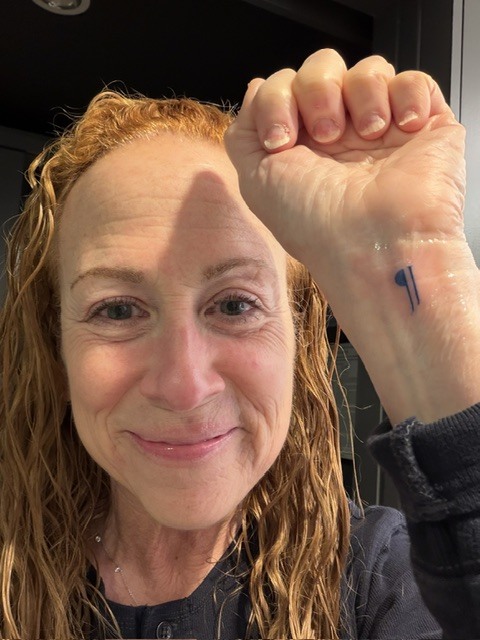
A half hour later I walked out with a brand-new tattoo on the inside of my left wrist. It’s small—roughly three quarters of an inch tall, a cobalt blue like pen ink. It’s a pilcrow—the paragraph sign used in editing.
I genuinely adore it.
It’s graceful, compact, and visible every time I sign my name. To me it embodies the Pilcrow’s meaning in a manuscript: a fresh start alongside the continuing story.
When my birthday finally arrived, I received calls from my kids and gifts that made me giggle—a hand-thrown bowl, a Little Mermaid shirt, a candle that reads, “From a distance, you don’t look a day over 59!” I didn’t undergo a dramatic transformation on the actual day; I remained unsettled by turning sixty. Yet in the days since, looking at the tattoo on my wrist, I feel a symbol of all I’ve achieved and what lies ahead.
Please don’t tell my mother.
___________________________
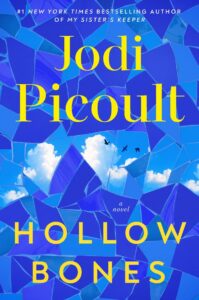
Hollow Bones by Jodi Picoult is available from Ballantine Books, an imprint of Random House, a division of Penguin Random House, LLC.