
From long before the time of Homer until the recent past—and in the present in some traditional societies—turning an amorphous mass of wool into thread via spinning and then weaving that into fabric was both an important skill and a source of powerful metaphor. We still use some of those metaphors—a thread is a connected series of exchanges by email, text, or on social media, and you can lose the thread of what you’re saying. The word spinning was mostly used to describe that making of thread… then came other forms of twisting, all the way to spin doctors and spin control. The distaff that holds the unspun fiber became a term for the female or distaff side of a family or household and spinster became a term, eventually pejorative, currently being reclaimed, for an unmarried woman. The analogy between storytelling and turning the shapeless wool into thread or the thread into woven fabric is why spinning a tale and weaving a story are (perhaps now slightly archaic) ways of talking about narrative.
In Greek mythology the Moirai, or the Fates, were three sisters, one who spun a human life as a thread, one who measured it, and one who cut it, making the connection between the linearity of thread and time explicit. (Norse mythology’s Norns are another trio of women meting out human life via threads.) Penelope takes on the Moirai’s power of controlling destiny by constantly rolling back the time in which she must choose a husband from among the suitors by unweaving at night what she wove by day. This makes her loom a device on which time goes both ways. Denied conventional power in a patriarchal society, she finds an unconventional form of it and spins her own tale rather than being subject to the fate the suitors intend to impose on her.
*
“The Liquid Birds”
Pēnelopē (Πηνελόπη) is usually understood to combine the Greek word pēnē (πήνη), “weft,” and ōps (ὤψ), “face,” which is considered the most appropriate for a cunning weaver whose motivation is hard to decipher
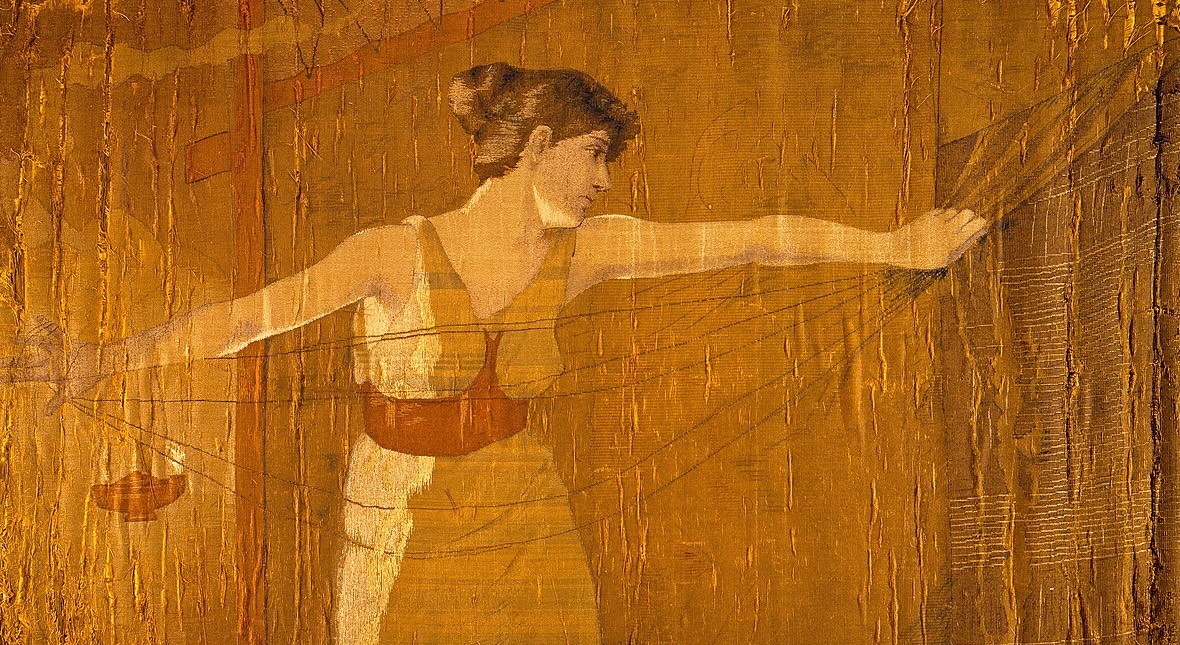
Penelope finds when she unweaves the shroud—
that she was making for the father of her husband,
who of course is absent and has been for years—
that when she undoes what she wove in this time
she can unweave all time that has passed and by
weaving a different pattern can shift the present
and as she weaves warp through weft, thread by thread
she finds mastery and after much practice can
unweave better than she ever wove, can unweave
her marriage back before she ever met the man
can hover with threads added and subtracted
in the passion of their first years, make one night,
one kiss, happen over and over, and then she can
unweave it all so that their marriage bed, famously
made from a rooted tree, is not yet a bed, the tree
only a sapling, crones become maidens, eagles, doves
drop from the skies to find the nests they left
and the gulls, cormorants, terns likewise find
the fragments of their old eggshells that begin to
pull back together to hold the liquid birds within,
the wool itself unspins and goes back to the flock
and the flock goes backward, wool shorter and shorter
on their frames as they disgorge grass to the earth,
enough to replant the hillsides, as snow flies upward,
and rivers flow uphill, and she works time like a dj
scratching the record back and forth, revolutions
giving way to the rhythms, lyric music to notes
clustering forward and backward; she masters time
and weaves and picks apart many endings, turnings,
weaves other lives for herself, lives for centuries
during the decade she waits for his return, lives
as a priestess, as the beloved of the handsome sailor
who came to shore when she was a girl, has daughters,
has travels, studies, passions, strange woven patterns,
and then she lets it go and weaves his return,
weaves the massacre of the suitors, weaves the shroud,
and takes her knife and cuts the last thread, done,
and she knows this is not the only or the best
of all her destinies but that the pattern is good.
______________________________
More of Rebecca Solnit’s writing online can be found here.
Featured art: “Penelope Unraveling Her Work at Night” by Dora Wheeler (1886)
