
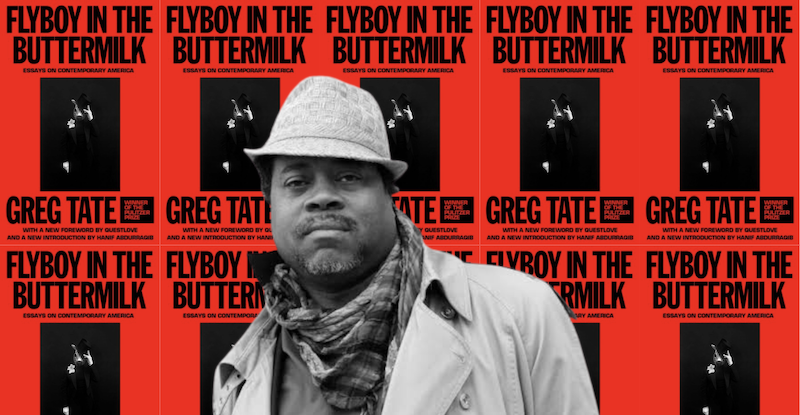
Praise be to Akhenaten, Cleopatra, Ra, Sun Ra, Iris, Osiris and all the ancestors and ancestresses: Flyboy in the Buttermilk, by the late, towering Greg Tate—this posthumous Pulitzer laureate who could ride the wave of bebop as deftly as any—has returned to the ink and paper world.
Titled Essays on Contemporary America, this volume gathers 40 pieces that remain strikingly timely, decades after their initial appearance. Whether tackling athletics, policy, sounds, or visual culture, Greg left an unmistakable imprint on American letters and arts coverage. Alongside bell hooks (a fellow luminary who passed away in the same week as Greg in December 2021, both leaving gaping voids in critical discourse), Tate helped redefine cultural criticism by infusing it with a Black, streetwise sensibility that could rise as high as Miles Davis’s upper register in Kind of Blue or lift off like Alvin Ailey through the air in Revelations.
Okay, that’s my modest attempt to echo Tate’s voice. But there isn’t any rival. How can you rival the G.O.A.T.? How can you compete with a writer who could string together sentence after sentence on Wynton Marsalis’s legacy in “Baby Miles and Bay Wayne” (describing how neither freemen fuzhacks nor funkateers stood as mere archivists, but as keen interpreters of the trumpeter’s early CBS emergence as a trailblazer of forward-looking jazz) and on Skip Gates in “Merely conceiving a poststructural reading of this deuteronomic tribal scroll…” alike?
You can’t keep pace. It’s like trying to beat old LeBron at horse or snatching the ball from prime Yamal.
In being himself—carrying the weight of Black genius that came with it—Greg smashed the door open with unrestrained force
And yet what stood out about Greg was that, as a critic, his blade could cut both ways: he could slice through Michael Jackson’s troubling image with the precision of a samurai sword (“To fully grasp the sickness of [Michael] Jackson’s denigration of his own Black features you must recall that when he wore the face he was born with, Black people saw him as the most striking thing since sliced sushi.”); he could praise a peer with a generosity that resembled a clutch shot in the dying seconds of a game (“Before he began recording, George Clinton was building a lifespan of hair-styling craft; before the studio, he was shaping waves and conk work for the hustlers who roamed Plainfield’s streets”).And he could also bring the same subject down with surgical care—“George Clinton’s Computer Games is a masterpiece and a mess at once”—with a ruthless exactitude that matched Mbappé’s clinical finish on a game-winning strike. Perhaps not until this very month—when our colleague Emily Wilson fired with a force strong enough to topple a ship’s hull, sending a jolt through the London Review of Books—has anyone hit a fellow traveler with such accuracy as Greg did when he critiqued art gone sour from artists he admired.
Yet among writers, Tate remained among the gentlest souls—never trying to outshine others. Even when he mentored, he urged you to find your own voice, not to imitate his.
In being himself—carrying the burden of Black brilliance—Greg blasted the door with the same iron resolve (and tenderness) you’d expect from an afrofuturist captain piloting Artemis II toward lunar glory…so you could be truly yourself.
No one who received his mentorship—from those who wrote for Vulture, Gawker, BuzzFeed, Lit Hub, the Nation, and beyond in recent decades—would have made it without the warmth, flamboyance, and fierce, lucid engagement of Greg Tate, and without the downtown, no-nonsense, high-energy concerts he could conjure about figures like David Bowie, Sam Delaney, Don DeLillo, Dawn Suggs, the Daughters of the Dust director Julie Dash, and—of course—the collection’s symbolic “flyboy in the buttermilk,” Jean-Michel Basquiat.
Like a runaway path-clearing through a sugarcane field under a moonless sky, Tate laid down a new route for us all.
*
Originally published in 1992, Flyboy has long been out of print—something that deeply troubled Greg when I spoke with him about a decade ago on the occasion of Flyboy 2. It also troubled me as a professor: I always hoped to teach the complete Flyboy in one go, and never got the chance. If journalism students could study one book that teaches many lessons—sentence construction, rhetoric, how to shape narrative, dialogue, wordplay, humor, writing with authenticity, theories both high and low, language as music, craft, CRAFT—then Flyboy in the Buttermilk would be a perfect pick.
Too many subjects of this wheezing colonial empire want a proximity to Blackness without any responsibility for what ails Black people.
Greg treated criticism as an act of love. Sometimes that love took the form of tough honesty, as when he took aim at Bad in “I’m White! What’s Wrong with Michael Jackson”—“Proof that God doesn’t admire ugliness, the title of Michael’s new LP, Bad, captures the essence… The sole redeeming feature of Bad is that it came from the same artist who gave us Thriller.” Sometimes, that love turned into grief, as in “The Man in Our Mirror,”—a funeral oration for the ages written in a single day. The cover essay, which I’ve reread countless times since first extracting it from a red Voice box on Cooper Square, is a searing cry of pain and a critique of American culture’s commercial rot: “What Black American culture—musical and otherwise—lacks now isn’t talent or ambition, but the unmistakable spark of a spiritual genius: a sense that something beyond the human speaks through the fragile vessel charged with representing the divine, the magical, the ancestral.”
That approach — reading individuals like Michael through the lens of an entire nation (both white and Black) — remained a defining core of Tate’s work.
Too many voices tied to this imperial framework crave proximity to Black life without accepting responsibility for the harm it endures. (I can imagine his response to today’s billionaire couple Beyoncé and Jay-Z partnering with Target, a move that sparked a DEI boycott in some circles.)
Or, to riff on another Tate line, when it comes to Blackness, far too many Americans want “everything but the burden.”
*
A decade after Flyboy, 2003’s Everything But the Burden: What White People Are Taking from Black Culture collected essays by Robin D.G. Kelley, Michaela Angela Davis, Arthur Jaffa, and others, with Tate at the helm as editor.
In the spirit of George Clinton, Tate noted, “As Clinton likes to say, ‘Without the humps, there’s no getting over.’”
In other words: creation—true art—requires bearing some weight.
Greg credited the expression that names the book’s core idea to his mother, Florence, whom readers knew as “Mama Tate.”
The premise was simple, yet potent: White culture—and, as Greg and Mama Tate argued in The Overseer Class, certain Black pioneers—wanted the everyday Black world’s goods…except for one crucial thing:
They wanted the music.
And the art.
And the style.
And the cool.
And the fashion.
And the rhythm.
And the hoops
And the blues.
They crave the bee bop.
And the hip-hop.
And the scat-jazz,
and church-soul.
They even want
Basquiat’s strokes,
and Richard Pryor’s
bold humor.
They crave all of this—
and they demand the burden!!!
Just as they wished to indulge in imperial nostalgia for Native American dreamcatchers without living on the land they displaced, when it comes to Black culture, white people wanted everything but the burden. They rejected the price of being Black—the health gaps, the economic gaps, redlining, and the policing that weighs on us all.
And they certainly didn’t want to hear about (or endure) John Henryism—that real mechanism described by Doc Sherman James showing how racism’s strain can shorten a Black man’s life. Named after the folk hero who died trying to hammer faster than a steam engine, John Henrysism claimed my father at 67, his father at 57, and Greg at 64. (After Greg’s passing, artist John Simms—creator of How to Hang a Confederate Flag—told me he’d had breakfast with Greg not long before; Greg spoke of pride in me. That meant everything, and I felt closer to John as we spoke, until John Henry claimed John Simms a few months later—and carried him to the other side after 58 brief years.)
A theory, my teacher and OG queer theorist Lisa Duggan reminded me, is just an idea that helps people think differently. If it’s a good theory, it opens up angles on many topics the thinker never anticipated.
Like a roaming messenger considering an earlier sermon, burdenology is a framework I’ve kept returning to since October 2023.
Tate long illuminated how cultural appropriation operates. Yet flipping his burdenology to the other side helped me understand why claims of appropriating Palestinian culture have been less prominent in recent years—especially as the keffiyeh became a global symbol of solidarity.
I began wearing a keffiyeh I’d owned for years with increasing frequency in October 2023, as U.S.-backed violence against Palestinians intensified. Others did the same.
Even as large numbers of people outside Palestine wore the scarf, and as a largely online world spoke up, I noticed surprisingly few accusations of cultural appropriation directed at non-Palestinians wearing the keffiyeh.
In the United States, a non-Palestinian or non-Arab donning this garment creates different conditions than, say, a white person sagging or sporting a Wu-Tang tee. It’s not merely a fashion statement devoid of risk.
To be sure, those of us who wore keffiyehs in Europe and North America did not endure the existential, genocidal violence faced by people in Gaza for decades. Yet many demonstrators faced brutal state force on the streets and on campuses, and many who supported Palestine saw jobs, careers, diplomas—or even their freedom—put in jeopardy.
Wearing a keffiyeh was never akin to flashing Air Jordans or hanging dreamcatchers. It wasn’t like blasting Jay-Z while planning to displace a Black neighborhood for a data center or setting up a Tupac poster in a Harvard dorm as you advance your career at a firm in Boston.
The act carried risk and reward, a charge that can feel exhilarating. As one Palestinian cousin, Suzanne Barghouti, put it, slipping on a keffiyeh in the U.S. before stepping out sometimes feels like donning a lion’s mane or a suit of armor.
But it also places a bullseye on the wearer for the military-industrial complex. It signals support for the armed resistance connected with the keffiyeh’s long history of symbolizing struggle.
For many who began wearing the scarf through community ties, the act became a way to share in others’ vulnerability, risk, fear, and burden. Ideally—and as a way to deflect some danger from those most at risk—the gesture could diffuse danger by distributing it a little more widely.
In embracing a small fragment of that burden, I found a generous welcome from Palestinian family, friends, and comrades to exchange a symbol of their culture in a meaningful, reciprocal way.
I wish I could talk to Greg about Mamdani, the Knicks’ championship, and the recent rent freeze for millions of New Yorkers.
That’s why I admired Zohran Mamdani’s July 21 video, which began with the line “Benjamin Netanyahu is a war criminal.” Although many found it troubling that he admitted he lacked legal authority to arrest Netanyahu, I deeply valued his willingness to name Netanyahu’s crimes and cite a long list of them—including the killing of nearly 300 journalists who rarely appear in U.S. political debates, a point Mamdani emphasized (alongside Al Jazeera’s Ahmed Wishah).
I cannot speak for Palestinians, but after suffering for speaking out about apartheid in Israel at work in 2019 and again in recent years, I deeply appreciate Mamdani stepping into a place where he earns his bread to declare Netanyahu a war criminal, risking a price on his head and a target on his back, and taking on a portion of this burden.
*
I wish I could talk to Greg about Mamdani, the Knicks’ title, and the latest rent freeze affecting countless New Yorkers. I wish I could ask him about everything that’s unfolded in the years since.
We are fortunate to have Greg’s words accessible again.
Yet it’s bittersweet: I only wish he’d lived to see Flyboy reissued—so he could read the glowing new foreword by Questlove and the introduction by Hanif Abdurraqib. I wish he’d witnessed Cats: The Jellicle Ball make it to Broadway, the way Coogler’s Sinners could reshape cinema, or the chronicling of The World of Black Film under Ash Clark at the Criterion, and the moment his own mentor-figure work, The Overseer Class, found a home in print.
Most of all, I wish he had the opportunity to receive the flowers he deserved while still with us—alongside the long-overdue Pulitzer recognition and the institutional support that would have sustained him while he supported so many of us without compensation.
“Slavery, minstrelsy, and black bourgeois aspirations are responsible for some of the county’s most pernicious stereotypes about Black people—viewing us as property, as cultural commodities, or as imitators of white wealth. Given this history, there’s a delicate line between a Black entertainer who pleases white audiences and one who trades the race’s vitality for white approval. Berry Gordy, a pioneer of crossover appeal, balanced that line with such finesse that some Black folks were surprised to learn, through The Big Chill, that many whites consider Motown to be their own music.”
Unlike Michael Jackson on Bad, Greg did not pander to a society that fetishizes young Black futures as mere steps toward integration and corporate acceptance. He did not leave us with a legacy intended only to placate the mainstream—he left us with a model that endures, even after his passing, by resisting the ism that claimed too much of the Black experience.
He did not depart from us in life—he was carried away, by the same burden that claimed John Henry.
He loved us.
And we love you, Greg.