
This first appeared in Lit Hub’s Craft of Writing newsletter—sign up here.
I’ve long cherished television, though in childhood it earned the moniker “idiot box.” Experts warned that this device could dull the brain, nudge one toward immoral acts, and even damage sight. Sitcoms, and later reality television, were often seen as the lowest common denominator of the medium. Books were deemed the intellectual pursuit, even though they carried their own missteps and sensational plots hiding between their covers. As an adult, many writers I knew insisted they did not watch TV. If I wanted to be a serious writer, it seemed television ought to be a concealed, guilty pleasure.
After earning an MFA and releasing a collection of short stories, I resolved to finish a novel. Years of toil, hindered by financial pressures and depression, pushed me back to my clandestine affection: television’s potential to rescue and inspire. I revisited ideas about character types, the hijinks of sitcoms, and those “very special episodes” addressing drug and alcohol use, danger, and drifting toward the “wrong crowd” I had witnessed on 1980s and 1990s television.
Television also taught me about pacing and structure. As a literary short-story writer, plot sometimes felt more burdensome than helpful. I could spend ages developing characters and dialogue, but making things happen—and lots of things happening—felt daunting. Literature offered limited guidance on that front. The books I loved tended to skew toward the erudite, the challenging, and occasionally the obscure. Once I realized I was crafting a social commentary, a biting satire, I understood it needed to be entertaining as well. I wanted it to be irresistibly consumable, a binge-read, and television demonstrated what could be achieved in that regard.
To coax readers toward the next chapter, I plotted cliffhangers. I traced shaky alliances, the arrival of surprising new figures, and the culmination of a will-they-won’t-they romance at the ends of chapters that I naturally labeled Episodes. It wasn’t until the manuscript was complete that I recognized the need for interludes in the form of “commercial breaks.” I felt as if I were rearranging dementia patients like furniture within the novel. They appeared disembodied, which served the plot in one sense, yet the broader themes demanded a more fully realized treatment. I wondered about the person my grandmother had been beneath the thick silence of Alzheimer’s, and when my father, in the midst of cancer, began to wander through hallucinatory landscapes in his mind, the rationale for my formal choices grew even clearer. The breaks gave dementia-struck characters the opportunity to assert themselves with agency and depth. They also allowed me to step back into the short-story mode. Each interstitial piece became flash fiction, with each character taking the lead in narrating their own slices of life.
When I reread the novel before sending it to my agent and editor again, I could see both the “serious” writer and the girl who couldn’t wait for the next episode of her favorite show. In teaching, I tell students that the unique work they create grows from their own experiences, tastes, and perspectives. A few years ago, during a chat with a writer friend, I was surprised to learn that many writers decide what belongs on the page not by “seeing” the scenes but by other means. That facet of craft—the love of the visual dimension—paired with the bold words of my favorite writers didn’t have to compete; one could coexist with the others. All of these elements could fuse into something wild, strange, and utterly me. Television hadn’t ruined me or my eyesight; rather, it opened a doorway to a deeper, more inventive practice of writing.
______________________________________________
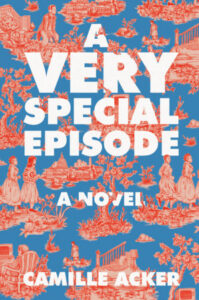
A Very Special Episode by Camille Acker is available via Random House.