
The first time I saw this place, I knew I had come home. I do not mean I knew it in a peaceful, comforting sort of way, the way one recognizes an old friend; that first time it was like an electric shock, sharp and abrupt, strange and terribly painful, and it changed everything. With it, the life I had disintegrated. From the first moment this was my home. How can that be understood?
But after that initial shock of recognition, after the first changes and the settling in, the shiftings in me came more slowly, took their time in rooting. I cannot say that I lost right away the sense of distinguishing myself from what was around me. I heard the birds, looked at the flowers, but always I was separate from them, someone listening and looking. I do not know when the distinction disappeared, but it must not have been for a very long time. Not until I became a part of it, which is a different thing from feeling at home.
It was spring then, which was a blessing because if I had arrived later, toward autumn, I most surely would not have been ready for winter. Odd – I see that remembering has separated me from it; that looking back at myself as an object of my memory has made everything I saw then an object as well, so that I have lost the unity. It is part of my confusion now, my disorientation. At this moment I don’t belong, although the knowledge that I am home has not changed.
Of course it’s a different season now, summer instead of early spring, but that does not make the difference. The rhythm of the seasons is quite natural to me now. Each year, I know, the same sensations, the same breaths recur; there is security knowing that in the spring I will feel the new life, my own joy, a wish to touch all young things, the crocuses and snowdrops, searching them out, walking, the tenderness of finding a cluster of small flowers hiding from still-chilly winds, waking in the mornings, hearing each day the return of more birds until the air is filled with them.
And in the summer working, caring for the garden, cultivating my plants, my food, inhaling the sun, seeing my skin become brown just as the flowers are also growing their colours, and my beloved garden plants are delivering their brilliant food. The long evenings, the sense of having achieved in each day what there was to be achieved.
The autumn, the yellow squash lying in the garden, waiting their turn to be picked; the one maple tree, not on my land but near the crest of a hill on a neighbour’s farm, that turns such a radiant scarlet, the only one that is so dashing, so flagrant. On my trees the leaves change more softly, lighter oranges and yellows, until they fall and I gather them up, and although I know it is probably against some township by law I burn them, the ones I do not keep for rotting down for next year’s garden, and the scent of the burning is a perfect day. It is my last rite for the dying year.
And then the snows fall, easily at first, sometimes then with fury, but mostly with huge soft flakes that stay white on the ground and are almost always fat, because, I think, they don’t have to force their way through the black and the heat of the skies above cities; here, although I am truly not far from the city, less than two hundred miles, which is nothing really, it is clean.
The first time the snow comes, it is a surprise even to itself, it seems, tentative, not belonging, an advance guard set out to test the ground which absorbs it immediately and leaves no trace. But then the snow falls harder, more determined, clinging to the earth, unwilling to be thrown off or pulled in, and winds come too so that it is not silent, not this time, not yet, and quite suddenly it seems the earth is white, green and brown one moment and then in an instant white, and soon after that the winds slow, the snow slips down more gently, knowing that it has won, it is its turn, and there is no more need to be ferocious. I watch that first snowfall late into the night, the lights turned off so that I can see better into the darkness outside, and although it marks a change there is nothing unwelcoming in me.
I wake up in the mornings and look out at untracked snow. In the evenings I have my fireplace, my drawings, my self. Everything is very slow, very soft, and my thick quilts are like the snow, heavy and protecting. In the beginning it was a test, this hibernation of the winter, and I felt pale for a long time that first year, before my mind became as still as the whiteness outside.
One cannot regret the loss of a season. I do not feel sad because the snow melts and the time to leave my quilted womb has come, or because the last squash is picked, the last scarlet leaf gone, and it is time to retreat once more. Each time is right for its time, and it may be mildly astonishing to find that each season corresponds exactly with some rhythmic need of my own.
I know that in the next two or three months I will gather up my small harvest, pickle it, freeze it, preserve it. I will turn over and fertilize the earth, so that it will be rich in the spring. I will have my major fall expedition to the town, to find the things I need for winter that I cannot provide for myself. I will sweat over my stove, stirring and pouring, and my home will be filled with the odd, bitter smell of cucumbers becoming pickles, and I will see the freezer filling with the food I have blanched and bagged for the long time ahead. The wood which I have cut throughout the spring and early summer, and of which I will cut more in the next weeks, I will carry close to the house and cover with a weighted tarpaulin, so that in the snapping winter afternoons I can easily gather in enough for the evening and the next morning, to take away the chill. I will gather up seeds and put them in bags, ready to hand out to winter birds and squirrels.
At that brief moment, perhaps just a day, when I feel that autumn has ended and that winter must begin tomorrow, I will walk. It is the day I say goodbye to the season, and I do it at the end, the beginning, of each one.
In this autumn I will begin with my daily check of the garden, or what will be left of it by then. The soil should be moist, faintly acid smelling, from its infusion of decayed compost. It should be very soft, too, loose and crumbling, and I may walk through it in my bare feet.
Then there will be the slow progress down the lane, through all the great old maples, enormous trees that must have seen generations passing by. I know very little of the history of this place; farming families mostly, I suppose, not well off for the land is not good enough for prosperity.With my own past discarded, I wanted my home to come to me the same way. When I did learn a little of its past, it was inadvertent and did not matter.
I will sit in my car at the end of the lane for a few moments warming it up. I have to admit I keep the car locked; it is one of my key possessions, and to have it stolen, unlikely though that is on the wilderness of a back country road (but farm boys are not so unlike city boys in their desire for adventure, although the maliciousness one sees in the city is generally absent), would be serious and so I take care to keep it, and them, from harm.
The ditches along my lane, and along the road that I will follow on foot for a way, will be almost dry. Only a trickle. In the spring, when the snow is melting and the springs that are high up in the rock cliffs some miles away are carrying it down full speed, the ditches overflow as does the little creek that runs near my cabin.They move with a rush then, their sound loud in the night; but in the fall they are quiet, almost dormant.
I will walk along the road a short way, then cross the ditch and climb the little rise on the other side. There is a fence there that separates the land that is mine from the land that belongs to the township, and I have not kept it up and neither has the township. It doesn’t especially matter, since neither I nor they have livestock that may wander off, although I thought once of keeping goats. I decided against it, because I do not want to be responsible for the well-being of animals.
The fence, as I say, is not what it once was, when this land was truly a farm. It wobbles on its posts, the wire sags, and the only part of it that has kept its tension and purpose is the barbed wire across the top, which may be what holds up the fence posts. The barbs make the fence difficult to climb because it is an easy thing to be caught on one as the fence bends under my weight. Each time I say I will come out one day and clip the barbed wire away from the top, but I never do. It belongs.
When I have edged over the fence, I will be standing in my own woods. Not a forest by any means, but a small woods where there are squirrels and chipmunks, probably snakes and skunks, rabbits and, now and then, passing through on some mysterious transient route, a deer or a family of deer. I will be very still; I will sit or crouch on a blanket of leaves, and the trees will be almost barren. If I wait motionlessly, carefully, the easiest of the wildlife, the squirrels and chipmunks, will go back to what they were doing before my disturbance, chasing each other, carrying off nuts, preparing for the next season as I have. Do they also recognize this last day, this moment of the break?
When I take this same walk in the spring, the first small flowers are just opening. In the fall different flowers, the last of the season, will be finally wilting.The trees will be almost skeletal then, and yet I do not ever have the sense of death.
After a long while, for I take the whole day for this walk and move only when the time comes, I will go on. At the other side of the woods the land dips into a ravine, the great trees end and dense bushes clot the bank. But I will go down, pushing through, and at the bottom, where very little sunshine penetrates, is my stream, the one that runs through the property, from other people’s toward other people’s, but here it is just my stream, and it passes from here close to the cabin. The sounds of the frogs that live around it dot my sleep, and the sound of the creek itself is always in the background of my hearing. Here in the ravine it is wider, narrowing farther along, and I must step carefully on stones to get across without wetting my feet. The water will be very cold in late autumn, is in fact cold all year around; it is not the sort of stream in which one paddles for long, as I have learned.
The water will be very low, and the ravine so dense that it will seem there is very little life; it will be more silent even than the woods, except for the gentle trickling. The birds that have not yet flown south will seem far away, far above, and there is no place on my land that is more quiet. One can drink here not only the water from the stream, but the silence.
Up the other side of the ravine there is another fence, much like the first, but without the barbed wire. Because I do not want to be the person to break it down entirely, I will climb it gingerly, testing my weight on it, finding the strongest spot. One of these years, I know, it will just lean over and not come up again, but not, I hope, in my time.
Over the fence is a pasture, rocky and rough, flat and unlovely. The land here is generally not good for crop farming; one would want to be grazing cattle here, not trying to plow it.
I know it’s selfish to keep these acres to myself, not contributing by raising food. I know I could rent this land to a farmer who wants a little more for his cattle, but I don’t because I want to be able to walk here undisturbed.
There are big rocks to sit on to survey my world. I will move among them, pausing, watching the tiny life of the pasture, toads, birds, insects, worms, everything is there except that it is tiny and if you take a step you must be aware that something is dying underfoot. In places like the woods, where everything is larger and grander, one is not so conscious of that. But in the pasture, with just rocks and grass and weeds, one must look down and see the little forms.
At the far side is a fence that is important, because it divides my land from the next farmer’s and he has cattle that could stray. I keep an eye on this fence on my periodic walks, but he is the one who keeps it repaired. When I see that he has worked on it, I pay for half of the repairs the next time I see him. He is the same man who delivers my eggs and starts my car.
Eventually on this walk I will come to the end of the pasture and head back along a path toward the cabin.There are bushes along this path, wild flowers, a couple of maple trees. Ahead I will see the enormous willow that hangs over the cabin; one day, I think, there will be a winter ice storm or heavy snowfall and one of its great limbs will crash through my roof. Or the whole tree may just lean over, because it is already split naturally, and collapse on me. I would not cut that tree, though, if I could, so until it happens, I try to trust it and forget it.
On each walk, the sight of the cabin and the willow ahead makes me eager to get back, to light a fire, put my feet up, think, perhaps, about what I’ve seen, be warm in my home. And so I will hurry along the path, forgetting already the creatures dying beneath my feet.
The cabin itself is very old, hand-built of stone, carefully, solidly made. It is not, however, primitive; it has electricity and plumbing, and I bought a freezer as soon as I came here. It is my home. It is not an outback, a wilderness; I do not have an interest in “roughing it.” I am accustomed to comfort.
There are just four rooms, not counting the bathroom. The kitchen is large, modern appliances and ancient wooden counters and cupboards everywhere, hooks that I have put up myself to hold the pots and pans. I have painted the room in black and white, except for the counter tops, which are plain wood.The colours do not sound warm, but they are. I have a small table, round, some heavy kind of wood that I refinished, and two chairs, one of which sits empty. I eat breakfast at this table, and often lunch, but rarely dinner. I did not used to eat so many meals, but here the work is different and I need more food.
The refrigerator and the stove are second-hand and white.The kitchen is the first thing that happens when you walk in the door. There is only one door to the outside in the cabin.
It is pleasant to sit at the table in the centre of the kitchen and look around this room, which has no curtains on the window above the sink. Often kitchens are the best rooms for sitting. Certainly mine is welcoming; I would find it difficult, though, to say that I have a favourite among the rooms; each one is different, and each serves its purpose with, I think, a certain grace.
Past the kitchen, through a short, low hallway, is the living room. I eat the evening meals here, because it is an evening room, dark, with just two narrow farm windows, at its best at night. In daylight, it can seem oppressive.
I covered this room when I came in an old-fashioned cream wallpaper with deep red feathery patterns. I had never done such a thing before, and will not attempt it again, for I am not good with my hands. I spent several painful days doing it, trying desperately to smooth out lumps, make edges meet, cut the paper away from the obstacles of doors and windows. When it was finished, I felt tired, discouraged, incompetent, for there were gaps between sheets of the paper, wrinkles on the walls – nothing too obvious, but mistakes nonetheless. I look at it now and do not notice the mistakes.
The furniture I bought at a second-hand store in the town, just an old couch, a deep chair with relaxed springs, three small tables, two table lamps, a floor lamp, a footstool. I bought many yards of material and recovered the couch and chair myself.
I chose a quiet flower print, all muted blue and rose, and the rose blends more or less with the wallpaper. But actually covering the furniture with it was another struggle, with tacks and corners, and even now, sometimes something will come loose and I have to repair the damages I did. It is, however, comfortable.
The tables I sanded down, because they are made of fine wood that had been painted over.Again I spent days on it, but for that I was able to work outside, in the sunshine. Now and again I rub oil into them and they have a deep, quiet glow. They are the one part of the living room that has elegance.
Later I made curtains, a dull blue shade to match the couch, but only after I had experimented with making some for the bedroom.
The vital feature of the living room is the fireplace, which is enormous and I suppose must once have been used for cooking. Now and then I use it that way, too, in the long winter evenings when there is nothing but time, and in front of it, a few feet from the flames, is a good place to set bread to rise. I have never yet run out of wood, nor had to buy any. Every day except in winter I chop wood, sometimes taking down dead and dying trees, sometimes stripping the limbs and bundling twigs for kindling, other times cutting the trunks into smaller pieces, so that there is always ample by the time the fireplace is needed. It is built into a wall, and the furniture is arranged around it so that it is the focus of the room.
It isn’t for warmth that I take so much concern for it. The cabin is kept comfortable by electric heaters in each room, and often in the winter I find myself turning off one or two of them because it is too warm. I think just that it is a great pleasure to sit in front of a fire, and even the labour is, now, part of the pleasure.
The bedroom, which is next to the living room, is also full of second-hand furniture, wooden, and it, too, would probably look elegant and fine if I sanded it down and refinished It. But I have never gotten around to that, and I don’t expect I will, now.
It has been painted white, not by me. There is a huge old dresser with a place, a kind of broken-off stand, for a missing oval mirror at the back.The mirror was not with it when I bought it.
The bed is a double one, with a plain headboard, and I have set it up by the window so that in the mornings and at night I can lie in it and look out to see the dawn and the wakening birds, or the stars. I painted the walls blue, but not an ordinary blue, a kind of sea blue-green, and the curtains are also a blue shade with a pattern of deep green flowers.
They are lopsided. I cut the material carelessly, hemmed it badly, and this is the result. But still there is a feeling of resting peacefully on the sea, looking into this fragile colour of my bedroom.
The bathroom is only a bathroom. I have done nothing with it, apart from putting up a new towel rack and shower curtains that are an unattractive pink but were the cheapest I could find. The tub, toilet and sink are all white, shining more or less, and the room has faded bluish linoleum on the floor and tired, dirty-pink walls. I pay no attention to it.
But the other small room, which is only slightly larger than the bathroom, received the most thought if not the most time, and is certainly the most intimate. It was once a second bedroom. Now it contains a desk, a swivel rocker and some of my own sketches on the wall, which are not good, but mine.The desk is very old, pine, and it is the only thing on which I spent much money. It has huge drawers, and in two of them I keep a careful record of my getting-and-spending, as my grandmother used to call it. In the others are my journals, the books I have kept of my travels through this place. I write here, fill in sketches. It is where I come least frequently, but with the most thoughtfulness.
After Katie leaves, after the wood is cut and the cake baked, I sit in this room. Bewildered by her and by my own reactions, I come here to write about it, to try to clear it up in that methodical way. But I can’t. It is a jumble in my mind. I wonder for the first time since coming here how I look, how I appeared to her, and it bothers me that I seem to care.
I know for certain that my hands have aged. I see them every day, and I see their thinness, their callouses. The veins stand out in them, and the skin is remarkably transparent; it is a shock to first realize how thin the covering of skin actually is. I have moved that tiny protective layer back and forth and seen through it clearly to the veins and arteries that do not move beneath, and realized how little there is to protect them, how very frail and vulnerable I am, just being human.
I know that my body is trim; when I look down at my belly and legs I can see that they are tight and muscular, without extra flesh, even in the winter when I had thought I might be plump.That is the time when my body pales, but in the summer it becomes a deep brown and tough, not as fragile-looking as the winter translucence of it.
I do not know about my face. I began to cut my own hair soon after I came here; the first time chopping it off short, almost in anger against the long darkness of it that I kept in coils, or braided, around my head, or pulled back and falling loosely down. I remember now that people used to tell me it looked gracefully old-fashioned, but I cut it all away. Now when I run the scissors through it, I see much gray in what I cut, and I assume that that is now the predominant colour, although I am not so old. Only forty-three or four, I think, if it has really been nine years.
I know I have a habit of running my fingers through my hair, which likely makes me look still more odd. I wonder now what Katie saw, and am not surprised that she may have been frightened.
The hair, I can feel, is uneven. It is still cropped short. I do not have a mirror.
Two things I have been without here: mirrors and clocks. At first it was so hard. It was an instinct to want to know how I looked; or perhaps I wanted to be able to catch glimpses of myself, just in passing, to reassure myself that I existed. That is what mirrors do; and also, I have decided, what clocks do.
Now I prove my existence by what I do. A growing pile of wood that is larger than yesterday’s tells me that this is what I have accomplished, that progress has been made, which is what time is.
I remember now that in the old life, I watched clocks. They told me everything: when to do each thing, waking, cooking, laundering, watching television, reading the newspaper, even having a cigarette. And sleeping.Time was how I counted off my life.
Now I see that it was time I was accomplishing. I was not timing my tasks, but making the tasks into time; and all that is gone. A job now takes simply what it takes, a season is something in which a certain amount is done, but not according to any schedule of mine. I do what I can and for the rest I have no further responsibility. I have been absolved.
I learned the hard way. When in the first enthusiasm and energy I tried to push, to do more than was necessary or possible, nature took no notice. After I finished with the inside of the cabin and went out to work the garden, I learned that I could not make it hurry. Elementary, obvious – but for me it was a revelation, and so I learned to let each thing have the time it needs.
Slowly, in those first weeks and months, and painfully because so many things went against the nature I brought with me, I learned.
__________________________________
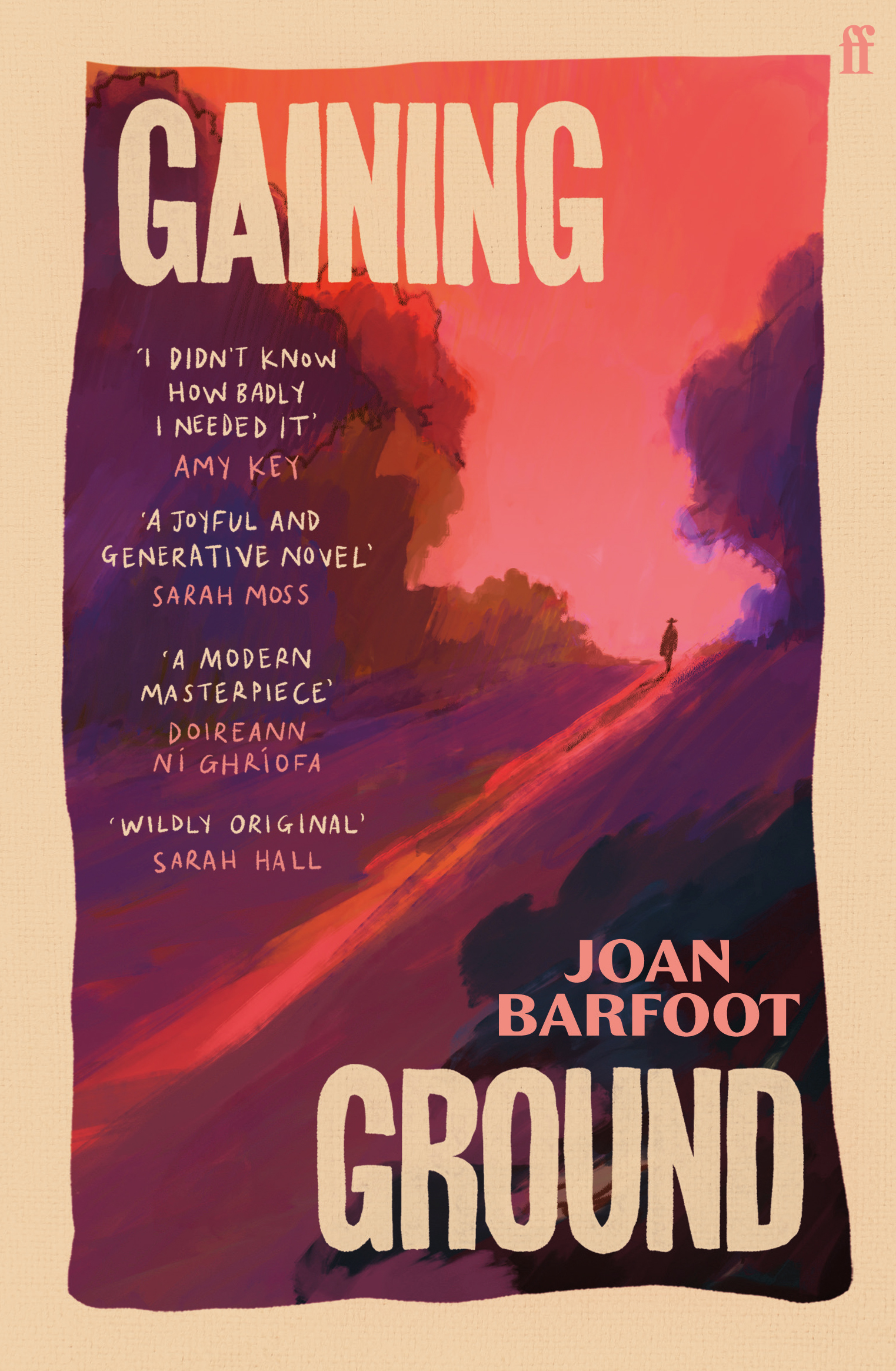
From Gaining Ground by Joan Barfoot. © Joan Barfoot, 1978. Used with permission of the publisher, Faber & Faber.