
The data centers have been speaking to me lately, in the form of ChatGPT slop.
The spam offers to market my new novel for a fee, perverting the language I’ve written about a place the data centers promise to destroy:
You’re not just telling a story about a dam. You’re telling a story about erasure. And about what survives despite it.
That line from the epigraph or from the souls in the water “I’m with you. All us, we’re with you” has been living in my head for days. It’s a promise. A reminder that the drowned are not gone. That the past is not past. That the waters remember.
“When you wrote this novel set in the 1960s but speaking so directly to our present were you thinking about it as a work of historical recovery? A way of bearing witness to the communities and landscapes that were erased by progress? Or were you doing something more urgent: using the past to illuminate the present, to show us that the same forces corporate greed, environmental destruction, political persecution are still at work, still drowning people and places that can’t fight back?”
Because if it’s the latter and I suspect it’s both then this novel isn’t just historical fiction.
It’s a warning.
And a testament.
A warning that we keep making the same mistakes, and a testament to the people who refuse to look away, who refuse to be silenced, who keep fighting even when the water is rising.
[sic]
*
Growing up in West Virginia, you are resolutely assured by popular culture of how unfortunate you are to have been born there—backward, isolated, living on scraps—while real American life flourishes elsewhere, vaguely in Hollywood, Silicon Valley, NYC, dream coasts. In some ways that’s true. But even as a deluded child, I knew we were rich, because we had over a million acres of public mountain land to do whatever we wanted, without asking or begging for it. You could walk on it as if your name was on the deed. The Monongahela National Forest slouched gloriously, messily down ten counties. Its great jewel was and is the complex of Dolly Sods Wilderness (that high rugged plateau of flagged spruce and snowshoe hares) and Canaan Valley National Wildlife Refuge (that low, creeping, tannin-stained, red-water wetland). I hope you’ll go there before you die.
Canaan, כְּנַעַן – the colonists named it right. That’s where you’ll find me on New Year’s Day, following bird dogs, starting the year off with hope in my heart and pain in my bad knee.
The land offered up its secrets in each harsh season. Come springtime, for five generations so far, we fished the Blackwater River. My great-grandfather would drive his Model A from the foothills, camp for two weeks, and return with barrels lashed to the car and stuffed with a layer of salt, a layer of trout, layer of salt, etc. When I was a teenager, we’d wait until the water dropped, wriggle down sheer mountainside into the Canyon, fish the foam-lines with crickets and grasshoppers, and take the entire day to work 3.5 miles upstream to the Falls then drag ourselves up with handfuls of laurel onto the overlook stairs somehow. I remember windchimes hanging from trees to mark where kayakers had drowned.
You could spend a life there, happily.
In summer, up on Dolly Sods, you fill buckets with wild huckleberries and see the flaming azaleas that nearly glow.
Come fall, the feathery English setters lead you in search of spooky grouse you rarely shoot. Long looping walks of twelve and fifteen miles up on the Sods and Cabin Mountain, with the dogs doing twice that, then going down into Canaan when the woodcock migrate through as October dies into November—they hold tight for the dogs there off A-Frame Road.
In bitter months, skiers travel from D.C. and Baltimore, and that’s what I like most about the place, that it’s big enough for lots of people to love it. After the Post ran a feature, the hikers and the craft beer crowd discovered Dolly Sods, which they share with Tucker County rednecks running bear-hounds all over creation—even if the different groups have a way of baffling one another, they can find their own space. The mountain bikers have Loop Road, the cross-country hippies have White Grass. The towns of Davis and Thomas, born out of timber boom, were half-empty when I was young, but they’re alive again with people who have come from without. In the last twenty years, people have worked hard to build new trail systems, record the county’s immigrant histories, reopen shuttered storefronts downtown, and repair a watershed damaged by mine acid runoff. You could spend a life there, happily.
Enter Governor Patrick Morrissey. MAGA Republican, a white-shoe lawyer and lifelong political lobbyist from New Jersey, who moved here to insinuate himself into elected office. I am not surprised that he is disassembling everything that made West Virginia a good place to live—after eighty years of one-party Democratic rule and powerful labor unions to back that up, the state once had the most progressive labor laws in the nation. But Morrissey’s administration has steered the state to the right—school vouchers, abortion bans, “right-to-work” (right to starve), Christian nationalism, etc.— cheered on by residents who should know better.
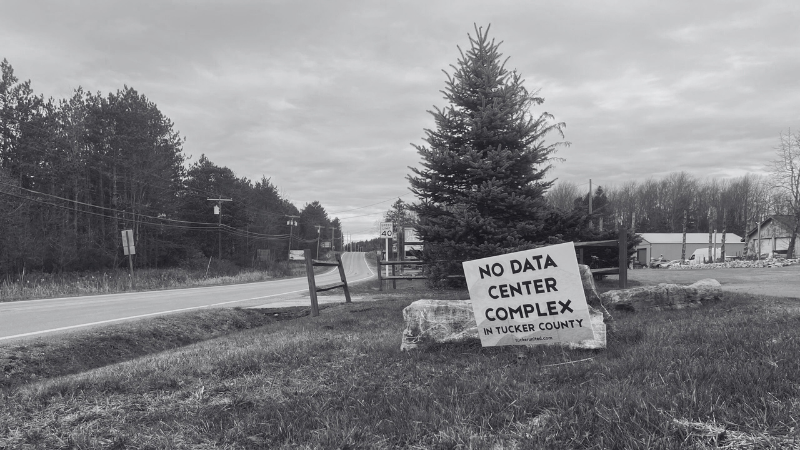
And now the data center has come to Canaan.
However, I am surprised how he’s positioned himself as the most pro-data center governor in the country. His Republican supermajority pushed through House Bill 2014 to lure microgrid facilities to the state, even though it will raise electric rates for an already struggling, aging population.
Local opposition to data centers has been resolute, but Morrissey’s administration has used its legislation to bypass local zoning rules and public opposition; it recently pushed through a $4 billion data center in Berkeley County on 548 acres. When residents pressed for information on the project, even on basic matters of impacts to water, air quality, job creation, and revenue sharing, members of the Berkeley County Development Authority said they had signed NDAs and could not share details.
My apologies for quoting myself, but all my fiction has been concerned with “the resource curse” and life in the internal colony. Billions of dollars have been made here from coal, oil, timbering, and fracking—but the profits have fled, and it consistently remains one of the poorest states, with crumbling infrastructure and a drinking water crisis. How can such a resource-rich place leave its residents so poor? Where’d the money go?
In my latest novel, Floodgate, I wanted to take on what I regard as the last frontier for extraction: our water. Floodgate follows the construction of the massive Summersville Dam in 1964, for the purposes of flood control and industrialization, which totally shaped my birthplace of Nicholas County, burying the villages of Gad and Sparks and inundating a particularly beautiful stretch of the Gauley River under the lake. A shadowy authority appeared one day and told the people that they had to leave, that the land must change. As the planet warmed, I expected West Virginia to be pillaged for its water, but I thought the pillaging would come from rich, thirsty humans, rather than vast, AI-driven data centers which can drink up to 5 million gallons of water a day.
And now the data center has come to Canaan. With its water-rich, delicate wetland complex. The largest wetland in southern Appalachia.
Quietly, a legal notice was posted by “Fundamental Data LLC” about permitting a new gas-powered plant between Davis and Thomas. Sharp-eyed locals took notice. County officials were blindsided. Opposition is severe. Some sources say the data center will encompass three hundred acres. Others say “thousands of acres.” Now Fundamental Data LLC promises it will span 10,000 acres across two counties, explaining to the Wall Street Journal it will be “among the largest data center campuses in the world.” (Only Silicon County would call it a campus with a straight face.) But its impact on the water table will be vast, polluting, lasting.
Say goodbye to the place the woodcock have visited since the beginning of time.
When I was ten years old, my father said to me of West Virginia, “Enjoy it while it’s there, because it’s not going to last.” Alas, he’s been proven right. We fished Grassy Creek until the mine opened on it. We fished Dry Fork until the No Trespassing signs went up. My elementary school and high school no longer exist, consolidated due to population decline. Ormet Steel where my classmates’ parents worked good union jobs declared bankruptcy after NAFTA and everyone was laid off. My grandparents’ house was condemned and bulldozed by FEMA after a flood in 2017. What gives a regular person joy is tenuous here. I must admit that when I read news of the Canaan data center, I reckoned it would be more of the same. According to West Virginia Watch,
Per the permit application, the Ridgeline facility—in its currently proposed form—would use gas-fueled turbines with heat recovery steam generators. Diesel would be kept on site in three 10-million-gallon storage tanks as a backup power source in case of gas line interruptions. Those tanks would be 66 feet tall and 180 feet in diameter. Leaks from pumps and valves, among other pieces of equipment, are to be expected per the application. Operations for the facility should begin by 2028.
The dollar is America’s god, and it’s hard to fight god.
But Canaan is the promised land, above money. It is too precious to lose. I hope you’ll go see it before you die, before it’s taken away. I hope your children can see it too. But I’m not sure they’ll be able. The local people—I proudly include transplants here—are fighting hard. They have coalesced into Tucker United. They know the data center revenue won’t stay in the county, no matter what the bright-eyed, dead-souled lobbyists say; it will buy, what?, yachts, Dubai apartments, and bottle-service nights for the men of Silicon Valley, men who do not know the beauty of the woodcock’s wild, spiraling, trilling flight as it puts on its mating display, in hope of a future, over the alders of Canaan.
__________________________________
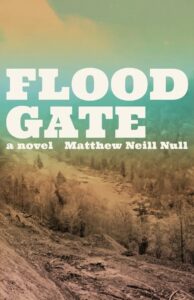
From Floodgate. Used with the permission of the publisher, Blair Publishing. Copyright © 2026 by Matthew Neill Null