
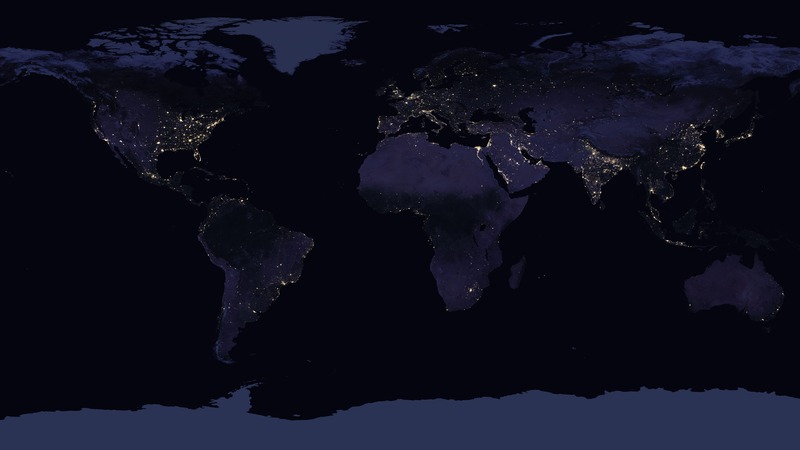
An image of Earth at night as seen from space appeared on my laptop screen during an internet search. The captivating image with a vague title—“Global Map”—drew me in like an insect mesmerized by the warm glow of a streetlamp at night.
At first, the map reminded me of a nighttime flight over a lit planet, where cities, suburbs, and roads glow below, stretching toward the horizon, though the view was evidently on a much grander scale. Yet, despite the enormous distance, several places could still be recognized by their artificial radiance. The bright points marking major metropolises—Paris, Delhi, Johannesburg, Mexico City, and the radiant expanse of Cairo, plus the shimmering “snake” of the Nile—stood out. I was struck by the map’s clean yet striking aesthetic: contrasts of deep blue with warm yellow, a pairing that both clashes and complements.
What did it mean to watch and map Earth using only the day’s light, given that daylight occupies half of the planet’s cycle? The map suggested there is another half to the tale: night, often overlooked or ignored because of what I now call an implicit daytime bias.
Night is defined by the absence of the sun, yet the map exposed a nocturnal world that wasn’t entirely dark. Certainly, vast areas remained the darkest navy blue, indicating some moonlight but minimal artificial illumination. But what made the map truly remarkable, even breathtaking, was the reach and intensity of human-made light—so extensive that it could be seen from orbit.
This map showed there is another half to the story: night, frequently forgotten or ignored because of what I now call an implicit daytime bias.
Many scientists describe such illumination as light pollution. A prominent scientist defines light pollution as harmful artificial lighting at night, due to its detrimental scientific, ecological, human-health, aesthetic, and other consequences. Yet, not all researchers studying nocturnal artificial light agree on what precisely constitutes “harmful.”
Others offer a technical definition of light pollution: “an increased volume concentration of photons in the nocturnal environment above naturally expected values.” This precise explanation is useful, but it fails to capture the emotional impact of the map—its portrayal of human presence on the planet and the resulting proliferation of artificial brightness. A key aspect of the map’s power lies in challenging the assumption that night is simply a veil hiding what is visible by day. The intense visibility of human-made illumination at night undermines that notion; night proves especially effective at revealing artificial light.
This global map offered a snapshot of nocturnal Earth in 2012, yet, as a historian, I began to wonder how it would have appeared if created in, say, 1912 or 1812. In short, I realized that night has a history.
*
Several years after this unexpected glimpse of the nocturnal map, I resolved to write a book about the history of artificial light at night and the way scientists became attentive to it.
In Transforming Night, the narrative begins with the earliest scientists who questioned nocturnal artificial illumination: astronomers. Many observatories were constructed in or near city centers before nighttime illumination became widespread. As artificial light, along with air pollution and vibrations from new transit systems like streetcars, intensified in urban areas, many of these observatories closed, their facilities repurposed for non-observational work, and new scientific sites were built farther afield to escape the disruptive qualities of urban nightscapes. This pattern is evident in Mexico’s Observatorio Astronómico Nacional, founded in Mexico City and moving four times between 1867 and 1969.
The history of Mexico’s observatory illustrates how night has been altered by darkness and light. It demonstrates three ways artificial illumination has transformed the night: it has grown larger, its brightness has increased, and the pace of these changes has quickened—from the nineteenth century onward and especially since the early twenty-first century.
Scholars have also identified a fourth way in which human-made light reshapes the night. Different lighting technologies emit differently colored light, and the recent widespread use of light-emitting diodes (LEDs) has given many cities a whiter lightprint.
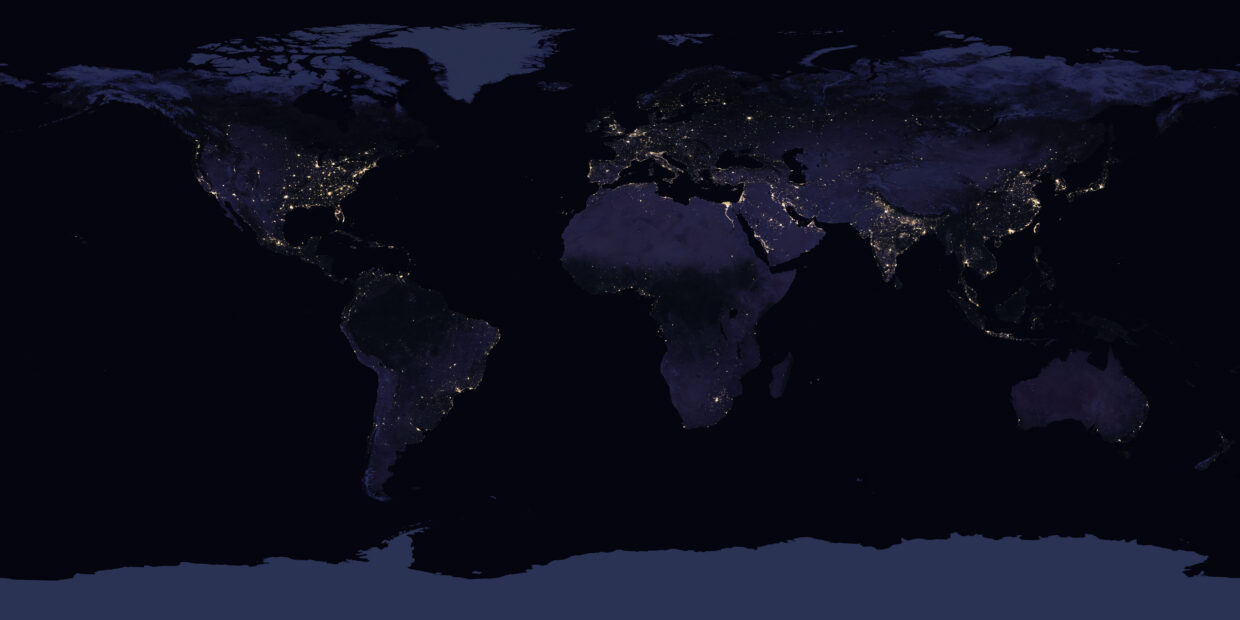 Data for this map was gathered over 9 days in April 2012 and 13 days in October 2012. It required a satellite to complete 312 orbits and process 2.5 terabytes of data to obtain a clear image of every patch of Earth’s land surface and islands. (Download Map Views—NASA Earth Observatory and NOAA National Geophysical Data Center).
Some researchers and activists who worry about nocturnal artificial light contend that contemporary nightscapes have inverted their arrangement: from scattered point sources across a predominantly dark backdrop to a world where bright lights populate the planet’s surface, casting a luminous haze far above. They have suggested that terrestrial lights may outshine celestial light, obscuring even the stars themselves.
In many regions, the everyday experience of night is becoming less night-like. In densely lit metropolises such as Hong Kong, residents experience what scientists call an ongoing “artificial twilight”—a bright hinterland where true darkness is never fully restored. This raises the question: can night exist without natural darkness?
*
When I began researching for my book, I wasn’t sure where the narrative would lead. That shift came with SpaceX.
On May 23, 2019, the aerospace, telecommunications, and artificial-intelligence company founded by Elon Musk launched sixty Starlink test satellites into low-Earth orbit to supply affordable internet to rural and remote communities. The following day, Marco Langbroek, a Dutch amateur astronomer, became one of the first to share a video of these satellites crossing the night sky just hours after launch. He described a “spectacular view” over northwestern Europe: a line of bright satellites moving in a tight formation across the heavens.
“Global Map” also demonstrates that we need to consider not only the history of nocturnal artificial illumination but also its future.
“It began with two faint blinking objects,” Langbroek recalled. “Then, mere seconds later, my jaw dropped as the ‘train’ slid into view.” To the naked eye, the satellites look like moving stars, but in astronomical imagery they appear as parallel streaks that hamper the observation of celestial phenomena. Given what I was witnessing, I exclaimed, ‘oh wow!’—accompanied by a few exclamations, Langbroek added.
At the time, I was in Colorado conducting fieldwork. I watched the astronomy-and-light-pollution communities blossom on Twitter (now X) as these overlapping groups suddenly grasped what was unfolding before their eyes, cameras, and telescopes.
They could not have anticipated what has happened since. Between 2019 and mid-2024, more satellites were deployed than in the previous six decades combined. By June 15, 2026, there were over 16,000 active satellites orbiting Earth (of which 10,634 are Starlink satellites), but this figure covers only operational spacecraft. It does not account for space debris—or the ambition to deploy another million satellites by SpaceX alone.
Ground-based artificial illumination since the late nineteenth century had already reshaped nightscapes. Space-based illumination is now extending the reach of nocturnal artificial brightness into extraterrestrial space, rapidly broadening the geographic footprint of human-made light and, with it, its nighttime effects across nearly the entire globe—unless decisive action is taken promptly. The shifts in night brought about by both ground- and space-based lighting are monumental in human history, given every culture’s ties to the night.
*
In the end, I chose to close my book at the origin—back with the map that began the inquiry, though my view of it has shifted. “Global Map” stands as an image of artificial night lighting, light pollution, and light poverty. Created from data collected in 2011, it is a historical artifact that is already outdated.
“Global Map” also shows that we must think about the history of nocturnal artificial illumination as well as its future. That future includes which form of environmentalism can best address forthcoming challenges. Since 2020, a fresh movement around light justice, rooted in environmental-rights principles, provides the strongest ethical and political framework for weighing the advantages and drawbacks of both artificial light and darkness for humans and nonhuman beings alike. The next phase involves pursuing fairer, more just access to light—and to night.
_______________________________
From Transforming Night: The History and Science of Light Pollution by Sara B. Pritchard. Copyright © 2026. Available from University of Washington Press.
