
I first encountered Elizabeth Taylor in The VIPs as a moony, impressionable teen, and I was instantly swept up. I missed some subtleties, perhaps, but the bigger message came through with force: a life could glitter, surge with drama, and be shaped—and possibly redeemed—by love. I was hooked from that moment.
Years later, while studying cinema in college, I began to grasp the broader arc of Taylor’s career, even as I continued to feast on the sensational details from gossip pages. Critics seemed to place her in a mosaic of verdicts—great actress, great beauty, ultimate movie star, a creature of extravagant excess, or some magnificent fusion of all four—sometimes occupying multiple labels in a single review.
The six books below illuminate that question from markedly different angles. Some are scholarly; others are deliciously indiscreet; all offer a perceptive angle in their own right, and one even ventures into obsessive territory. None purports to capture the entirety of the real Elizabeth Taylor, nor could they, as I discovered while drafting a faithful fiction of my own, for my new novel The Woman Who Had Everything. In the most fitting way, Taylor is simply too much. Perhaps that is why reading about her remains such a pleasure: a true diva consistently exceeds the available evidence, leaving behind a glow—a touch of the divine—that ordinary reality cannot fully explain.
*
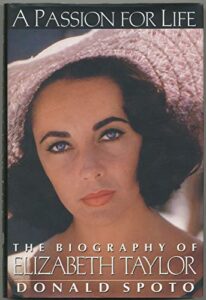
Donald Spoto, A Passion for Life: The Biography of Elizabeth Taylor
If you want to start with Taylor as a person rather than as “Liz,” Donald Spoto offers the most traditional, weighty biography of the set. It’s the one most deeply invested in examining her as a performer, not merely as a symbol of eight marriages, famous diamonds, and a medical saga that could fill a teaching hospital.
Spoto’s strength lies in the paradox at the heart of Taylor’s life: she created a dazzling public self that also consumed her. He sees the marriages not as a string of scandals but as experiments in transformation—each union granting Taylor another role to inhabit and another possible exit from the one she had played since childhood. Some readers may find his psychological readings a touch too orderly for a life lived in riotous energy, yet no other biographer I’ve read comes as close to explaining how a frightened child, a formidable actress, and a soap-opera heroine can all fit inside the same petite frame.
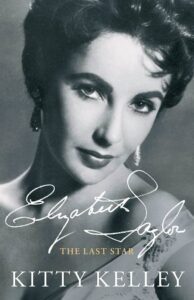
Kitty Kelley, Elizabeth Taylor: The Last Star
Kitty Kelley’s unauthorized chronicle remains the group’s louche pleasure. Kirkus famously labeled it a “tacky stroll” through Taylor’s life, and that verdict isn’t entirely off the mark. Kelley favors Taylor’s appetites—food, men, feuds—over the subtleties of her craft, stitching gossip together with a prosecutorial zeal that leans on people eager to settle scores.
Yet the book has gained a curious value as a historical artifact. Published in 1981, it captures a moment before Taylor’s AIDS activism, before the fragrance empire, and before later readers understood the courage and generosity she showed toward others. Here she remains the scandal-prone, indulged, late-to-arrive, over-spending, and frequently infuriating star of the tabloids.
The best way to approach this work, by the way, is with a battered paperback in hand rather than a pristine edition; its spirit feels most authentic when it wears signs of use.
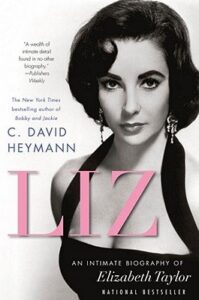
C. David Heymann, Liz: An Intimate Biography of Elizabeth Taylor
C. David Heymann’s Liz moves with the ease of someone admitted into every dressing room, bedroom, and hospital suite, delivering a continuous, breathless narrative about Taylor that keeps pages turning. The tone is intimate and polished, as if the author knows exactly which line to utter to coax a smile from the reader.
Yet there are reasons to approach some of the most arresting details with skepticism. Questions have arisen about Heymann’s methods as a biographer, so I wouldn’t treat Liz as the sole evidentiary source in any sworn statement. Biography, after all, isn’t only about proof; it’s also about atmosphere, the experience of being carried into another life. On those terms, Liz remains immensely appealing. Heymann captures both the scope of Taylor’s world and the remarkable number of people who wanted to be near her and reveal what she was really like.
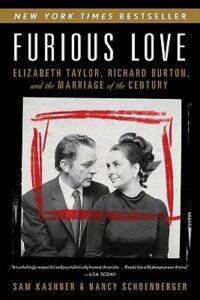
Sam Kashner and Nancy Schoenberger, Furious Love
When you want a portrait not merely of Taylor but of “Liz and Dick”—the unstoppable weather system they created in the sixties and seventies—this is the volume to pick. Kashner and Schoenberger present their relationship as the ultimate romantic spectacle: a collision between something sublime and something wildly excessive, sustained by a seemingly endless supply of Bulgari.
The book’s strongest asset is Burton’s letters, which bring him onto the page with urgency—needy, self‑mocking, jealous, yet undeniably smitten. That makes him the more legible half of the duo, while Elizabeth remains the more enigmatic force, less eager to reveal herself in writing.
The narrative has a tendency to repeat itself—passion leads to quarrels, then to separation, followed by gifts and reunions, again and again. But that repetitive arc is part of the book’s pleasure: it helps explain why the world watched the Burtons with such belief in their romance, treating their chaos as if it were fate or perhaps a lavish traveling production of Who’s Afraid of Virginia Woolf?.
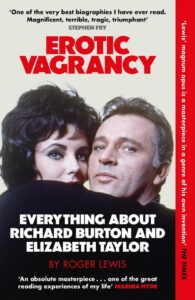
Roger Lewis, Erotic Vagrancy: Everything About Richard Burton and Elizabeth Taylor
The subtitle promises everything, and Roger Lewis does his best to deliver. Erotic Vagrancy is sprawling and stubbornly unruly, intensely personal, and often undeniably entertaining. Lewis broadens his scope to cover Taylor and Burton, and then everything within reach of the Burtons, and then anything that followed from that. He includes the weekly yacht rental for their dogs to dodge quarantine, along with the papal denunciations and congressional movements to block their entry to the United States—plus a great deal more that his electric, live-wire mind thought worthy of note.
This is clearly the most meandering of the books listed, but “meandering” hardly does justice to its method. Lewis digresses, argues with himself, and even interrupts the biography to state what biography ought to be. You may want to challenge him every few pages, and that friction is part of the fun.
Because excess feels somehow right for the subject, a restrained, orderly account would be a larger distortion. Several critics have observed what this book mimics: it mirrors its subjects and behaves much like the Burtons themselves. It takes up too much space, lingers too long, drinks in every corner of the house, hurls occasional insults, and somehow leaves you feeling a twinge of regret when it ends.
John Waters, Crackpot: The Obsessions of John Waters
John Waters’s Crackpot isn’t a conventional study of Elizabeth Taylor; it’s a collection of subversive essays on his many obsessions, among which Taylor ranks high. Because Taylor is one of his obsessions, his piece on Boom! fits naturally into any essential reading about her. Waters turns his gaze to Joseph Losey’s 1968 adaptation of Tennessee Williams’s The Milk Train Doesn’t Stop Here Anymore, featuring Taylor, Burton, and Noël Coward, with wardrobes of fabulously regal caftans and one of the most extraordinary headdresses ever captured on film.
Boom! captures a peak (or trough) of Taylor’s most extravagant phase as a performer. In the role of the dying aristocrat Sissy Goforth, she bulls about the set, dictating her memoirs, berating her staff, and ruling her private Mediterranean island like an exile-empress. The film drew its fair share of criticism, yet Waters adores it—and I do as well—without trying to render it respectable. Its grand excess, its miscasting, its almost operatic hysteria—these are not flaws to be explained away; they are the point.
After half a dozen volumes attempting to interpret Elizabeth Taylor, Waters finally yields to the impulse to worship. Sometimes the most astute response to a goddess is not analysis but reverence.
__________________________________
The Woman Who Had Everything by Stephen Greco is available from Kensington Books.