
For years, I believed people avoided letter writing because they lacked time. But after teaching leadership, communication, and storytelling to thousands of students, I’ve come to believe something else entirely: People do not avoid writing because they’re busy, or even because they have nothing to say. They avoid writing because they know, deep down, that the letter may be saved, may be re-read, even answered. A text can disappear into a scroll. An email can be deleted in a swipe. But a letter—especially a handwritten one—feels dangerously permanent. It asks us to choose what deserves to outlive us.
I have become less a writer and more a letter doula: someone who helps usher difficult truths, buried gratitude, overdue apologies, impossible love, and unfinished grief safely into the world. When my students struggle to write speeches, they often believe the problem is craft. They ask questions about structure, transitions, hooks, and conclusions. But usually the real problem sits somewhere deeper. We live in an age of performance writing. We curate ourselves constantly. Even our vulnerability now arrives edited, filtered, captioned, and optimized for engagement. We have become remarkably skilled at sounding like people who feel deeply while revealing almost nothing.
A text can disappear into a scroll. An email can be deleted in a swipe. But a letter—especially a handwritten one—feels dangerously permanent.
Letters resist that instinct. A real letter does not survive on branding. A real letter eventually asks of the writer: What do you actually mean? And perhaps more frighteningly: Will you say it plainly?
* Prompt #1: Write Toward One Person, Not the World
Right this moment, pause and picture one person whose face lights up when you step into a room. One person. Now complete this sentence in private:
What I have never fully told you is…
Do not worry about elegance. Do not aim for profundity. The human nervous system recognizes sincerity faster than polish. Some of the most unforgettable lines in history are structurally simple. “I miss you.” “I forgive you.” “I was wrong.” “Thank you for loving me when I was difficult to love.”
Years ago, I began writing letters not because I had literary ambitions, but because certain experiences refused to stay quiet inside me. Some letters were written to people I adored. Others were written to people who hurt me. A few were written to people who would never read them at all. And that is when I discovered something important about writing in general: Writing is not always communication. Sometimes writing is clarification, or excavation of what we actually feel or believe.
A letter creates immediate emotional stakes. Unlike a journal entry, a letter presumes relationship. Even if unsent, it imagines witness. Someone is on the other side of the page.
The irony is that people often wait to write until they feel emotionally resolved. But resolution is overrated. Some of the most powerful writing emerges mid-confusion. You do not need closure to begin. You need willingness. I have seen students write extraordinary things immediately after admitting they “didn’t know what to say.” That phrase itself is often the doorway. Uncertainty sounds human. And readers trust humanity far more than certainty.
* Prompt #2: Begin Before You Understand
Take out a blank page and write this sentence at the top:
I do not entirely understand why this matters to me, but…
Then keep your pen moving for seven uninterrupted minutes.
No deleting, rereading, correcting grammar, or performing intelligence.
A real letter does not survive on branding. A real letter eventually asks of the writer: What do you actually mean? And perhaps more frighteningly: Will you say it plainly?
Just movement.
Most people stop writing at the exact moment they are about to say something real. Keep going thirty seconds past that point. That is usually where the truth begins.
I worry sometimes that we are becoming emotionally fluent in reaction but emotionally illiterate in reflection. We react instantly now. We comment instantly. We post instantly. But meaningful writing often requires incubation. A letter asks us to sit beside our own thoughts long enough to hear them fully formed. That kind of patience can feel uncomfortable at first. Silence usually does. But silence is where original thought lives.
Letter writing matters because it trains us to notice what deserves articulation before it is too late. That may be the central task of all meaningful writing. To rescue what would otherwise go unsaid.
* Final Prompt: The Unwritten Letter
Somewhere in your life there is a letter you already know you should write. You have rehearsed pieces of it in the shower. While driving. At 2 a.m. While watching someone sleep. At a funeral. At an airport gate.
You already know the recipient, the purpose, even the opening line. Write the letter you have been postponing. Not tomorrow. Not when you feel eloquent. Not when you feel healed. Not when you finally “have the words.” The words arrive through writing.
And if you are very lucky, years from now someone may hold your pages in their hands and feel less alone because you finally chose to say the thing you meant. That is not merely correspondence. That is literature at its most human.
_______________________________
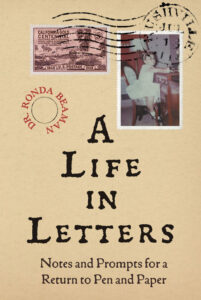
A Life in Letters: Notes and Prompts for a Return to Pen and Paper by Ronda Beaman is available from Amplify Publishing.