
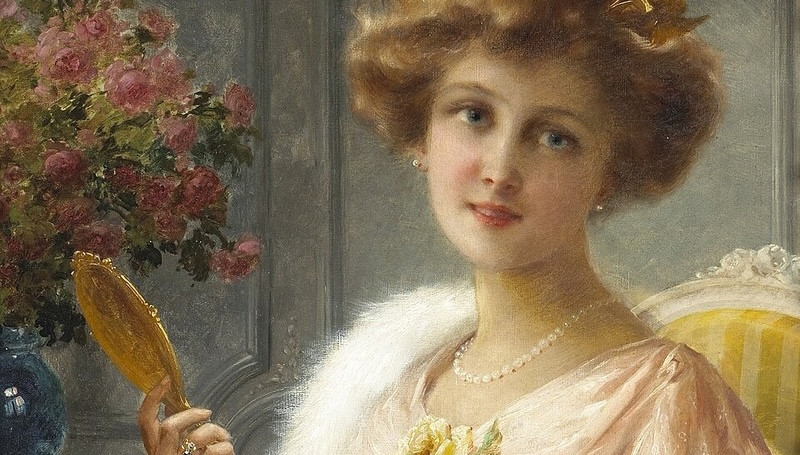
It will be the Year of Perfect Skin, I told myself. I had arrived at my mid-forties, and the mirror suddenly gave me a face crosshatched with creases. I was Portrait of a Woman Aging. I was a cubist composition, something by Picasso. I was a strange collage of exhaustion. Mouth, eyes, along the Cupid’s bow of my lips—each one was crinkled like a piece of paper that had been balled up and then pressed flat again.
I no longer looked twenty years younger. But, worse, my skin had broken out in a strange midlife puberty. Every morning, another pink spot on my cheek. Every night, another small mark of embarrassment written along my jaw.
To begin the Year of Perfect Skin, I ordered creams and moisturizers, serums that arrived in glass ampules, oils I would measure out by the droplet. I learned to double-cleanse: first a balm that melted like butter, then a soapy liquid to wash all residue away. I ordered little disposable face towels from a company called Clean Skin Club, because immaculate skin was a society I wanted to join. I tapped something called essence into the fat of my cheekbones. My fingertips moved across my face the way they did across the keyboard of my laptop. I wanted glass skin, bouncy skin, skin slickened like the trail a snail leaves behind. Tap. Tap. I am revising myself, I said.
It was January 2020. Soon there would be a global pandemic. I would learn how to distance socially. I wore a disposable mask to the grocery store and a pair of surgical gloves. Standing in the produce section among the bins of apples, I grasped each piece of fruit with my blue, latex hand. Beneath the protective layers, I could smell the fear in my sweat.
Back home, I stood before the mirror’s metallic scrutiny. Sometimes the mask left a welt around the perimeter of my mouth, a groove that briefly obscured my aging and acne.
The frivolous is a splendid excuse. It allows us to partake in stead in the fun of gossip, to enjoy the delights of fashion and fragrance, to devour sugary cookies until our gluttony is sated, the soul fat as a full belly.
What could I do in that year but insist on skin without flaws? What power did I have beyond leaning toward my own reflection and studying the lunar contours of a pore? If I stood close enough to the mirror, the world was reduced to my face. My skin became a whole topography. There was nothing beyond the landforms of forehead, nose, and chin.
*
Frivolity, meaning connected to the frivolous. That is, unimportant, undeserving of rigorous thought.
*
Frivolity is always intended as an insult. We deem certain lawsuits frivolous. Some entertainments. Some conversations. Frivolity is seldom a compliment we pay.
*
The word frivolity wears a feathered boa. When uttered, it is coquettish. It opens with an unvoiced f. It closes with what grammarians call a feminine ending, which seems to fizz like a pale splash of prosecco.
*
Feminine, because frivolity is stitched to gender. It is often tied to queerness and to color as well. Those who call an object “frivolous” criticize the thing and, by extension, they also critique the person who loves the snippet of lace, the leather fringe down the length of a sleeve.
*
Feminine, because items deemed frivolous—let’s say a lipstick shaped like a sleek, red bullet of seduction—are mostly marketed and sold to women. Men’s passions are taken seriously. The games they play as children become their weekend hobbies as adults, even if now they only watch a ball being hurled back and forth from the marshmallow cushions of their living rooms. Men are permitted to be fans. They can wear jerseys that hang to their knees, baggy shirts in primary colors, without censure. And the game (whatever that game might be) is never a frivolity.
*
But a woman who buys a bottle of perfume must be condemned for spending money on a silly spritz of mimosa and patchouli. She is judged for wanting what women want. Purses and heels. A dress made of something silky called charmeuse, a French word that means a woman who charms, one who bewitches.
And never mind that she has bought only what the market is selling. Never mind that she will be disparaged if her lips remain plain or her lashes lack the necessary coat of mascara, that caterpillar thickness. She should still be blamed for giving in to the allure of billboards ten feet tall with languorous models. Shame on her for wanting those vast cheekbones highlighted in gold, those great eyelids heavy with shadow the color of smoke.
*
In Ways of Seeing, the art critic and writer John Berger examines the unkindness with which women are often viewed. The book considers the work of European artists, from the Middle Ages to the Renaissance and into the twentieth century. Berger examines the moral judgements that are embedded in representations of women’s bodies, their lovely faces:
The mirror was often used as a symbol of the vanity of woman. The moralizing, however, was mostly hypocritical. You painted a naked woman because you enjoyed looking at her, you put a mirror in her hand and you called the painting Vanity, thus morally condemning the woman whose nakedness you had depicted for your own pleasure.
The real function of the mirror was otherwise. It was to make a woman connive in treating herself as, first and foremost, as sight.
Berger shows us Hans Memling’s Vanity. The piece is oil on wood. Created around 1485, it’s one third of a triptych. A woman stands naked, except for her sandals and the thin, gold circlet in her hair. She holds a mirror. The only thing reflected is her face staring back from the glass. Although she’s positioned in a landscape dense with greenery, dogs, a thatched cottage in the distance, she sees nothing but herself. We are meant to hate her for the way she has fallen into her own reflection. But why should she not? Her breasts are pert. Her belly’s curve implies fecundity. A cloud of auburn hair hangs past her waist, reaching almost mid-thigh. Her flesh is so pale she might as well be alabaster, carved and polished smooth.
*
In Georges de La Tour’s The Penitent Magdalen, the artist gives us another version of a woman. Painted circa 1640, she too sits before a mirror, this one rectangular, a frame placed within the frame of the painting. A gleaming skull is cushioned in her lap. Eyeless, it seems to gaze upward toward a candle that burns on the tabletop. The flame high and pale, voluptuous in its flickering, its image reflected in the glass.
As is typical of La Tour, the scene is split between brown shadow and stretches of brightness. The woman’s face glows with light. The V of her white blouse plunges almost to her navel but not immodestly. She has none of the seductive vanity of Memling’s subject. This must be Mary Magdalen, reformed and healed, after her encounter with Christ. Although her skirt simmers red, some kind of heavy satin, she isn’t presented as a figure of sexual pleasure. Her purity neuters her. Memento mori, such paintings instruct us: Remember death. Magdalen confronts herself in the mirror, neither delighting in her own beauty nor regretting its imminent loss. She is appropriately humble (as the artist sees it). Her self-regard is forgiven because she confronts her flaws. She acknowledges the corruption of skin.
*
The Year of Perfect Skin, for instance, was more than an example of self-centeredness….It was my small was of insisting: This body is alive and permanent.
Early on in George Eliot’s great novel Middlemarch, Dorothea Brooke agrees to her younger sister’s request that they finally divide between them their dead mother’s jewelry. Dorothea is serious, pious, and beautiful. She wants not only to be a good Christian but also to appear like one to others. She wants to be seen as fastidiously unadorned, dressed only in her devotion to God. But the jewelry box holds some very pretty stuff, including “a necklace of purple amethysts set in exquisite gold work, and a pearl cross with five brilliants in it.” Although she is tempted, Dorothea gives the piece to her sister, Celia. “A cross is the last thing I would wear as a trinket,” she intones.
A few paragraphs later, the girls discover an emerald and diamond ring. Dorothea is captivated by its sparkle and hue. “I suppose this is the reason why gems are used as spiritual emblems in the Revelation of St John,” she muses. “They look like fragments of heaven. I think that emerald is more beautiful than any of them.” There is a matching bracelet, and Dorothea can’t resist it either. She decides to keep the two pieces, although the ornaments require that she “justify her delight in the colours by merging them in her mystic religious joy.” Celia notices her sister’s philosophical inconsistencies and asks if Dorothea will wear the jewelry around other people. It’s a moment of unusual tension between them, the biddable younger girl gently pointing out the elder’s hypocrisy.
We are meant to love Dorothea. She stands at the center of the narrative. But Eliot wants us to understand too how the young woman will suffer for her performances of virtue. She will marry someone older—Casaubon, a fussy and self-centered clergyman—who makes her miserable, all because she believes him to be a scholar and imagines a romantic life in which she might help him pursue academic distinction, the couple bent over the yellowed pages of books and parsing dense passages together.
In an essay titled “It Can Be Embarrassing to Love Dorothea,” the novelist Pamela Erens reminds us:
Eliot makes it clear that Dorothea is no saint but rather a morally immature young woman. Her self-denials have roots in youthful arrogance and impetuousness….Dorothea doesn’t recognize her bossiness and grandiosity. Her ideals of Christian humility and simplicity and service are genuine. But she is very young.
Instead of admiring her mother’s jewels for the sake of their splendor, the girl must rationalize her love for faceted stones. The gems glitter with holiness, she assures herself, because she cannot yet accept frivolous beauties on their own terms. Eliot departs here from the moralizing messages of Memling and La Tour. As the novelist sees it, ornamentation is not vanity. Dorothea’s abnegation is.
*
The great Renaissance essayist Michel de Montaigne begins “Of Vanity” by arguing that there’s nothing vainer than to write about vanity itself. “What the Divinity has so divinely told us about it ought to be carefully and continually meditated by people of understanding.” Montaigne is alluding to Ecclesiastes 1:2. “Vanity of vanities, saith the Preacher, vanity of vanities; all is vanity.” In the Christian tradition, these words are a grim warning of our transience, the vaporous substance of our lives. To be distracted by vanities (read: frivolities) is to forget that earthly pleasures have no lasting value. They are temporary dust. The body is a candle that glimmers briefly. Only the soul persists.
But because Montaigne is subversive and a wit, he then devotes many pages to examining vanities, both his own and those of others. “Of Vanity” is as much a meditation on the experience of being a writer as it is a discussion of different forms of political rule. Then, just as it seems he has lost track of where he began, Montaigne returns to examining the matter:
This common attitude and habit of looking elsewhere than at ourselves has been very useful for our own business. We are an object that fills us with discontent; we see nothing in us but misery and vanity. In order not to dishearten us, Nature has very appropriately thrown the action of our vision outward. We go forward with the current, but to turn our course back toward ourselves is a painful movement: thus the sea grows troubled and turbulent when it is tossed back on itself. Look, says everyone, at the movement of the heavens, look at the public, look at that man’s quarrel, at this man’s pulse, at another man’s will; in short, always look high or low, or to one side, or in front, or behind you.
We’re all implicated in what Montaigne says. Vanity is what’s false or empty. Vanity is the fruitless. We share in Montaigne’s metaphor of the sea and feel uneasy when we are forced to encounter ourselves in the blue waves of self-reflection. We will do anything to avoid such crashing, downing scrutiny. And this is where frivolity enders. The frivolous is a splendid excuse. It allows us to partake in stead in the fun of gossip, to enjoy the delights of fashion and fragrance, to devour sugary cookies until our gluttony is sated, the soul fat as a full belly.
*
Montaigne in “We taste nothing pure” writes about the flaws of the human condition. He says we live in a state that makes it “impossible for things to come into our experience in their natural simplicity and purity.” Whatever we delight in “has an air of groaning and lament about it.” And even the greatest joys have “more seriousness than gaiety.” Later in the text, he observes that painters believe that the expressions formed by faces—their creases and wrinkles—must serve both for crying and for laughter.
If I am to follow Montaigne’s argument, then I might say the frivolous is always tinged with solemnity, a grey pigment. The Year of Perfect Skin, for instance, was more than an example of self-centeredness, more than an effort to turn my face translucent, luminous as a moonstone set in silver prongs. It was my small was of insisting: This body is alive and permanent. The clearer my complexion became, the greater my distance from all the dying in that year.
____________________________

Excerpted from Frivolity: A Defense by Jehanne Dubrow. Copyright © 2026 Columbia University Press. Used by arrangement with the Publisher. All rights reserved.