Readers, this publishing season is saturated with poets—brilliant voices I didn’t have room to honor in full and others I carved out space for who nonetheless merit more than a few hundred words to sketch their work. This lineup could have been a double edition with double the entries. Let me foreground, though, that September also introduces Sherwin Bitsui’s The Next Sky (Copper Canyon), Cynthia Cruz’s Twilight (Four Way Books), Erica Meitner’s Assembled Audience (Milkweed), Don Mee Choi’s Freely Frayed (Wave Books), Joanna Klink’s Days and Chances (Penguin), Kiki Petrosino’s Perfect Italian (Sarabande), and Brenda Hillman’s Still House in the Desert (Wesleyan), among others.
As I wandered through the September stacks, it struck me that we may have finally reached a post-pandemic moment when poets, together, are finding their bearings. Of course, I speak only for myself, but this month’s verse feels incisive and soulful, bearing both wounds and light.
*
Aldo Amparán, The House Has Teeth (Alice James Books)
In the heart of Amparán’s second collection sits a caustic meditation on the self—its traumas, its reclamations, and the hauntings that keep returning. The poems travel from an opening sequence of sonnets shadowed by closets, candlelit rooms, and bodies marked by harm, to a linked set of pieces titled “Parable” that address a haunted doll, cloak, and mirror. The volume also attacks pseudoscientific notions about sexuality, as a poem about “the theory that male same-sex attraction might be caused by female ghosts” gives way to an insistence on confronting violent histories and inherited beliefs. The speaker confronts past eras and their dogmas, even as she grapples with a present where cruelty persists; one poem about watching a cartel’s ending with a brother ends on a note of futility at revisiting another’s demise.
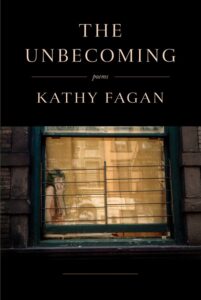
Kathy Fagan, The Unbecoming (Norton)
In the arresting opening of The Unbecoming, “Listening to Others,” Fagan offers fourteen compact, weighty meditations that puncture the pretensions and freedoms of a woman stepping into the late stages of life. The speaker is addressed with disdain as an “Old Bag” by a passerby, then marks the man’s cruelties. The speaker remembers a Mother’s Day Mass, a father who trained cruelty, and a fracture that remains after his passing—yet grief and memory become a field of language, not a resignation. This is a book propelled by gravity and a fierce, lucid witness, following Fagan’s prior recognition and signaling the ascent of her craft into more luminous altitudes.
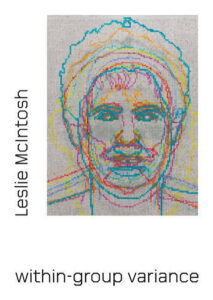
Leslie McIntosh, within-group variance (Changes)
Changes’ prize for first and second books, inaugurated in 2022 with Louise Glück serving as the inaugural judge, has continued to yield luminous discoveries, such as Jimin Seo’s Ossia and Rachel Mannheimer’s Earth Room. This year’s judge, Terrance Hayes, introduces Leslie McIntosh’s debut collection, within–and–group variance, a work that invites readers to learn how to love words enough to loosen them from mere information. The poems move through questions of observable biological differences—pondering why one person retains asthma while a sister does not—alongside broader, systemic inequities: why a critical water line might be lead while a governor’s line remains untouched. The volume radiates a sense of vastness throughout. In “psychopomp,” the speaker muses on a time before the stars learned to abandon Earth, a departure that leaves the world aching but not empty. McIntosh’s biographical note emphasizes a multiplicity of identities—“black, male presenting, male attracted, autistic, an older millennial”—and his background as a psychologist lends a particular lens, shaping the voice as one that acknowledges that the speaker’s face changes, while the mind remains a constant machine.
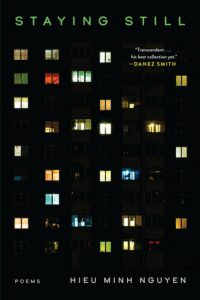
Hieu Minh Nguyen, Staying Still(Tin House)
The speaker inside Nguyen’s Staying Still asks a stark question: who dictates what you’re supposed to be when nobody’s watching? The poems cast the speaker as a keen observer of self and others, capable of both vulnerability and agency, with openings that trust complexity and fallibility over idealized certainty. In “The Dress,” the speaker looks back to a moment of realizing that beauty can hurt others when worn; in “Lucky,” beginning with a startling admission—“I pushed him off the cliff. I was three”—the speaker wrestles with what they can truly claim about their own capacity. The longer “Looking” sequence unwinds power dynamics with deft care, and the voice insists on the toll of carrying oneself in spaces that demand performance: you’re exhausted from finding places to house your body when you’re not using it. The memory of a childhood, running naked and imagining the body turning into glass, becomes a recurrent image of risk and longing.

Emily Skaja, Black Lake
“I wanted an uncomplicated joy,” declares the voice in Skaja’s Black Lake, a piercing meditation on infertility and the grief of miscarriages told through a strikingly singular voice. Describing a visit to a nursery opposite a Planned Parenthood as she endures a miscarriage, the speaker toggles between mordant humor and raw ache—making the humor feel like a lifeline and a coping mechanism. The book treats miscarriage as a multi-faceted grief, with sequences that name the stages and the eruptions of rage that accompany waiting, alongside meditations on protecting what the future child might become; the speaker embodies tenacious endurance as life’s fragility is made concrete and personal, even as the speaker conjures a fierce, almost defiant tenderness toward the possibility of another life.

Paisley Rekdal, Heritance (Copper Canyon)
Following the ambitious hybrid project West, Rekdal returns to the intimate, ardent lyric voice—narrowed to the “I” standing alone on the page and guided by fearless inquiry into difficult, liminal subjects. The poems move through experiences close to home—a neighbor affected by police violence, a public confrontation that riffs off racist provocation, dolls that embody racialized histories, and a daughter’s gaze watching and weighing what carries forward. Amid extended investigations, gorgeous shorter pieces rise, such as “Fledgling Cooper’s Hawks,” where the miracle is found in living creatures learning to become what they are meant to be. Rekdal’s work does not shy away from pain—whether it’s a dog’s paw or a fractured marriage—insisting that hurt must be named and recognized as part of the human story.
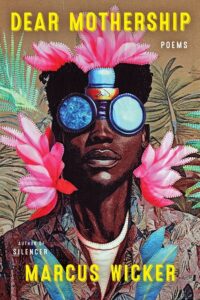
Marcus Wicker, Dear Mothership (Ecco)
In the heart of Wicker’s third collection, the poet stakes a static, stony ground for a distinctive, musically charged voice. The book leans into a kind of Afrofuturism—an inquiry sparked by Outkast’s ATLiens and a response to how academic discourse often whitewashes complex selves. The poems move with momentum through mid-life and mid-career anxieties amplified by the pandemic, taking aim at the professional ranks of scholarship and the practicalities of making a life: house-hunting, the cadence of long-term commitments, and the honesty of desire. A sequence titled Toilet Paper Invective with Self-flagellation confronts the absurdity of existence and the stubborn task of grafting meaning onto an uncertain world. The collection culminates in a reparations-oriented section that blends buoyant lightness with overwhelming depth, insisting that relief and recovery must arrive in tandem with recognition of the burdens carried and the waters still to be crossed.