
When I walked toward the Roman statue of the Three Graces in The Metropolitan Museum of Art last month, my eyes began to water. I registered the familiar details in person for the first time: The contrapposto stance of three sister goddesses, one turned away from the other two. The graceful nudity of three women. A gentle marble hand resting on another’s shoulder.
I first heard of the subject of the statue—the myth of the Three Graces—more than twenty years ago. In high school Latin and art-history classes, I learned that these three sister goddesses, known as “The Charities” in ancient Greece and “The Graces” in ancient Rome, each bestowed a distinct gift upon humanity: Aglaea (radiance), Euphrosyne (joy), and Thalia (blossoming).
In practice, there were a range of depictions of these goddesses in ancient Greece—their number, their names, and their traits differ across sources. Benevolence and beauty were near universal attributes across their iterations and iconography, and scholars believe they may have first appeared as fertility deities. In one telling, the Graces were meteors who fell from the sky, sparked the first growth on earth, and morphed into goddesses. Homer described the three as supporting Aphrodite, the goddess of love, after her birth. The Graces helped love bloom in the world, metaphorically and literally.
I created these mortal, modern counterparts to the myth…to reflect the generosity and grace that already emanates from women around the world in their flaws and imperfections.
Although they were minor figures on Mount Olympus, the cult of the Graces was widespread. They became a prolific visual motif in ancient Greece and Rome, appearing on pottery, coins, mirrors, sarcophagi, mosaics—as well as magnificent statues like the one I saw at The Metropolitan Museum of Art, which was unearthed in 1892 beneath a Roman road.
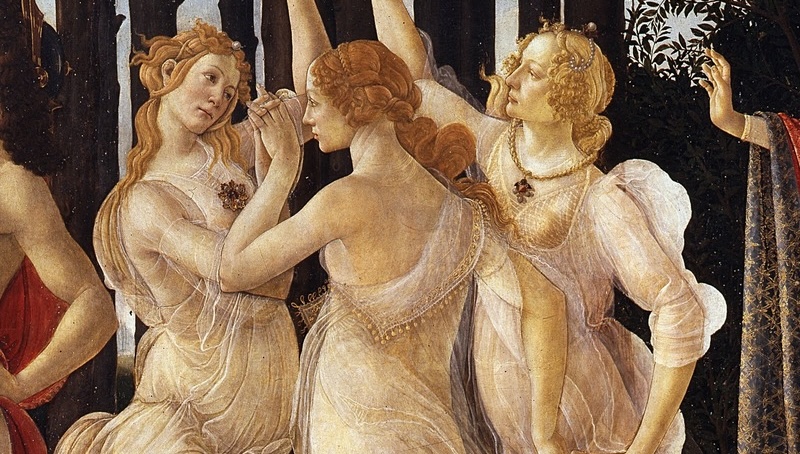
Because their likeness was undefined beyond their venerable beauty, the goddesses have long served as symbols of the idealized female form. Some of Western civilization’s greatest artists, including Botticelli, Raphael, Rubens, Canova, Cezanne, and Picasso, have all adapted their forms to fit the tastes of their eras.
The Three Graces are not confined to the realm of high art and academic study. Once you’re aware of these goddesses, you notice them everywhere. On a recent trip to Rome, I glanced up to find a mass-produced print of them hanging above the bed in my hotel room. Last month, I learned they were the framework for a beloved Greek sitcom in the 90s, Oi Treis Harites, about three sisters in their forties.
For decades, I’ve felt drawn to these goddesses. Unlike other Olympians, who were often violent and wrathful, the Graces offered kindness and care to their fellow gods and mortals alike—bestowers of grace in every context. This unequivocal goodwill became my muse. Even so, I could not help feeling as though their symbolism fell short of my own feminine ideal. Radiance and joy are essential to a happy life, but I do not imagine them as the highest virtues. In a world where women endure the impossible to bring new life into the world—holding agony and beauty together—shouldn’t women be celebrated for more than their idealized form and youth?
But as I delved deeper into research on the Three Graces, I discovered they were not merely idealized figures, but a visual allegory cherished by ancient philosophers. The original Greek word χάρις, or charis, not only connotes beauty but also the gratitude and goodwill that arise when gifts are given, accepted, and returned. As discussed by Denis Vidal in an academic piece on the Three Graces, the late scholar Jean-Pierre Vernant defined charis as “the divine power manifest in all aspects of gift giving and reciprocity (the round of generous liberality, the cordial exchange of gifts), which, in spite of all divisions, spins a web of reciprocal obligations.”
In the ancient world, the Three Graces represented the virtuous cycle of giving, accepting, and returning gifts, which the stoic philosopher Seneca described as “the chief bond of human society.” Each Grace represented one facet of this virtuous cycle, and together they embodied an ideal to strive for in society. Seneca noted that the visual elements of traditional Hellenistic and Roman depictions all reflect this allegory: The Graces are often shown in a circle holding hands to demonstrate the uninterrupted passing of gifts—with joyful expressions to express the joy of giving. “They are youthful because the remembrance of ‘benefits’ should not grow old,” he wrote.
Each of us have our own gifts, as distinct and varied as our fingerprints. Sharing those gifts—and receiving other women’s gifts in kind—is the closest thing I’ve experienced to grace on earth.
Approximately four hundred years earlier, Aristotle also referred to the motif of the Three Graces in Nicomachean Ethics when he explains their ubiquitous presence in the ancient world, “This is why we set up a shrine of the Graces in a public place, to remind men to return a kindness; for that is a special characteristic of grace, since it is a duty not only to repay a service done one, but another time to take the initiative in doing a service oneself.” These words became the epitaph to my debut novel and an introduction to the ethos of the story.
I felt called to embark on a modern riff on the myth not only to play with the symbolism of Three Graces’ virtues but also to relieve us of their dark shadow. As with many vestiges of the past, this myth is both a blessing and a curse. The word charis refers not only to this virtuous cycle, but to the way women must sometimes give themselves to men. The female figures of the Three Graces represent the literal gift of a woman offering her virginal body to a man as property bestowed upon a new owner.
In my own contemporary reimagining, I wanted to counter that legacy with nuance. I wrote about three generations of ordinary Italian-American women of Roman descent, all of whom are named after a statue of the Three Graces. This triumvirate uses their voices, their power, their compassion to embody this virtuous cycle of generosity and reciprocity without forfeiting their personhood, bodies, or resources to anyone. In fact, in this retelling, their free will and autonomy are essential elements of that virtuous cycle, rather than subjugated by it.
I created these mortal, modern counterparts to the myth not to make a grand aspiration statement—like the idealized statues erected across the ancient world—and instead to reflect the generosity and grace that already emanates from women around the world in their flaws and imperfections.
What I’ve found in studying these sister goddesses is the truth of my own life. No woman fits into an idealized form. Each of us have our own gifts, as distinct and varied as our fingerprints. Sharing those gifts—and receiving other women’s gifts in kind—is the closest thing I’ve experienced to grace on earth.
____________________________

The Three Graces of Pearl Street by Elizabeth Wellington Rollins is available from Atria Books, an imprint of Simon & Schuster.