
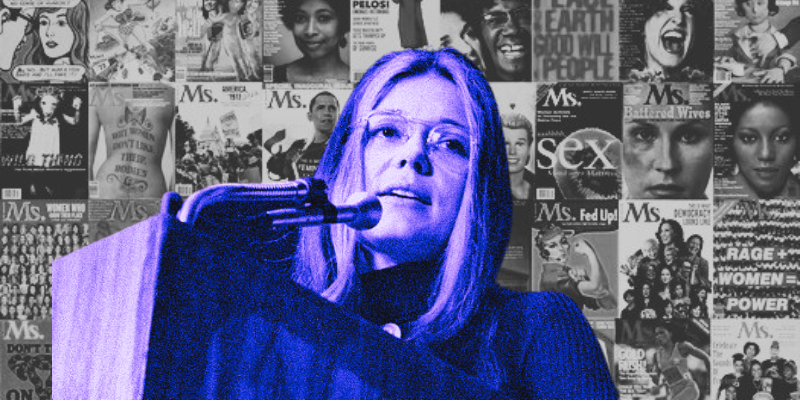
Gloria Steinem, the trailblazing feminist journalist best known for embodying the American second wave, has died at 92.
Gloria Steinem, a trailblazing journalist and organizer who helped crystallize the American second-wave feminist movement, has died at the age of 92.
Steinem was a co-founder of Ms., a magazine that introduced the title without tying it to anyone’s marital status. From 1971 to 1987, monthly issues of Ms. found their way into living rooms that were longing for both radical ideas and reassurance. The magazine endorsed Shirley Chisholm and supported a renewed Wonder Woman, and it broke stories about the wage gap, the Equal Rights Amendment, date rape, and domestic violence.
Many pieces in its pages helped shape the national mood in the late era of Roe v. Wade, including a famous open letter that ran in 1971. Aiming to destigmatize abortion and demanding a “repeal of all laws that restrict our reproductive freedom,” the letter was signed by numerous celebrities who admitted to having abortions—among them Susan Sontag, Nora Ephron, Lillian Hellman, and Billie Jean King.
Steinem stood for a particular ideal of femininity, and she bore the critiques that accompanied it. As a cisgender, white, straight, slender, conventionally attractive woman, her early activism wrestled with questions tied to those identities. (Her 1963 exposé in Show magazine, A Bunny’s Tale, exposed the indignities of the Playboy Club.) The Black feminist Alice Walker famously left Ms. in the 1980s amid elitism accusations. Yet Gloria’s mission and her commitments to an increasingly multicultural feminism broadened as her career progressed.
After climbing higher on the Ms. masthead, she redirected her energies toward activism. And as Belinda Luscombe notes in Time,
She campaigned for indigenous communities, was arrested during anti-apartheid protests, publicly opposed the first Gulf War, pressed for disarmament on the Korean Peninsula, spoke out against child abuse, female genital mutilation, and pornography, and was an early advocate for lesbian, gay, and bisexual rights. (Her embrace of transgender rights came a bit later.)
She found allies in unlikely corners and incurred resistance from the early online world that would later be labeled the manosphere. Her literary works included My Life on the Road, Revolution From Within, and the forthcoming An Unexpected Life.
*
I first met Gloria in 2018, when I was understudying in a play about her life. Emily Mann’s Gloria: A Life drew inspiration from several of Steinem’s own memoirs, notably My Life on the Road and Outrageous Acts and Everyday Rebellions.
Before stepping into this project, my sense of Ms. Steinem could be boiled down to a few signifiers. (Namely: Playboy, Ms., and Aviator sunglasses.) Even while I recognized that image, I also carried a quiet sense that the glamorous form of feminism she represented wasn’t immediately legible to the grandmothers who shaped my own upbringing. I was excited, yes—but I was also a touch skeptical. As the saying goes, never meeting your heroes can be a blessing in disguise.
At our first table read, Gloria moved about the room, handing out bespoke bracelets stamped with feminist slogans to each actor. (A friend of hers had crafted them.) She was warm, present, and excruciatingly modest about the challenge ahead.
She insisted she had joined the biopic project for one precise reason: inspired by her collaboration with the late Cherokee Nation leader Wilma Mankiller, the second act of our play was designed as an open forum—a “talking circle” in which any audience member could voice a grievance or offer insight to lift the collective consciousness.
“That will be the best part,” she kept saying, insisting that she would moderate as many talking circles as her schedule allowed, and that on nights when she was tied up, other prominent feminists would step in to hold the space.
Initially, I was doubtful about audience participation. Yet her self-effacing humor and warmth were irresistible. As we plumbed the narrative and I connected the thread between Gloria’s private life and the landmark moments she lived through—from the unstable Ohio childhood to the pivotal 1977 Women’s Conference—I found myself increasingly unsettled. It was hard to picture living as fully as she had and not wanting to tell the story.
Her unwavering commitment to the collective, her anti-hierarchical approach—these aspects stayed with me. Our production shifted its focus away from the intimate details of Gloria’s life toward her work and the people with whom she moved: Bella Abzug, Dorothy Pitman Hughes, Flo Kennedy, and Wilma Mankiller.
Inside the talking circles, Gloria modeled the practice she had cultivated all along: she listened deeply, spoke honestly, and kept the space open and inviting. Yet whenever someone thanked her for changing the world, she waved away the sentiment. Look around, not up, she liked to remind us about heroes. We build solidarity side to side.
The show opened while the Kavanaugh hearings were unfolding. On nights after Christine Blasey Ford testified, the talking circle could become a storm of rage and tears. I remember glancing at the octogenarian icon—still chic, still robust—and watching her hold the circle’s focus, guiding us through all that thorny feeling and all that unruly life.
And I found myself thinking, Gloria, you were right. This is the best part.