
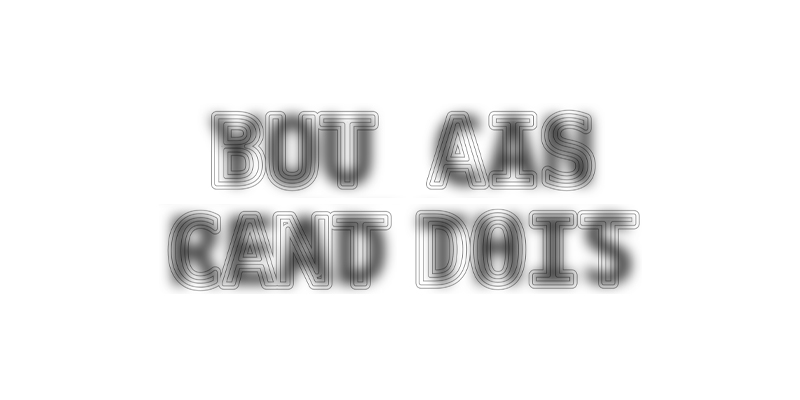
Can you read the text above? Because large language models can’t.
Are you able to interpret the words shown above? The short answer is that most large language models can’t.
The design and tech studio Mixfont has introduced Decoy Font with the intention of concealing text from AI crawlers. Dezeen notes that the technique relies on two layers per character, an explicit outline and a darker, blurred layer beneath. Humans can still parse both layers—try squinting or stepping back—whereas AI systems struggle to do so. This marks Mixfont’s second venture into AI-proofing text; their first experiment was Ghost Font, a font that hides by moving around the display.
“Most AI systems operate by examining the pixels of an image up close,” Mixfont explains, “So when this kind of image is fed into an AI model…the LLM concentrates on the foreground text because that portion is most clearly defined.” It’s a clever, low-fidelity tactic to disrupt AI models’ ability to interpret your writing.
I appreciate this project both as a design object and as a creative means of resisting AI. I also enjoy camouflage (apologies to friends who’ve heard me rave about dazzle ships) and I have a general aversion to AI. That said, Mixfont isn’t exactly a militant ally in the anti-AI cause. The company describes itself as “an AI-powered digital font foundry,” and many of its tools enable users to generate synthetic fonts via AI—presumably drawing on the work of other designers.
M ixfont’s AI-resistant design experiments are part of their broader engagement with AI, a way “to test the limits of what LLMs would easily solve,” as Mixfont founder Eric Lu told Dezeen.
“I think the reaction to the font shows that there are many people who feel strong AI fatigue,” Lu said, “and want a way to defend themselves against the presence of AI in their lives.” You’re preaching to the choir, my friend! It’s not too late to repent.
You can experiment with Decoy Font and read more about the methodology on Mixfont’s website.