
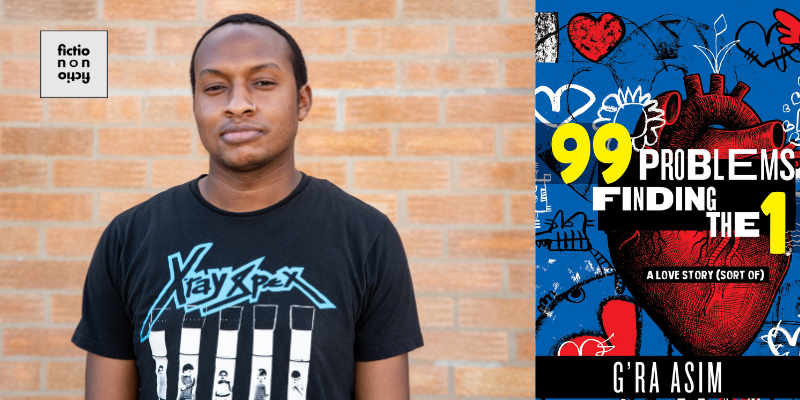
Nonfiction writer G’Ra Asim joins co-hosts V.V. Ganeshananthan and Whitney Terrell to talk about his new book, 99 Problems Finding the 1: a love story (sort of). Asim explores Afropessimism, heteropessimism, and how these ideas relate to his search for love as a cisgender straight Black man; he clarifies the notion of “thinkful wishing”; and reflects on the examples of partnerships within Black families, including his own parents, that have shaped his sense of what relationships can be. He describes how—drawing inspiration from the viral New York Times essay “The 36 Questions That Lead to Love”—he crafted a sequence of prompts intended to prompt two participants to examine their experiences of gender and race. He discusses how culture can mold our understanding of romance, citing Destiny’s Child, Dexter, and Minor Feelings. He also reads from 99 Problems Finding the 1.
To hear the full episode, subscribe through iTunes, Google Play, Stitcher, Spotify, or your favorite podcast app (include the forward slashes when searching). You can also listen by streaming from the player below. Check out video versions of our interviews on the Fiction/Non/Fiction Instagram account, the Fiction/Non/Fiction YouTube Channel, and our show website: https://www.fnfpodcast.net/ This podcast is produced by V.V. Ganeshananthan and Whitney Terrell.
G’Ra Asim
99 Problems Finding the 1: : a love story (sort of) • Boyz n the Void: a mixtape to my brother
Others
“On the Necessity of Turning Oneself into a Character,” by Phillip Lopate from To Show and to Tell: The Craft of Literary Nonfiction •“Is Having a Boyfriend Embarrassing Now?” | Vogue • Dexter (TV Series 2006–2013) – IMDb • Atlanta (TV Series 2016–2022) – IMDb • Destiny’s Child – Soldier ft. T.I., Lil' Wayne • “The 36 Questions That Lead to Love,” by Mandy Len Catron, The New York Times • Minor Feelings by Cathy Park Hong • Dreams from My Father by Barack Obama
EXCERPT FROM A CONVERSATION WITH G’RA ASIM
V.V. Ganeshananthan: A couple of additional ideas that you introduce early on, which propel the book’s argument forward, are heteropessimism and Afropessimism. At the start, you note that in dating, these two mindsets can operate in tandem, much like the old medical school adage about hearing hoofbeats and assuming the presence of horses rather than zebras. Could you define these concepts for us and explain how they intertwine in your reflections on romance?
G’ra Asim: To frame the response, and as you asked, I view Afropessimism as a line of thought grouped loosely around a circle of theorists who contend that genuine anti-racism is the very adhesive that keeps the current social order intact. From their stance, the only path to eliminating anti-Black racism would be to dismantle the world as we know it. By contrast, heteropessimism—though the term suggests grave stakes—reads more like a viral cultural meme than a formal school of thought. Yet it has gained real traction across different spheres. For instance, I’m thinking of a recent viral piece, perhaps in The Cut, whose headline probed whether it is embarrassing to have a boyfriend nowadays. I use that example to illustrate how deeply cynical convictions about romantic potential between genders can take hold in public discourse.
The guiding maxim you referenced underpins the idea that the longer people date, the more likely they are to become jaded, interpreting any pause, hesitation, or ambiguity as conclusive evidence that the other person is fundamentally unsuitable. In my view, grounded in my parents’ relationship and in my own intimate interactions, it’s nearly impossible to cultivate real intimacy with someone when you insist they are destined to disappoint. Yes, we all have flaws and limitations, but treating every sign of trouble as an omen can keep us from noticing the genuine delights that might emerge if we simply allowed things to unfold with patience.
Whitney Terrell: There’s a moment in the book where you describe a text exchange with someone you’re dating. She tells you, “I don’t want this book’s narrative to be that I desired you more than you desired me.” Is that the core idea you’re after—this reluctance to admit genuine interest, the instinct to foresee an ending before it begins?
GA: That’s exactly it. The person who spoke those words wasn’t even alluding to the book; she was commenting on the arc of the relationship itself. She felt as though the relationship were already a story being written and edited for social media feeds that map life according to Freytag’s pyramid. People invest so much in turning experience into content that they can lose sight of what is happening in the moment. I understand how that mindset forms, but at the same time, allowing a preconceived finale to govern the present can prevent recognition of the current moments that could be the source of real joy if given space to develop.
VVG: You also helpfully challenge rigid norms around masculinity and femininity early in the book, and you question the notion that straight and queer identities lack fluidity or overlap. That kind of fixed outlook only makes the lower expectations seem more inappropriate, especially in a world that’s increasingly nuanced and slippery. Whitney and I were discussing last night the Stockdale Paradox, a concept I hadn’t encountered before reading your book. Could you explain what the Stockdale Paradox is and how it applies here?
AG: Sure. The Stockdale Paradox, as I understand it, involves facing the harshest facts of your situation without flinching, while maintaining an unwavering belief that you can prevail. It stands in direct opposition to heteropessimism and complements Afropessimism in its own way. I mention it because, in the opening, I do a close reading of Destiny’s Child’s song “Soldier,” a track that, in my view, has done lasting damage to the ability of many people in my generation to approach romance with sensitivity. The Stockdale Paradox, a concept attributed to James Stockdale, a Vietnam War prisoner, offers a framework for a more disciplined and constructive vision of love—one that’s less fear-driven and more purposeful. I’m not out to glorify soldiers or glorify conflict, but I find the paradox deeply inspirational when it comes to thinking about love in a new light.
WT: So, in practical terms, you’re saying that even when things could go wrong, you should keep an open mind about the possibility that they might work out—and perhaps even commit to the expectation that they will succeed?
GA: I’d push further: if you’re determined to establish and sustain a fulfilling relationship, there’s value in embracing the conviction that it will work out, not merely hoping it might. There’s something to be gained from deciding with resolve that success is possible, much as Stockdale did in his own circumstances when faced with extreme adversity.
WT: I totally agree. People need to craft positive narratives about one another. You spend a good deal of time talking about your parents, but my grandparents, too, were adept at creating uplifting stories about their bond and what they felt for one another. Even when they argued, they invested energy in constructing a shared narrative of “this works.”
GA: I’m sure their lasting connection wasn’t incidental to their longevity. Maintaining morale and a hopeful outlook is valuable for almost any collaborative effort, and love should certainly be no exception to that rule.
Transcribed by Otter.ai. Condensed and edited by Rebecca Kilroy. Photograph of G’Ra Asim by Kate Hoos.