
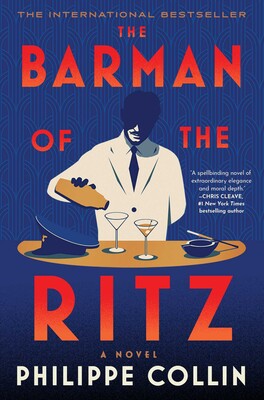
Paris was occupied by German troops from June 14, 1940, to August 25, 1944: 1,533 nights. One thousand five hundred and thirty-three nights during which the Ritz was transformed from a luxury hotel into a stomping ground for the Nazi elite. There are a thousand and one ways to recount this story; The Barman of the Ritz is a novel based on actual facts and actual people. It is an account of those dark years in France. But there are grey areas in the life of Frank Meier that—as René Girard puts it—intersect fictional “truth” and romantic “lies.” The Frank Meier in this novel is both real and fictitious. The character of Luciano is fictitious, just as that of Fersen is inspired by various people in Meier’s entourage during those years. The excerpts from Meier’s diary are my own invention, conceived as a way to shed light on this extraordinary life.
In this attempt to recreate life in Paris under the Occupation, the aim is less to be “true” at all times than it is to capture the conflicting emotions that may have preoccupied Frank Meier.
In his position, what would you have done?
*
June 13, 1940
Tomorrow, German troops will march into Paris. France has dissolved like a lump of sugar in a glass of absinthe.
Barely a month has passed since the Battle of France began. By now, the tanks and armored vehicles of Generaloberst Guderian’s panzer divisions are rolling through the forests of the Ardennes. There is fighting in Rouen. There are battles in Senlis. The Nazis have crossed the River Marne. Since yesterday, the skies over the city have been thick with ominous black smoke; the capital has already surrendered. It has been declared an “open city.” As for the people of Paris, many of them have fled. By train, by car, in horse-drawn carts, or on foot, families take only as much as they can carry, leaving most of their possessions behind. The mass exodus has gutted the city, with millions of its inhabitants scattered to the winds. Those remaining have locked themselves away in their apartments. The only thing circulating in the city now is rumor.
The government of the French Republic fled the city two days ago and is now based in Tours. No more government, taxis, police, mail—no more public services. Panic is spreading like wildfire. Archives have been burned in ministerial courtyards, while gangs of looters plunder abandoned shops and apartments. Otherwise, the streets are empty; shops have rolled down their shutters. Paris is mired in silence, solitude, and death.
But in the Place Vendôme, the grand Hôtel Ritz is still open for business.
It is difficult to believe that, only a fortnight ago, Winston Churchill was staying in this very hotel. Now, the regulars have vanished. Coco Chanel has taken refuge in Biarritz. The Duke of Windsor and his wife Wallis have flown to Spain. Barbara Hutton, née Woolworth and heiress to the Woolworth fortune, is still ensconced in her first-floor suite, packing and unpacking, unsure whether to stay or to go.
In the passageway that connects the two wings of the hotel, the Galerie des Merveilles, the boutique stores of famous brands that line its corridor have already taken on the patina of a bygone era. Two days ago, the Bar Cambon closed its doors.
Only the Petit Bar remains open. As usual, service begins at 6 p.m. The decor has not changed since the day it first opened: polished bar, mahogany paneling, leather lampshades, Louis XV armchairs upholstered in eau-de-nil velvet. The bottles are impeccably arranged behind the bar like books in a library. This is the realm of Frank Meier, the barman of the Ritz. Austrian by birth, celebrated for his artistry with cocktails and revered by the most discerning drinkers in Europe and America, the man is a legend in the world of luxury. His pencil mustache, his careful gestures, and his twinkling eyes are as renowned as the drinks themselves. On the eve of the German invasion, he remains behind his bar—his white jacket crisp and black tie neat—as he has for the past twenty years.
It was Frank himself who opened this bar in 1921, and he is determined to stay, regardless of the cost, despite the Germans and the downfall of France. He tries to maintain an aura of detachment, yet tonight the Ritz’s barman is unsettled. Troubled. Beneath his affable exterior, signs of anxiety and fear begin to surface. Frank Meier has spent a lifetime running from his past, carefully concealing his heritage, though others seemed not to mind.
People simply see me as a bartender, someone skilled with his hands, a deity of bottles. It feels as if I’ve always been here, as if I were born behind the bar.
Yet Frank Meier was not born behind the counter. And even as he feels distant from his origins, a secret clings to him: he is Jewish.
Tonight, his sole patron, Otto von Habsburg, the displaced heir to the Austro-Hungarian throne, seeks solace in a measure of gin. A price has been set on his head by the Nazis, forcing him to flee. Tonight. So, Otto sits at the far end of the counter, reflecting on recent weeks, then drains his glass of Gordon’s. Gradually, the Royal Prince of Hungary, Bohemia, and Croatia rises and envelops the barman with a clasp that feels like an ending. Otto von Habsburg bids farewell to Europe; in a few days he will be heading for Washington. The barman of the Ritz watches as his final customer of the old world slips away.
__________________________________
From The Barman of the Ritz by Philippe Collin. Used with permission of the publisher, Scribner. Copyright © 2026 by Philippe Collin.