
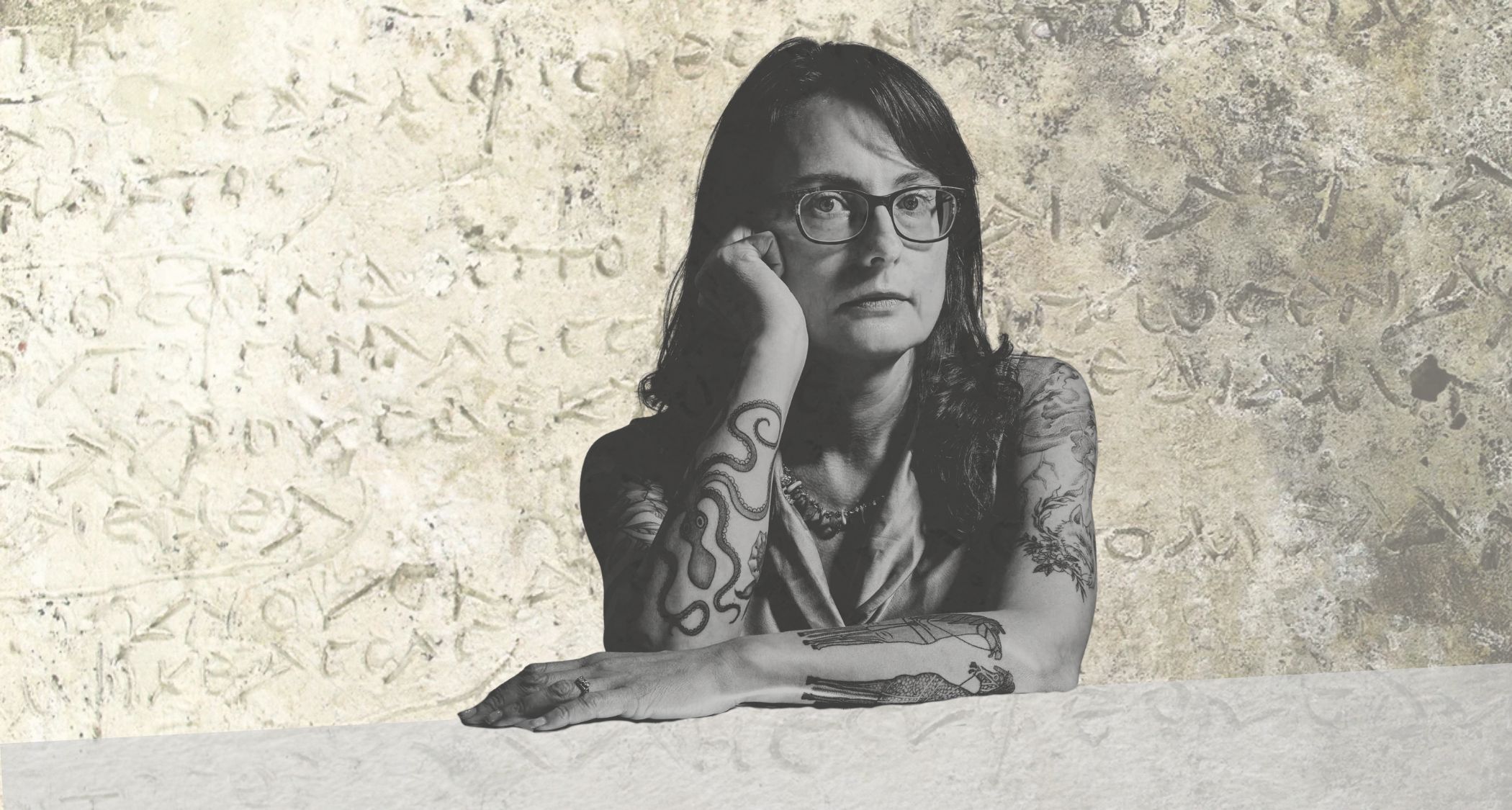
Among today’s most renowned figures in classics, Emily Wilson rose to a rare level of literary fame in 2017 when her English rendering of Homer’s Odyssey made her the first woman to publish a complete edition of the epic. Her body of work, which includes volumes on Sophocles, Euripides, and Seneca in addition to Homer, is celebrated for its strict adherence to traditional metrical form and its striking clarity.
Her profile has grown as a public intellectual in recent years, especially when Christopher Nolan cited her well-known opening line as a pivotal influence on his take on Odysseus, only for Wilson to publish a pointed critique of the finished film soon after.
Like many readers, I was eager to encounter her new collection of essays, Crossing the Wine-Dark Sea: Journeys Through Ancient Literature, which Liveright will publish in the US this September. As a translator myself, I was particularly keen to discuss with her the decisions that render translation an ever-evolving craft: what to keep, what must inevitably disappear, and how to render an ancient world in ways that are accessible without dissolving its remarkable oddness.
*
Leanne Ogasawara: The line about “tell me about a complicated man” has sparked intense debate in recent translations—one reader even quipped that it sounded like a Facebook status. In your book you explain that polytropos can express versatility, cunning, wandering, and a life of being swung by circumstance. How did you settle on “complicated,” and were you surprised by the intensity of the response?
Emily Wilson: I discuss that choice at some length in Crossing the Wine-Dark Sea, so I’ll avoid restating the whole argument here. What I will say is that I reached that decision after many days of testing and reflection, and nearly a decade later I still believe it fits the aims of my rendering of the original poem. My goal was to reproduce the poem’s traditional metrical cadence and its nature as a piece meant for oral performance—unlike many English translators who’ve favored prose or free verse. Therefore I needed a term that could scan when followed by the stressed syllable in “man.”
It’s heartening that so many people feel empowered to join the conversation about the high-stakes, intricate issues of translation, regardless of their background, knowledge, or feelings.
I also sought, unlike most translators, to recapture the brisk tempo of the source, so I avoided rendering a single four-syllable word as a lengthy multi-word phrase; such a choice can echo the ambiguity of this one word but also slow the opening of the whole narrative. Like every translation decision, “complicated” is a compromise. It does not map exactly onto the original in denotation, connotation, register, or sound—and neither do other approaches to polytropos.
I sometimes compare it to democracy: the least awful option among imperfect choices. It isn’t surprising that there’s so much fixation on the fifth word of the first line in a poem spanning more than twelve thousand lines. Sticking to a single word in the opening saves a great deal of time. It’s encouraging that many people feel empowered to contribute to discussions about the high stakes and complexities of translation, regardless of their background, knowledge, or feelings.
LO: When your translation appeared in 2017, it was repeatedly described as the first English Odyssey by a woman—the Guardian, the New York Times, and the Washington Post all ran headlines to that effect. I found that framing perplexing, especially since we didn’t see a similar emphasis with Edith Grossman’s Don Quixote. It also made me wonder why men have long dominated translating Greek and Latin works, even though many women hold PhDs in the field. The contrast with classical Japanese translation is striking: women are well represented, except for The Tale of Genji, whose English renditions have all been by white men. Why do you think the translator’s gender became a focal point specifically for Homer? And has that conversation widened to questions of who gets to translate canonical texts in general—touching on race, class, access, and gender?
EW: Your surprise mirrors mine. When I undertook the Odyssey, I hadn’t contemplated the possibility of being the first non-male to publish a complete English edition. Over the years I’d taught various English translations and hadn’t even noticed that they were all by men. I don’t believe my translator’s work—whether for Homer or for Seneca, Sophocles, or Euripides—depends on my gender. My aims were about poetic form, pacing, and narrative perspective. Yet the label of “the woman translator” or “the feminist translator” persists even now. It has become a traditional epithet, much as Homer’s ships are described as “swift” and “sea-going,” even when they’ve been stranded on land for years. Epithets stick to us.
Over the past decade I’ve been deeply moved by how many people, especially younger readers, tell me I’ve served as an inspiration. I feel honored and aware of the responsibility that comes with it.
But you’re right that there is a strange gender gap: published English translations of major, long-canonical Greek and Roman works tend to be by men, even though that’s not the case in other languages (there are many translations of Homer by women in French and Italian), and even though there are plenty of English-speaking classicists who are not men. I think this reflects a cluster of partly independent factors, including the training available for living languages (there is a larger pool of capable translators there), whereas for languages no longer spoken, competence has to be cultivated in the English-language academy; in contrast, in France or Italy those skills may be nurtured in school rather than in graduate programs. There is also the marginalization of translation within the Anglophone academy—translation rarely advances tenure or promotion, reducing motivation to undertake lengthy, demanding projects.
But these factors don’t fully explain why many mid-to-late twentieth-century and contemporary English-language translations of Greek and Roman classics have been handled by retired male scholars rather than older women. Perhaps networks play a role; I personally took on projects only after editors approached me with proposals. It may be that editors and publishers have blind spots about who should translate. But this is speculation; I don’t pretend to know the full answer.
Over the past ten years I’ve been moved by how many people, especially young ones, tell me I serve as an inspiration. I’m grateful and mindful that this comes with a responsibility.
I’d welcome a broader discussion about who translates the canon and why it matters (or doesn’t). Classicist Jackie Murray has written persuasively about the need for more BIPOC translators of Greek and Latin classics.
Regarding media coverage: it’s a somewhat separate issue. A reason for persistent headlines, I’d argue, is that it’s hard to craft fresh angles, and journalists tend to cluster around familiar narratives. After the New York Times framed my work by saying “Wilson is a woman and she used the word ‘complicated,’” dozens of other pieces repeated exactly those two claims.
To me, this framing misses the point, as it overlooks my actual interpretive and poetic aims and too easily sidelines the work of many other female classicists, Homerists, and translators who aren’t men. Still, I can understand the appeal of a quick, headline-friendly nugget, and I’m grateful for the broad coverage of translation and of Homer in popular media. Whatever the content, this exposure has helped raise public awareness of the interpretive stakes of translation, and I’m thankful for that, regardless of what anyone thinks of me personally.
As for why Edith Grossman’s Don Quixote drew a different response: that may relate to how Homer is perceived, and perhaps to broader attitudes toward Greek and Roman literature. Don Quixote’s hero is comically ineffectual; he doesn’t embody an idealized male ideal.
Spanish, unlike Homeric Greek in American popular culture, isn’t commonly imagined as a language belonging to men. The public’s reaction to my work often reflects these stubborn, historically rooted ideas more than it does the actual text I produced.
A major thread in Crossing the Wine-Dark Sea is that readings of ancient texts or cultures can become stubborn, regardless of truth. For instance, I examine Demosthenes, the famed orator who cast classical Athens as the beacon of liberty and resistance to empire, and whose portrayal has heavily influenced later periods, even if that portrayal isn’t fully historically accurate. The book also examines how revisiting texts in new translations can lead translators to echo each other rather than reexamining the originals’ interpretive possibilities.
LO: Is there something inherently adversarial about retranslation? After all, declaring that a work should be translated anew suggests the previous versions no longer meet all needs. Haruki Murakami, in an essay about translating The Great Gatsby, argued that translations have expiration dates. The original endures, but translations age with the language and cultural assumptions of their era. What’s your take on that?
EW: Arthur Sze’s latest collection, Transient Worlds, makes a parallel claim: the enduring value of great works across cultures is matched by the need to refresh translations as new readers come along.
As for whether re-translation must be adversarial: I wouldn’t say so, because it isn’t a zero-sum game.
I think that’s true to a point. A core idea in Crossing the Wine-Dark Sea is that as our culture evolves, we discover new angles on ancient literature and civilizations—and these shifts justify asking new questions, reframing and reinterpreting in light of fresh insights, priorities, and norms.
Yet it’s also true that translations can become canonical in their own right, as the Latin Vulgate or the King James Bible have, or the Pope’s translation of the Iliad—though not ideal for teaching American undergraduates today, they remain foundational for understanding the history of British poetry in the eighteenth century and can be a delight in their own right.
The course of literary history has never run smoothly. A central argument in Crossing the Wine-Dark Sea is that canons shift, and such worlds are inherently temporary. I often recall Keats’s Ode to Chapman’s Homer not only as a reminder of how profoundly a translation can illuminate someone without access to the original, but also as an illustration that the newest rendering isn’t always best for every reader. Keats had read translations that were newer, including Pope’s, yet it was Chapman’s seventeenth-century version that brought Homer to life for him, due to its stylistic qualities that resonate with a Keatsian emphasis on synesthetic experience.
As for whether re-translation is inherently antagonistic: I would not describe it that way, because it isn’t a zero-sum contest. Pope didn’t dethrone Chapman—both versions remain available. When I published new renderings of Homer, I didn’t burn the predecessors’ copies. The Apple of Discord—snatched into the wedding feast by Eris, goddess of Discord—fomented fierce disputes among goddesses and sparked mortal war because it bore the singular dedication: “For the fairest one,” or “For the most beautiful.”
The Greek term makes it clear there can be only one “fairest,” and thus there can be no sharing of the prize. Hera and Athena rage that Aphrodite is singled out, which triggers the Trojan War.
In Homer, that same dilemma plays out among humans too, in the contest to decide who among the Achaeans or Greeks deserves the title of supreme king of Ithaca. Yet the Homeric poems also remind us that in some arenas—banquet, council, athletic contests—honor and benefit can be shared, and disagreement need not spell doom. To me, re-translation feels more like a feast than a battle: I’m not slaying venerable predecessors to claim my own glory; I’m offering a fresh portion for everyone to enjoy at the banquet.
My commitment to maintaining a poetic form remains one of my foremost priorities when translating metrical verse.
At the same time, a retranslator bears a duty to bring something new to the table, not merely reheat familiar fare. Another thread in my discussion of translation in CWDS is the temptation for translators to echo their forebears’ approaches or even phrasing—when other options exist. I find this disappointing, since it narrows the scope of what readers can imagine from the original, especially for those without access to the source text. “Make it new” is a useful maxim for all writers, including re-translators.
Every new interpretive project needs a justification. This holds for new histories or literary analyses, and it likewise applies to re-translation. If I publish a new book about Sophocles, I must clearly delineate how it differs from the many existing works. Likewise, if I publish a re-translation, I should offer something genuinely engaged with the original and present a notably distinct vision compared with the current English renderings. Without that, the project wastes everyone’s time.
LO: I really valued the twenty principles you lay out for translating ancient texts in your afterword. My favorite is your insistence that translators should reproduce not only information but the effects: “If the original makes you laugh, cry, feel excited, get goosebumps, feel puzzled, grow bored, be charmed, then the translation should strive to evoke those feelings.” Which aspects of Homer did you feel previous English renderings downplayed or missed? And what did you most want to restore?
EW: I wouldn’t have undertaken a retranslating of Homer if I hadn’t detected crucial elements in the original that older translations had underplayed or neglected. The core aims I wanted to capture were: the resonance of traditional, musical meter rather than prose or free verse; the multiplicity of viewpoints rather than flattening disparate voices into a single one; the swift cadence of storytelling that makes the original feel more immediate than longer, more verbose versions; and the vivid emotional and descriptive power—what ancient critics called enargeia.
These objectives align with two central themes in Crossing the Wine-Dark Sea: the centrality of poetic form in verse translation—whether for drama, lyric poetry, or epic—and the necessity for literary translators to consider how the original and its translation affect readers emotionally and stylistically. For instance, in my extended discussion of translating ancient Greek and Roman comedies, I examine whether translators should strive to make readers laugh—even when the humor relies on social assumptions that are alien to many contemporary audiences.
LO: I didn’t realize until reading your Homer essay that you rendered the entire poem in iambic pentameter and kept one English line for each line of Greek. That’s an extraordinary formal commitment. What did maintaining meter and line-for-line correspondence force you to give up—and what did it enable? Do you have different priorities when approaching other ancient authors?
EW: Maintaining a strict metrical form is one of my most fundamental aims as a translator of verse. I bring a somewhat unusual background for a classicist, combining study in early modern English literature with classics, and I’ve long been fascinated by the long history of how classical works are received in English and by the musicality of poetry. Crossing the Wine-Dark Sea ties together my interest in the long arc of classical reception with a focus on poetic form.
unsurprisingly, the emphasis on traditional meter hasn’t been the centerpiece of public discussion about my work; “Scholar publishes traditional metrical translation of ancient poem” isn’t as catchy as “First Woman!” or “Modern Translation!” But I find this framing quite misleading, just as much as the gender framing, since my method isn’t truly modern: I want to convey the alien strangeness of the original texts, and in my Homer translations I strive to reflect the plainness, briskness, and nobility of the originals—the traits highlighted by the Victorian critic and poet Matthew Arnold, rather than the verbosity and lax rhythm that characterize many contemporary translations.
The decision to keep the Odyssey’s line count intact yielded huge benefits in terms of pacing. English has a vast vocabulary, and Homeric Greek makes extensive use of little particles that English can convey through word order rather than direct equivalents, so many translators omit particles that signal emphasis like “indeed,” “at least,” or transitional cues. If you want to preserve those triggers in English, you often need to restructure sentences rather than rely on particles. For example, consider a line from the Iliad (9.309): chrē men dē ton muthon apēlegeōs apoeipein. The Loeb prose translation doesn’t render the particles “men dē” and thus loses a subtle sense that is typical of Homeric poetics.
Yet clinging to the original line count while maintaining strict meter was a tight constraint. Odysseus is polymechanos in the original, and the translation would have to render him as crafty or cunning, which limited how freely I could translate every five-syllable word into five syllables of English. With my Iliad translation, I abandoned the line-for-line constraint while keeping the meter, aiming to preserve similar pacing without being bound to the exact line count. I’ve since begun a complete retranslation of the Odyssey along a similar logic, though this new version—likely the second English translation by a woman—uses very regular iambic pentameter but features more lines than the original, much like my approach to the Iliad.
With other verse projects like Seneca, Sophocles, and Euripides, I’ve experimented with different rhythms to suit changing meters in tragedy. In verse drama, line breaks are crucial—especially with stichomythia, where characters exchange brief lines in rapid alternation, which makes it essential to keep meter and the exact line breaks. I’m also working on Ovid’s Heroides, which are composed in elegiac couplets and repeatedly hinge on witty finales at the end of each couplet; here too it’s vital to convey Ovid’s technical craft, the tension between sorrow and humor, and to place the end-of-line breaks correctly.
As I repeatedly emphasize in Crossing the Wine-Dark Sea, there isn’t a single method for tackling the technical and stylistic hurdles involved in creating an English equivalent of a foreign text. Each translation project brings its own joys and challenges. It’s a privilege and a delight to engage in this kind of work every day.
LO: In your introduction you quote Susan Sontag on translation as an ethical encounter with people who are different from us. Throughout the book you stress the importance of preserving the strangeness of ancient literature instead of smoothing it out for modern readers. It struck me that your Homer isn’t strange because the English is archaic or difficult, but because of the Homeric world itself—its assumptions, values, and images. Could you describe how you retained that strangeness in translation?
EW: Great question! Any literary translator must seriously consider how to challenge readers’ expected horizons. I’ve found Korean fiction translator Anton Hur’s work and his critiques of what counts as “the reader” and the styles or genres that modern readers expect incredibly insightful—highlighting voices that are diverse, including humor, fantasy, and queer perspectives, and not always tailored to a mythical, white, male English readership.
There is no straightforward, linear path from antiquity to modern enlightenment.
When it comes to ancient Greek and Roman texts, popular and scholarly assumptions about how these works should sound in English diverge from what many readers might expect of contemporary prose. There’s a tradition that these poems ought to sound stiff, awkward, verbose, and nearly unreadable—even though the original is fluent and vibrant—or that to appeal to a “modern English reader” you must pepper the text with modern clichés and an excited, exclamatory style. My aim with Homer was to locate the source of the poems’ strangeness not in odd word order but in the magical, imagined worlds and metaphors themselves, as well as the experience of inhabiting metrical, traditional poetry for many hours on end—a novel experience for many modern readers.
Crossing the Wine-Dark Sea seeks to underline the strangeness of multiple ancient genres and cultural assumptions, extending beyond Homeric epic. I discuss, for instance, the alien nature of archaic Greek lyric, designed to be performed with a lyre—an art form that is very difficult to reproduce within the conventions of contemporary poetics on a printed page or screen.
A central idea in the book is that ancient literature and culture can feel familiar in surprising ways: I draw lines between ancient comedy and modern hip-hop, and between Athenian tragedy and current debates about gendered violence and justice. Conversely, another major thread is that antiquity is often stranger in ways we don’t anticipate—and reflecting on the past can illuminate the strangeness and mutability of the present. For example, my essay on the Helen of Troy myths shows that modern portrayals are sometimes more overtly misogynistic than the ancient depictions. There is no linear path from antiquity to today’s enlightenment.
LO: I learned a great deal from this book, both about translation and about the practicalities of transferring ancient Greek and Roman literature across languages and cultures. There was a time when translation was a standard educational practice—especially in England and the United States. Even if you only did word-for-word renderings, didn’t that exposure to other languages and ways of thinking broaden minds? I wonder what we lose when the study of other languages and literatures fades from education.
EW: I’m so glad the book resonated with you. I hope it proves engaging for readers interested in translation, antiquity, or both, and for those who aren’t sure they care about either subject yet!
I can’t overstate the importance of exposure to other languages and literatures, or to other cultures, in any form. I was grateful that my kids could attend a charter school with an immersion Spanish program, and they all speak Spanish to varying degrees. Knowing the words and stories of other people expands our world and invites us to move beyond personal bubbles into dialogue with others, with all the challenges and joys that entails. I’d love to see every child in the US or beyond gain at least bilingual proficiency. I also hope to see greater recognition and appreciation for the world-enlarging knowledge and insight brought by multilingual communities, such as immigrant communities where many people speak multiple languages.
Crossing the Wine-Dark Sea concentrates on Greek and Roman antiquity’s languages, literatures, and stories, and one of its central themes is how these cultural touchstones illuminate our own era, particularly regarding what makes modernity distinctive. We can’t fully grasp that without an understanding of the past, just as we can’t truly grasp what makes English unique without knowledge of other languages. Every culture and individual brings a distinct perspective to the world, and we should listen to as many of them as possible.